

President of Republic to Asharq Al-Awsat: Our Relationship with Saudi Arabia is Solid, Our Country is Subject to Malicious Campaigns
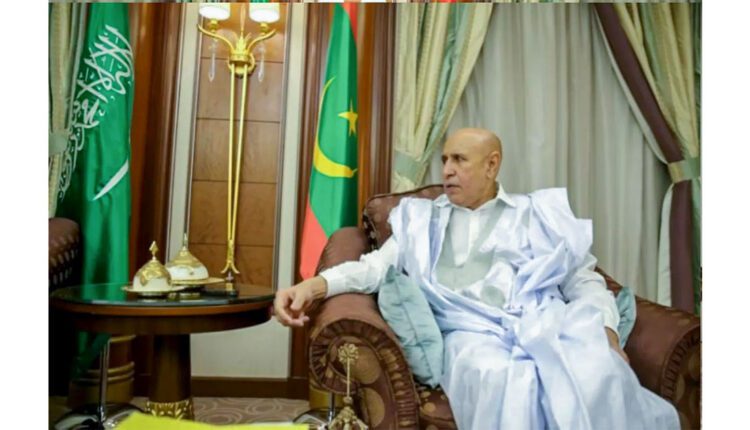
His Excellency the President of the Republic, Mr. Mohamed Ould Cheikh El Ghazouani, affirmed that the success of U.S. President Donald Trump’s peace plan in the Gaza Strip depends on full commitment to its provisions. He also stressed that the two-state solution remains indispensable for achieving stability and security across the region.
In an interview with Asharq Al-Awsat newspaper in Riyadh, Kingdom of Saudi Arabia, His Excellency stated:
“Mauritania and Saudi Arabia are bound by ancient ties of brotherhood and friendship, as well as distinguished relations at the official level. Strong human, spiritual, and cultural bonds unite our two fraternal peoples, reflected in the deep affection and appreciation the Mauritanian people hold for the Kingdom’s leadership and citizens.”
He explained that the convergence of visions between Riyadh and Nouakchott on regional and international issues reflects the depth of their mutual trust and the strength of their constructive partnership—one that continues to grow and diversify amid vast opportunities for cooperation in various fields, including industry, infrastructure, digitalization, and energy.
Regarding his participation in the Future Investment Initiative in Riyadh, the President said:
“The Initiative constitutes a global platform for dialogue, investment, and innovation, and an opportunity to express our support for the Kingdom’s tireless efforts to lay the foundations for comprehensive prosperity for humanity in light of rapid global economic, technological, and geopolitical transformations.”
His Excellency added that Mauritania, as a promising investment destination, will seize this opportunity to present its vision and investment prospects through the Initiative’s sessions and forums, and to discuss ways of strengthening cooperation and partnership across multiple sectors.
Addressing President Trump’s peace plan for Gaza, His Excellency stated:
“We appreciate this plan, which seeks to achieve a ceasefire and end the cycle of killing and destruction. It represents a welcomed and positive development.”
He noted, however, that the plan faces serious challenges, particularly regarding the commitment to its provisions. Its success, he said, “depends on the presence of a sincere will that prioritizes the humanitarian dimension.”
The President emphasized the urgent need to accelerate the two-state solution to enable Palestinians to exercise their legitimate right to establish an independent state, in accordance with international resolutions and the Arab Peace Initiative, as the only path to ensuring lasting stability and security in the region.
On another issue, His Excellency rejected the malicious accusations that Mauritania had deported African migrants, stressing the importance of placing the matter in its proper context—away from the “exaggerations and distortions circulated by certain malicious social media outlets.”
He explained that Mauritania has, for years, faced an influx of illegal migrants who use the country as both a transit corridor to Europe and a place of residence. Their numbers have recently increased, posing challenges to security and social stability.
His Excellency clarified that the state decided to conduct a comprehensive census of foreigners residing in its territory and to repatriate those in violation of the law, in coordination with their respective governments and in conditions that ensured their dignity and rights.
He reaffirmed that Mauritania remains a safe haven for refugees, noting that the country currently hosts more than 340,000 refugees from Mali, in addition to tens of thousands of other foreign residents who legally reside in Mauritania with full respect for their dignity and rights.
On the issue of youth migration, His Excellency explained that it is not a phenomenon unique to Mauritania, but a regional, continental, and global challenge.
“Nevertheless,” he said, “we are doing everything possible to address the factors that push our youth toward irregular migration. We have reformed our education system, upgraded technical and vocational training, and launched numerous youth employment projects in trade and entrepreneurship. We have also diversified the economy, focused on productive sectors, and strengthened the private sector to create more job opportunities.”
The President continued:
“We are also empowering youth in public administration and decision-making positions. We have seen tangible progress in youth employability and access to jobs, and we are determined to achieve more. Our government has taken strategic steps to combat poverty and marginalization.”
His Excellency highlighted that the government is working to support the purchasing power of vulnerable groups and to ensure access to housing and essential services such as water, electricity, and health insurance, as part of its steady efforts to overcome challenges and lay the foundations for balanced and comprehensive development.
He added:
“For years, we have been striving to enhance decentralization, expand health, education, and road infrastructure across several cities, and implement development projects that promote inclusive and equitable growth. These efforts stem from our belief that such conditions are essential for a cohesive, stable, and democratic state.”
On combating administrative and financial corruption, the President affirmed:
“We view corruption not merely as an administrative flaw, but as a strategic threat to the modern state. Confronting this phenomenon is a national and moral duty.”
He added that Mauritania has prioritized the fight against corruption by establishing an independent authority dedicated to combating bribery and corruption, activating oversight and inspection bodies, strengthening accountability mechanisms, and ensuring transparency through the publication of reports.
Regarding the situation in Libya, the President categorically denied claims that the Sixth Summit of African Sahel States, held in Mauritania, contained threats or ultimatums about finding a rapid solution to the Libyan crisis.
“The summit did not contain any threats,” he said. “On the contrary, it reaffirmed the need to resolve the crisis peacefully. The Libyan crisis is central to stability in the Sahel-Sahara region. For this reason, the Sahel countries—especially Mauritania—believe that instability in Libya means continued instability across the entire region.”
His Excellency reiterated that everyone agrees the situation in Libya requires an urgent, Libyan-led solution—an approach Mauritania supported and pursued during its presidency of the African Union.
He stressed that external interventions have prolonged the conflict and weakened the unity of the political process, underlining that “national consensus remains the only path to restoring sovereignty and decision-making.” He also emphasized the importance of revitalizing the African track, unifying international positions, and launching comprehensive national reconciliation to set Libya on the path toward lasting peace.
On the multi-dimensional action plan of the G5 Sahel countries to confront the surge in terrorist activity, the President stated:
“The five Sahel countries no longer operate as a single entity for reasons we will not elaborate on.”
However, he noted that the spirit and principles upon which the multi-dimensional action plan was built—addressing security through military, developmental, ideological, and social dimensions—remain valid.
His Excellency stressed the need for coordinated efforts in the face of terrorism, which continues to pose a threat, and affirmed that the region’s only hope for a decisive and sustainable victory over violence lies in collective action.
Addressing the impact of the G5 Sahel’s challenges on recent coups in countries such as Niger, Mali, and Burkina Faso, the President stated that “security and political stability—alongside a strong developmental focus—are the best safeguards against chaos and non-democratic transformations.”
He concluded by noting that the Sahel region has long faced a delicate situation marked by insecurity and escalating economic challenges. The recent reshaping of alliances, he said, has altered the regional balance and, to some extent, weakened coordination and collective responses to crises.