

Government: A package of economic and social measures has been taken to mitigate the effects of rising gas and fuel prices
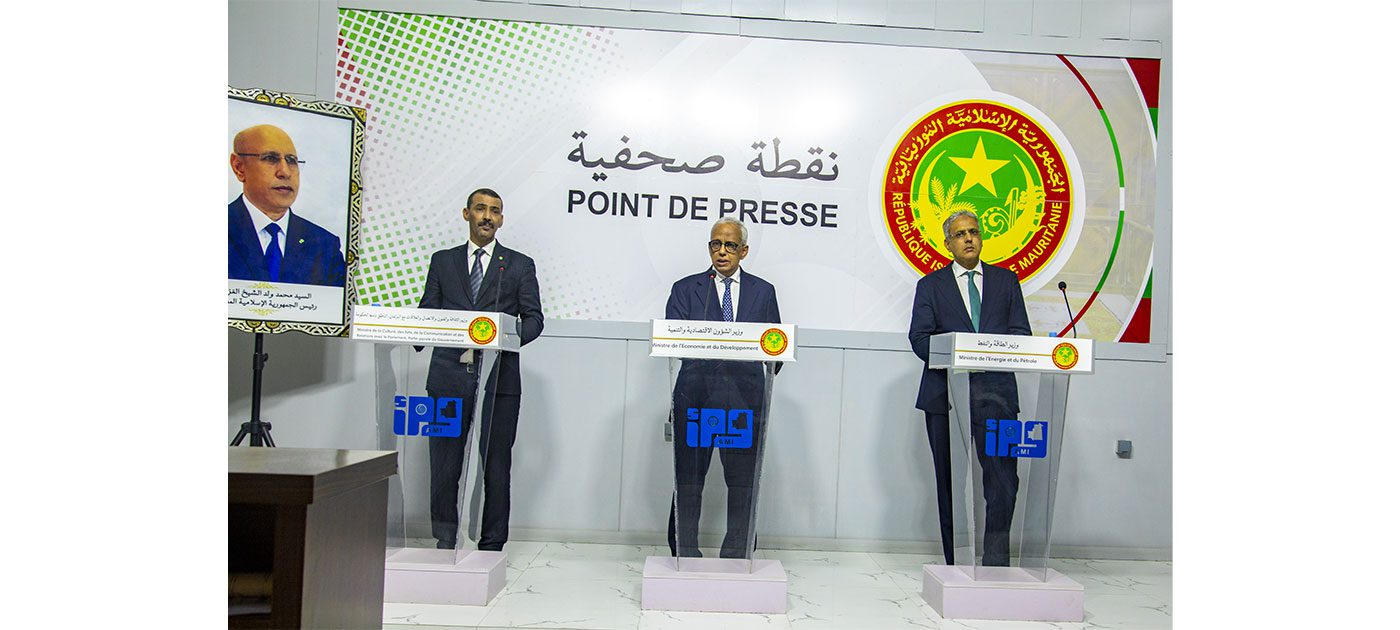
The Minister of Culture, Arts, Communication, and Relations with Parliament, the government’s spokesperson, Mr. Housseine Ould Medou, announced that His Excellency the President of the Republic, Mr. Mohamed Ould Cheikh El Ghazouani, directed the government, during the Council of Ministers meeting, to take a package of economic and social measures aimed at mitigating the effects of the recent increase in gas and fuel prices, within the framework of enhancing citizens’ purchasing power and supporting the social protection system.
He explained, during his comments on the results of the Council of Ministers meeting, yesterday evening Tuesday in the speech hall of the Mauritanian News Agency in Nouakchott, in the presence of the Minister of Economic Affairs and Development and the Minister of Oil and Energy, that these measures come in response to the exceptional international situation and its direct repercussions on energy prices, emphasizing that the government has taken an integrated package of social and economic measures with a direct impact on citizens.
The Minister pointed out that His Excellency the President of the Republic also gave his directives to take additional social measures as part of strengthening national solidarity, including His Excellency’s waiver of an amount of one million old Ouguiyas from his salary for nine months.
The Prime Minister and members of the government also decided to waive part of their salaries during the same period, contributing to this national solidarity effort. The government spokesperson confirmed that the Council of Ministers also decided to limit foreign missions, reduce the organization of unnecessary workshops, rationalize domestic tasks, in addition to intensifying efforts aimed at rationalizing energy consumption in public facilities and buildings, and appointing contact points responsible for monitoring the implementation of energy-saving measures within these institutions.
He added that the government has also obliged itself to take all necessary measures to combat the smuggling or re-export of subsidized energy materials outside the country, stressing that this responsibility is shared and requires mobilizing the efforts of all partners, including public authorities, transporters, and citizens, due to its direct impact on the availability of these materials and the stability of their prices.
In the framework of rationalizing energy consumption, the Minister announced that it has been decided, starting next Thursday, to prevent the movement of cars within cities, whether for transporting people or goods, from twelve midnight to five in the morning, clarifying that this measure does not constitute a curfew, nor does it include delivery bikes and emergency services.
For his part, the Minister of Economic Affairs and Development, Mr. Abdallahi Ould Souleymane Ould Cheikh Sidiya, affirmed that the government’s policy, under the high directives of His Excellency the President of the Republic, Mr. Mohamed Ould Cheikh El Ghazouani, is based on being transparent with citizens about the reality of economic conditions at both the national and global levels.
The Minister pointed out that the world has been witnessing an unprecedented economic crisis for more than a month, unmatched in its impact except by the global crisis experienced by the international economy in 1973, explaining that the sharp rise in oil prices is directly reflected on the national economy, with the probable consequences of slowing growth and rising inflation rates.
He confirmed that the prudent policy adopted by the government in preparing the budget, rationalizing spending, and enhancing resource mobilization has contributed to providing significant financial margins that will enable facing the repercussions of these exceptional circumstances.
The Minister affirmed that His Excellency the President of the Republic has directed the adoption of accompanying social measures to support low-income families, which included raising the minimum wage from 45,000 to 50,000 old ouguiya, and providing direct financial support of 30,000 old ouguiya for each family registered in the social registry, totaling 124,000 families. Additional measures were also approved in favor of employees whose salaries are less than 130,000 old ouguiya, aiming to absorb the effects of increases in gas prices.
The Minister said that the state will continue its support for the fuel sector, which will remain within the limit of 150 billion ouguiya annually, pointing out that these measures came after an in-depth study of developments in international markets and the situations of neighboring countries, and that taking them was necessary to avoid more severe economic repercussions.
In response to journalists’ questions, the Minister of Economic Affairs and Development affirmed that the state’s general treasury is fortified and financial resources are available, with revenue yields in the first quarter of 2026 increasing by about 30 billion old Ouguiyas compared to the same period in 2025.
The Minister emphasized that the government is working on improving tax collection and revenue without harming the less fortunate citizens, explaining that the national market remains supplied with goods, services, and fuels, and that financial and tax measures aim to maintain price stability and social support, while addressing any potential fluctuations in the global market.
For his part, the Minister of Energy and Oil, Mr. Mohamed Ould Khaled, affirmed that the global energy market has witnessed sharp and unprecedented fluctuations over the past four weeks, directly affecting various stages of oil production. He explained that this crisis, which some economists have described as unprecedented, has impacted the entire supply chain, altering the conditions that had led the state to set reduced prices at the beginning of the year for the benefit of citizens. He pointed out that the state continues to support energy prices, noting that if the global market remains stable at these levels, the support could amount to about 13% of the general budget.
Regarding cooking gas prices, the Minister explained that it was decided to raise the price of the large cylinder, which currently costs 9,011 Ouguiya, to be sold at 5,000 Ouguiya, an increase of 2,000 ouguiya, while continuing to support it with an amount of 4,011 ouguiya. As for the medium cylinder, which costs 4,325 Ouguiya, it will be sold at 2,400 Ouguiya, with support of 1,925 ouguiya instead of 1,440. Regarding the small cylinder, which costs 1,982 Ouguiya, it will be sold at 1,100 Ouguiya, an increase of 440 Ouguiya, with support reaching 882 Ouguiya.
Concerning liquid fuels, the Minister indicated that the price of diesel increased by 10%, reaching 563 old ouguiya per liter instead of 512, while maintaining support of 282 ouguiya per liter. The price of gasoline increased by 15.3%, reaching 589.7 ouguiya per liter instead of 511.2, with support amounting to 88 Ouguiya. In contrast, he confirmed that electricity prices will remain unchanged.
In this regard, he pointed out that the price of a ton of diesel in Europe currently amounts to $1,366.75, which is equivalent to about 546,000 Ouguiya before accounting for transportation and customs costs, highlighting the extent of the pressures facing the local market.
In response to journalists’ questions, His Excellency the Minister of Energy and Oil confirmed that rationalizing energy consumption remains the best way to support the national economy, emphasizing that direct price control is linked to the global market.
He also indicated that fuel supply is proceeding normally and regularly, with distributors continuing to be monitored to ensure compliance with the set prices.