

Minister of Foreign Affairs: Mauritania remains Committed to Building a Safe and Sustainable Maritime Future that Serves the Interests of Generations
Nice
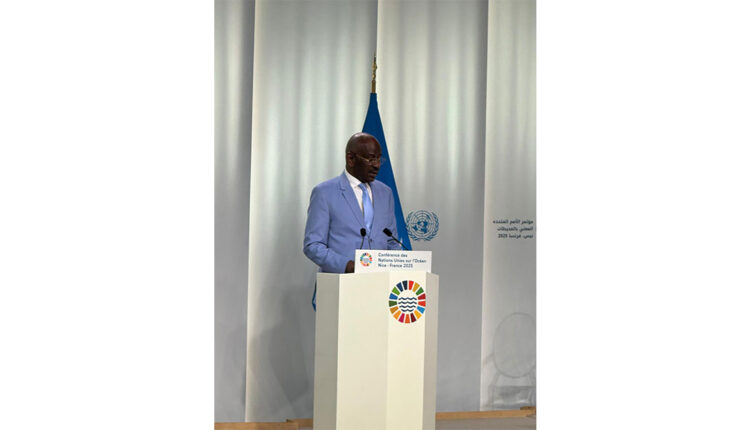
The Minister of Foreign Affairs, African Cooperation and Mauritanians Abroad, Mr. Mohamed Salem Ould Merzoug, affirmed that Mauritania, under the leadership of His Excellency the President of the Republic, Mr. Mohamed Ould Cheikh El Ghazouani, remains firmly committed to working with all partners to build a safe and sustainable maritime future that serves the interests of present generations and preserves the right of future generations.
During his participation representing H.E. President of the Republic Mohamed Ould El Cheikh Ghazouani in the third session of the United Nations Conference on Ocean Protection, held Yesterday, Monday in Nice, France, the minister said that thanks to the geographical location of The Islamic Republic of Mauritania and its coastal stretch on the Atlantic Ocean, Mauritania is fully aware of the strategic value of the oceans, not only as a natural resource, but also as a pillar of environmental, social and economic development.
Additionally, he highlighted that Mauritania’s coastline hosts one of the richest marine ecosystems in West Africa, to which government policies have paid close attention, through the creation and sustainable management of marine protected areas adding that Mauritania, like many coastal countries, is facing increasing challenges caused by climate change, including: Sea level rise, overexploitation of fisheries resources, ocean acidification, degradation of ecosystems, and coastal erosion. These phenomena, the minister said, not only threaten natural systems, but also affect people’s livelihoods, impact food security, and reduce resilience to environmental disasters.
He pointed out that to address these phenomena, Mauritania has adopted an integrated coastal zone management policy that strengthens maritime governance tools, expands environmental protection, and strengthens national capacities in the areas of control, inspection, and combating marine pollution. According to him, the policy is based on a dual approach that combines economic development with the preservation of the marine environment, in line with the Sustainable Development Goals (SDGs), particularly SDG 14.
He noted that on May 26, Mauritania ratified the Convention on Biological Diversity on the High Seas and the Additional Protocol to the Abidjan Convention on Environmental Standards in the Exploration and Exploitation of Offshore Hydrocarbon Resources, and is currently finalizing the ratification procedures for the remaining three additional protocols.
He also stressed the importance of the Blue Economy as a promising horizon for achieving fair, inclusive and equitable sustainable development saying that it will not achieve its desired goals unless it is based on rational and transparent management of marine resources, fair and effective financing, real partnerships to protect ecosystems, and fair access to technology, knowledge and innovation, within the framework of open and inclusive international cooperation.
The minister expressed his sincere thanks to the United Nations and the host countries for organizing this conference, which puts the future of our oceans and the fate of our planet at the center of international attention.
Since the Lisbon Conference three years ago, warnings about the accelerated degradation of the marine environment have continued, while the effects of climate change on the oceans have become clearer and more severe, emphasizing the need for ocean protection to remain at the heart of global priorities, he said.
He emphasized that there are crucial challenges that require ambitious commitments and concrete actions, centered around three main areas:
– Environmentally, by accelerating sustainable solutions to protect coastlines and marine ecosystems.
– Economically, by adopting responsible maritime models in fishing and blue energy.
– Scientific, by supporting research and knowledge sharing to enhance our understanding of the ocean and its changes.
He said that achieving progress towards these goals depends on a sincere political will and broad international cooperation, including modernizing and activating legal frameworks, while involving all actors, especially the scientific community and civil society, in building comprehensive partnerships capable of addressing the challenges in a spirit of solidarity and shared responsibility.
The conference was attended by the Minister of Environment and Sustainable Development, Ms. Massouda bint Baham Ould Mohamed Laghdhaf, and officials from the environment sector.