

Government spokesperson: Mauritania’s Commitment to Openness and Freedoms is Matched only by its Commitment to Enforcing the Law
Nouakchott
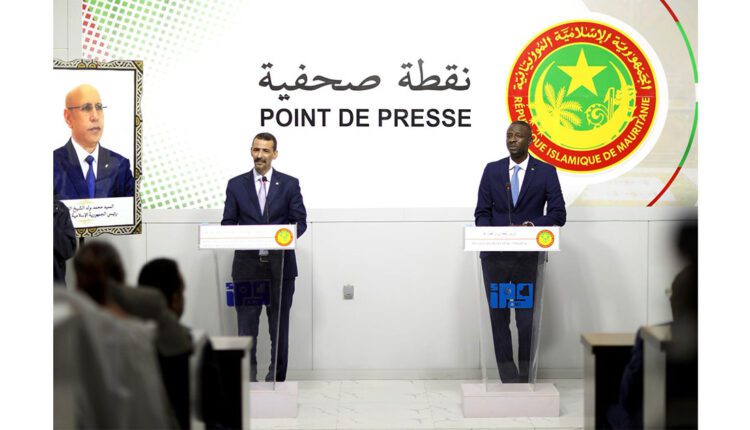
Mauritania is an open country and a guarantor of freedoms, and all indicators confirm this (it is the first Arab and African country in press freedom and 33rd in the world), said the Minister of 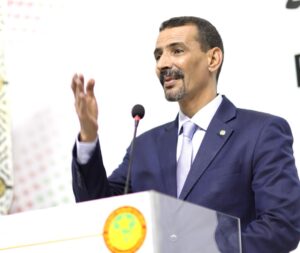 Culture, Arts, Communication and Relations with Parliament, the government spokesman, Mr. El Hussein Ould Medou, stressing that its keenness on openness and freedom is matched only by its keenness on applying the law.
In response to a question on the subject, while commenting on the results of the Council of Ministers meeting on Wednesday evening at the speech room of the Mauritanian News Agency in Nouakchott, together with the Minister of Mines and Industry, Mr. Etienne Tijani, he stressed the need for concerted efforts to confront the hate speech and abuse currently spread on social media networks, as is the case in all countries of the world.
In response to a question about the cooperators’ file, the Minister stressed that an announcement will be made soon about the final settlement of this file, which is going through its final stages by screening the final lists, in fulfillment of the orders of His Excellency the President of the Republic, Mr. Mohamed Ould Cheikh El Ghazouani, to settle the file once and for all.
In response to a question about the Madrid Bridge and the Industrial Village in Nouakchott, the Minister explained that the former has been completed and is expected to be inaugurated soon, while work on the Industrial Village is proceeding at a slower pace than the bridge, stressing that all the projects that the Prime Minister pledged to complete within the first four months of his assumption of his duties have been completed except for these two facilities.
 For his part, the Minister of Mines and Industry, Mr. Thiam Tidjani, affirmed the government’s continued commitment to the commitments of His Excellency the President of the Republic to grant the “Tamayeh” area despite the damage caused to some prospectors – which the government decided to merge its parts, after it had previously divided it into two parts, one for community exploration and another for companies due to several reasons, such as the lack of feasibility of community exploitation, due to the nature of the soil, as well as the nature of the soil.
Commenting on the oral statement on indigenous mining, he said that the sector invited prospectors to consult with them on the issue and expressed regret for the disruption of their work, emphasizing the government’s commitment to resolve these issues in line with the commitments expressed by the President of the Republic on several occasions, in which he expressed his interest and pride in indigenous mining and his willingness to support it.
The Minister emphasized that the government has been working to materialize these commitments on the ground, as the sector’s commitment comes in consultation with representatives of community mining to find a solution to their issues, adding that the ministry adopts a transparent policy to solve the issues of community mining and develop it to be a key lever in the national economy.
He mentioned the reality of indigenous mining, the most important issues facing it, and the stages it has gone through since it first started in 2016 in an indiscriminate manner, stressing the government’s keenness to regulate it due to its economic importance on the one hand and the risks it may pose to the lives of citizens, which was embodied through the establishment of the Mauritania Minerals Agency, for which 30 corridors were allocated in an area of 36,388 square kilometers, and one billion ounces for a special fund for prospectors in the Agency, in addition to issuing a legislative framework that regulates the sector.
In response to a question about the prospectors’ protest, the minister stressed that the President’s decision to limit exploration in the Tamayeh area to companies is irreversible, after it became clear that native exploration there is not feasible and that most prospectors have turned to companies by concluding contracts with them, stressing that the government will not give a license to a company to explore a prospector’s well as long as they exploit it.
He reiterated the ministry’s readiness to consult with the prospectors to resolve their issues and its openness to dialogue with them, noting that he met with them yesterday and expressed the sector’s readiness to consult with them and agreed to send representatives with the authorities there to examine the situation and find solutions, calling on them to cooperate and abide by the areas designated for community prospecting.