

Regional Consultative Workshop on the Expected Production of the 2024-2025 Season is opened in a Seamless Space and West African Countries
Nouakchott
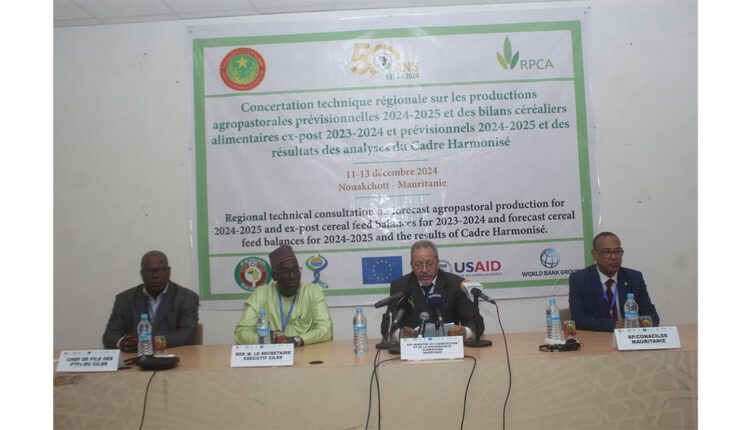
A regional technical consultation workshop to verify the expected agricultural and pastoral production for the 2024-2025 season, organized by the Ministry of Agriculture and Food Sovereignty in cooperation with the Permanent Joint Committee to Combat the Effects of Drought in the Sahel “Sils”, with the support of its technical and financial partners, began Wednesday in Nouakchott.
This meeting is part of the continuous monitoring of information related to food and nutrition security through the production of consensus information to support the decision-making process of governments and their partners in order to deal with food and nutrition crises in a timely manner in the Sahel and West African countries.
This workshop follows the technical consultation on agricultural and food prospects held between 16 and 18 September Niamey, Niger, which concluded with low to medium pastoral agricultural production expectations in light of the marked delay at the beginning of the season in the Sahel countries, long pockets of drought recorded in the northern parts of the Gulf of Guinea countries and heavy floods recorded in the region.
In a speech on the occasion, Mr. Mohamed Ould El Nimeen, in charge of a mission at the Ministry of Agriculture and Food Sovereignty, pointed out that with regard to Mauritania, the government’s efforts to support the agricultural campaign for the 2023-2024 season focused on providing the usual support to farmers with significant quantities of seeds and automatic and manual tractors in rainy areas, supporting fertilizers and pesticides and providing protection from agricultural pests, in addition to exceptional seed support for areas that witnessed floods to enable farmers to exploit the available water.
He said that our country has been paying outstanding attention to addressing food crises since His Excellency the President of the Republic, Mr. Mohamed Ould Cheikh El Ghazouani, assumed power, and this is reflected in the diverse support that has become available to citizens of vulnerable groups in various forms, supported and strengthened by the establishment of the Synergy Commission, which was able to address many crises that the country has experienced.
He pointed out that the context of the ongoing security crisis, mass population displacement and political crises in the region are factors that exacerbate the nutritional and nutritional vulnerability of the population in the region.
He added that this complex crisis of civil, social, political and economic insecurity accelerates the collapse of families’ livelihoods and leads to the disruption of trade exchanges, market imbalances and humanitarian interventions, stressing that this situation deserves “our full attention as well as the attention of our technical and financial partners to provide innovative solutions that meet the expectations of the population.”
He stressed the need to be careful in studying the results of the analyses that will be submitted for evaluation by the participants, explaining that the Mauritanian government pays close attention to the results of this workshop in order to properly monitor the nutritional and nutritional status of the population of the Sahel region and West Africa.
For his part, Professor Sanosa Ata, Director General and AGRHMET Executive Secretary of the Permanent Joint Commission to Combat the Effects of Drought in the Sahel, said that the consultative process in which we meet today is of paramount importance to the Commission and the international community, as the assessment of the nutritional and nutritional situation in the Sahel and West Africa region occupies the forefront of the regional alert tool developed by the Commission with its national and regional technical and financial partners and operates normally in a regular consultative framework in order to predict food and nutrition crises. in the Sahel and West Africa.
Thanks to this tool, the Sahel and West Africa region prepares every year the nutritional and nutritional situation in direct cooperation with member states and their technical and financial partners and with the support of regional and international organizations and financial partners, he noted.
He pointed out that this consultation enables the validation of the preliminary results of the pastoral agricultural crops obtained as a result of the joint evaluation missions of the agricultural campaign and the analysis cycles issued by the Common Framework that were evaluated at the country level in coordination with national services and technical partners.
He thanked the Mauritanian government for the facilities provided for the success of this workshop and the technical and financial partners of the SILS for funding it.