

King Salman Global Academy and UNA conclude Symposium on Enhancing Arabic Content
Jedda
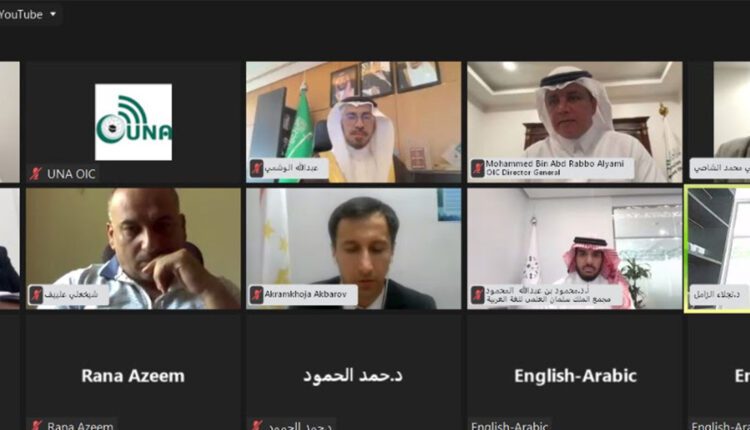
The King Salman Global Academy for the Arabic Language and the Union of OIC News Agencies (UNA) concluded, yesterday, Monday, a virtual symposium entitled “Enhancing Arabic Content in Non-Arabic-Speaking OIC News Agencies.”
The symposium targeted the official news agencies of non-Arabic-speaking member states that provide Arabic on their news platforms, namely: Azerbaijan, Afghanistan, Uzbekistan, Pakistan, Turkey, Tajikistan, Kyrgyzstan, Malaysia, and Chad.
During the symposium, the Secretary-General of the King Salman International Academy for the Arabic Language, Dr. Abdullah bin Saleh Al-Washmi, stressed that the Academy aims to organize this symposium to achieve its goals in enriching Arabic content in various media outlets, which contributes to motivating and supporting Arabic content producers, and raising their scientific and media level.
During his speech, the Director-General of the Federation of News Agencies of the Organization of Islamic Cooperation, Mr. Mohammed bin Abdul Rabbuh Al-Yami, pointed out that the member news agencies in non-Arabic-speaking Islamic countries were keen to establish Arabic sections in their agencies and launch pages with Arabic content on their digital platforms with the aim of providing a reliable source of information about their countries for readers in Arabic, which would build bridges of cooperation and establish them on solid foundations of cultural and cognitive communication.
He expressed his hope that this symposium would be a starting point for more programs in the field of enhancing Arabic content in news agencies of Islamic countries, especially since we are benefiting from the expertise and experience of the King Salman Global Academy for the Arabic Language, which is one of the most prominent global references regarding Arabic language policies and developing programs aimed at empowering it in various fields.
The virtual symposium was accompanied by two specialized discussion sessions, the first entitled: “Challenges of Arabic Content in News Agencies of Non-Arabic-Speaking OIC Countries,” and the second entitled: “The Vision of the King Salman Global Academy for the Arabic Language to Enhance the Content of Non-Arabic-Speaking News Agencies.”
The two sessions reviewed the mechanisms and programs contributing to linguistic development, while discussing the challenges facing the concerned news agencies, and the best ways and solutions to overcome them; to come up with a systematic vision that contributes practically to designing institutional linguistic rehabilitation programs and plans, and facing the challenges related to the use of the Arabic language for news and media purposes.
At the conclusion of its work, the symposium issued a number of recommendations, including working to enhance Arabic content in international media, especially news agencies, in view of the importance of the media in spreading languages, supporting the presence of the Arabic language in the digital space, and cooperation between the Academy and the Union in organizing forums to support its presence in news agencies of non-Arabic-speaking Islamic countries.
The recommendations also included establishing training programs in the field of using the Arabic language for media purposes with the design of programs and plans that enhance the presence of the Arabic language in news agencies, and the development of Arabic media content in several fields, in addition to enhancing the investment of artificial intelligence technologies and linguistic blogs in a way that contributes to supporting Arabic content in the news agencies of the OIC countries.
The Academy explained that organizing the symposium comes as an affirmation of its strategic role in serving the Arabic language, supporting initiatives and projects related to teaching non-native speakers, building bridges of cooperation between it and institutions concerned with teaching Arabic as a second language locally and globally, highlighting its value in expressing linguistic depth, and completing the efforts it seeks to achieve by strengthening its partnership with news agencies of non-Arabic-speaking OIC member states, contributing to qualifying their members in the fields of editing and linguistic review, using the Arabic language for media purposes, and implementing many training programs that contribute to qualifying members of news agencies of non-Arabic-speaking OIC member states.