

Government spokesman: All old Structural Problems have Either been Settled or Started to be Worked on
Nouakchott
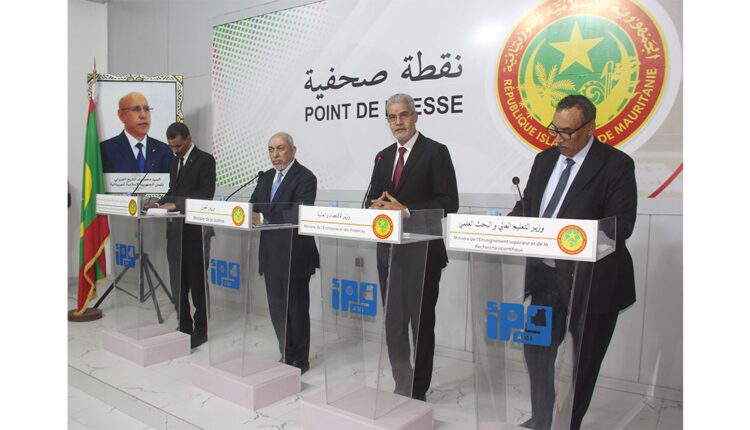
The Minister of Culture, Arts, Communication and Relations with Parliament, government spokesman, Mr. El Houssein Ould Medou, said that all indicators, whether economic, social or political, a promising future and testify to the vitality of the government. Compared to previous years, these indicators reflect substantial progress, and long-standing structural problems have either been fully addressed or concrete steps taken to address them.
Commenting on the results of the cabinet meeting Thursday evening at the pronouncement Hall of the Mauritanian News Agency in Nouakchott, accompanied by the Ministers of Justice, Economy and Finance, Higher Education and Scientific Research, he warned that the development path is continuous and never complete, as stated by His Excellency the President of the Republic, Mohamed Ould Cheikh El Ghazouani, in his electoral program, but that the efforts that have been made are great, as shown by figures and evidence, whether at the level of health, education or services
The city of Nouakchott, which has allocated more than 50 billion Ouguiyas in order to solve the problem of water, electricity, sewage, paving roads and building educational and health facilities, as the number of newly established schools has doubled, and the number of health facilities has also increased, and what has been subscribed in the field of education in recent years has reached a third of what was subscribed before that since the establishment of the state.
On the political front, the spokesperson stressed that the recent visits made by the Prime Minister of Senegal and the President of Sudan illustrate the growing status of Mauritania and its President on the international scene, both as Head of State and as Chairperson of the African Union.
Following him, the Minister of Justice, Mr. Mohamed Mahmoud Cheikh Abdoullah Ould Boye, said that the draft law on the declaration of assets and interests aims to fill the legal gaps in the 2007 text and to respond to the recommendations of the United Nations. The previous text, although it brought significant progress, revealed shortcomings, in particular the absence of mechanisms for the declaration of interests and a limited deterrent effect
The bill, he continued, aims to strengthen transparency, prevent conflicts of interest, fight against illicit enrichment and promote integrity in public life. It imposes mandatory disclosure of assets and interests, extending this obligation to parliamentarians and decision-makers. In addition, it provides the National Anti-Corruption Authority with legal tools to review such declarations and detect possible violations.
Regarding sanctions, the minister said that the text provides for administrative and criminal measures, such as suspension of salary, dismissal, prohibition from running for election, fines and prison sentences.
Regarding the draft law on the fight against corruption, the minister explained that it will repeal the legislation in force in this area. This new text responds to the State’s commitments in the fight against corruption, in particular by integrating the strategies established by the United Nations, the African Union and Arab countries. It also reflects the State’s commitment to combating all forms of corruption, as evidenced by the adoption of several repressive laws.
“The draft law aims to close loopholes in previous legislation and incorporate UN recommendations, while introducing specific provisions to prevent misappropriation of funds in the private sector and irregularities in the awarding of public contracts. These offences will be punished by prison sentences and fines,” he said.
The minister also stressed that new mechanisms will be introduced to recover embezzled funds and allocate them to the financing of economic and social projects.
For his part, the Minister of Finance and Economy, Mr. Sid’Ahmed Ould Bouh, announced that the National Anti-Corruption Authority, the creation of which was the subject of the draft law adopted today by the Council of Ministers, constitutes a broader organizational framework and complementary to the existing control bodies. This authority will be responsible for designing and supervising the national anti-corruption strategy, through actions such as the investigation of areas where corruption is rampant, the drafting and publication of reports, as well as the organization of awareness campaigns to promote a culture of integrity.
Among its missions, the new authority will also be responsible for managing asset declarations, receiving and processing corruption reports, while ensuring the protection of whistleblowers. It will also coordinate its actions with similar institutions abroad in order to strengthen the effectiveness of the fight against corruption.
The minister stressed that the creation of the new body represents a historic step forward in the protection of public funds and the fight against corruption. The authority enjoys full independence, and its six members, including its president, will be selected from among independent and experienced personalities. According to the minister, the adoption of the bill creating the body in question and the two bills on the declaration of assets and the fight against corruption, concretely illustrates the government’s commitment to this fight, which is hardly limited to slogans, but is now translated into reality
For his part, the Minister of Higher Education and Scientific Research, Yacoub Ould Moine, said that the draft decree on the mechanisms for the orientation and allocation of scholarships introduces four new criteria for the granting of these scholarships at the national level. These criteria are based on the principles of social solidarity and academic excellence, in a fair and transparent framework
The minister said that the four criteria used are: social support, promotion of decentralization, academic excellence and academic merit. The first criterion, social support, will be applied on the basis of the social register established by the General Delegation for National Solidarity and the Fight against Exclusion (Taazour). The second criterion aims to encourage the decentralization of education, giving priority to students enrolled in higher education institutions located outside the capital. As for the third criterion, relating to academic excellence, it is based solely on the academic performance of the students who obtained the best results during the previous year, while ensuring a balance between the different courses. Finally, the fourth criterion, related to institutional merit, awards scholarships to certain specific institutions. This year, the École normale supérieure will be honored, having welcomed 370 students destined to become college teachers for the new generation of students of the Republican School.
The minister also pointed out that the draft decree removes the age limit, which was previously a barrier for many students.
Regarding scholarships to study abroad, Ould Moine said that priority will be given to master’s and doctoral students enrolled in Mauritanian institutions under agreements with foreign universities. This measure also applies to students of local higher education institutions, such as Polytechnique. In addition, and with the aim of strengthening the transparency and efficiency of the process, the ministry will set up a digital platform dedicated to the management and allocation of scholarships, which will be available next Monday