

President of Republic Oversees Fourth African Peace Conference Opening
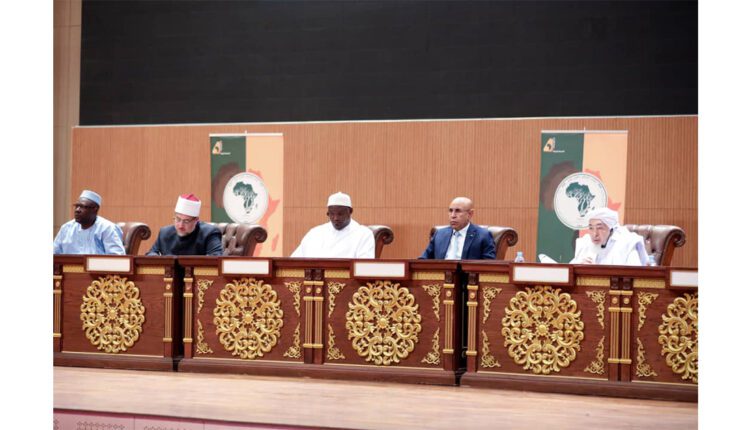
On 9 January, in Nouakchott, His Excellency Mr. Mohamed Ould Cheikh El Ghazouani, the President of the Republic, oversaw the opening of the 4th African forum for Promoting Peace.
Through the slogan, “Traditional Education in Africa: Science and Peace”, the conference seeks to shed light on the creativity of the historical experience of African societies in terms of private educational institutions, which formed roots of knowledge, bridges for communication and happy coexistence, impregnable fortresses against extremism, division, and difference, incubators of the values of peace and fraternity, and tributaries of authentic Afro-Islamic identity.
Among the objectives of the current edition is the creation of a platform for dialogue and consultation between decision-makers, religious leaders, and society elites to contribute to the search for ways in which private educational institutions can rediscover their role in promoting peace and harmony and strengthening the resilience of societies against extremist ideas, and how to enrich this authentic experience with modern educational approaches.
For three days, forum participants will follow scientific sessions on various subjects, including original education in Africa, the roots of knowledge and communication bridges, the role of this education in intellectual security, the fight against extremism, and the establishment of civil peace, its reality in the context of the national state and globalization, the mechanisms of its integration and cooperation with modern education, and the challenges it faces.
As part of this annual forum, a working session will be organized on the theme: Women and Youth Summit: Immunization and Empowerment, during which several presentations and interventions will be made to examine the mechanisms to empower these two segments of society in various areas and protect them against extremism and drift.
In his remarks for the occasion, Mr. Sheikh Abdullah Ben Beyyah, the President of the Abu-Dhabi Forum, declared that the United Arab Emirates shares with Mauritania and all Arab and Islamic countries the call to put an end to the barbaric war against the Palestinian people, noting that the United Arab Emirates had sent aid and mobile hospitals to support the Palestinian people in the Gaza Strip.
He explained that this annual meeting constitutes a step in the search for strengthening the sources of peace in Africa and in the world, stressing that the choice of “Traditional Education” as the theme of this edition is due to the fact that education is one of the most important factors in instilling a culture of peace and security.
Mr. Ben Beyyah, finally, indicated that there are three challenges that traditional education faces, namely the supervision of human executives, financial resources, institutionalization and organization, and reviewed the procedures by which those challenges can be overcome.
For his part, Mr. Mohamed Mokhtar Gom’aa, the Minister of Awqaf of the Arab Republic of Egypt, warmly welcomed the conference, particularly its theme, its organization, and its preparation, thanking His Excellency Mr. Mohamed Ould Cheikh Ghazouani, the President of the Republic, for overseeing its activities which constitute an opportunity to promote peace and disseminate its values.
He reviewed the relationship between science and peace, emphasizing that with more right Islamic sciences the path opens to peace, and with the dominance of ignorance reigns extremism and drift.
Mr. Gom’aa also stressed the importance and necessity of preserving social peace between the different members of the same country and world peace in general, calling on the nation’s scholars to deploy all their efforts to promote peace in the different homelands of the nation, as an umma of peace, and not a nation of war or submission.
He, finally, drew attention to the interest of legalizing the conditions of the traditional educational systems and placing them under the supervision, surveillance, and monitoring of the State, so that they are not exploited by violent groups and extremists.
Dr. Mohamed Kone, the Malian Minister of Religious Affairs, highlighted the interest of the meeting and its expected role in strengthening peace and the fight against extremism, while emphasizing the qualitative contribution of the traditional education in the promotion of culture and education and the popularization of Islamic values.