

President of Republic: “With our determination and the support of the international community, we will be able to address the challenges of terrorism, governance, and development”
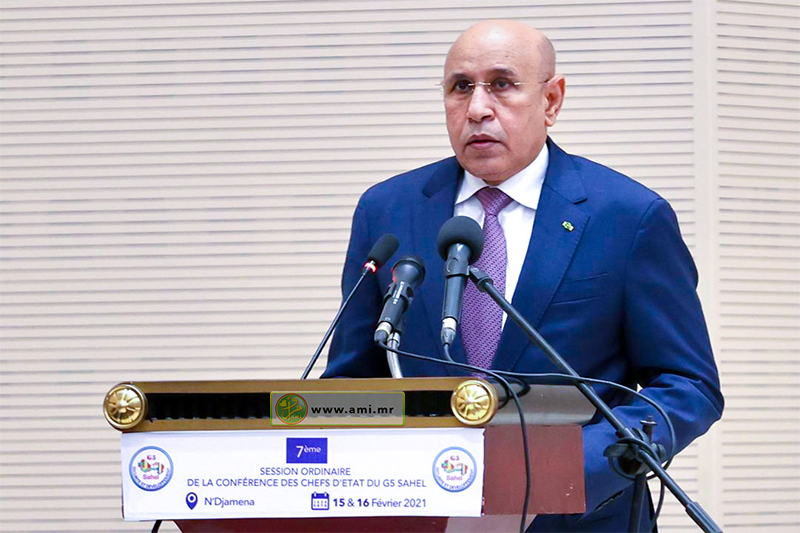
The President of the Republic, Mr. Mohamed Ould Cheikh El Ghazouani, current president of the Conference of Heads of State of the G5 Sahel, delivered an important speech on Monday in N’Djamena in which he reviewed the outcome of the Mauritanian presidency of the G-5 Sahel, before handing presidency to his brother and friend, the President of Chad Idriss Deby Itno.
He affirmed that during the term of office, which is coming to an end, the current presidency of the G-5 Sahel has worked to consolidate the achievements and to stimulate a new dynamic to collective action, to translate the strategic vision of our organization through concrete achievements in the areas of security and development.
The President of the Republic also highlighted the salient aspects of his term with the adoption of a roadmap intended to be both realistic and ambitious, a roadmap which has made it possible, to a large extent, to achieve the goals set forth.
This roadmap, he said, is defined into five major axes: security-defense, resilience, human development, and infrastructure, strengthening intra and inter-community dialogue, strengthening diplomatic support dynamic, and finally the institutional monitoring mechanism.
Here is the full text of the speech of the President of the Republic:
Mr. Marshal of Chad, Idriss Deby Itno, President of the Republic, Head of State; Excellencies, Heads of State of the G-5 Sahel;
Honorable partners and friends of the Sahel;
Distinguished guests; Ladies and gentlemen.
Allow me, first of all, to extend my sincere thanks to my brother and friend, Marshal Idriss Deby Itno, President of the Republic of Chad, for the perfect organization of this summit, the warm welcome and the hospitality we have encountered since our arrival in N’Djamena.
At the same time, I would like to express our gratitude to him for the efforts and sacrifices that Chad continues to make in favor of peace and security in the region; I will cite, particularly, the intervention of its troops in Mali, Operation Bohoma Anger and its decision to deploy a 2nd battalion for the benefit of the G-5 Sahel Joint Force.
I also renew our thanks and our deep gratitude to the countries, partner organizations and institutions and all friends of the Sahel, for the interest and constant support they provide to peace and to the economic and social development of our region.
Excellencies,
Ladies and gentlemen,
During the term of office, which is coming to an end, the current presidency of the G5 Sahel has worked to consolidate the achievements and to stimulate a new dynamic to collective action, with a view to translating the strategic vision of our organization into concrete achievements in the areas of security and development.
To this end, a roadmap, which is intended to be both realistic and ambitious, was adopted and has made it possible, to a large extent, to achieve the goals set forth.
This roadmap is defined into five major axes, particularly those of security-defense, resilience, human development, and infrastructure, strengthening intra and inter-community dialogue, strengthening the diplomatic support dynamic, and finally institutional monitoring mechanism.
At the level of the security-defense axis, the acceleration of the rise in power of the G-5 Sahel joint force, the strengthening of the national defense and security forces and the enhanced coordination with the Barkhane Force made it possible to achieve important results.
In this context, we can cite the intensification of operations in the three-border area, the deployment of the first contingents of the TAKUBA Task Force, the launch of planning work for the engagement of an African force, of 3,000 men, in the Sahel and, recently, the planning in Nouakchott of a large-scale joint operation in the western zone.
Thus, the national defense and security forces and the joint force are gradually regaining the initiative in the various theaters of operations and the terrorist armed groups are suffering more and more losses, both in terms of personnel and of material means, with the neutralization of several of their main leaders.
Excellencies,
Ladies and gentlemen,
In the field of resilience, human development and infrastructure, several projects aimed at the fight against COVID-19, climate change, the empowerment of women and girls, start-up enterprises resilience, water and social cohesion have been concluded or finalized.
In this regard, we welcome the start of 18 of the 21 projects of the Emergency Development Program (PDU) with partner members of the Sahel Alliance.
In addition, important projects in the field of emergencies in connection with rural development and resilience in the face of COVID-19 are underway with, respectively, the support of the International Fund for Agricultural Development and the African Bank of Development.
Regional integration is being strengthened with the process of removing roaming charges, the financing, by the Arab Bank for Economic Development in Africa and the Arab Fund for Economic and Social Development in Africa, of road section projects linking the countries, as well as the finalization of the feasibility study of the Trans-Sahelian Railway project.
The G-5 Sahel capitalizes on a political commitment framework now established and consensual and on the implementation of its programmatic plans, in terms of governance and development.
In addition, despite a difficult international and regional context, the G-5 Sahel was able, in 2020, to mobilize and engage international technical and financial partners in favor of the implementation of its development and security strategy.
Excellencies,
Ladies and gentlemen,
In terms of strengthening intra and inter-community dialogue, concrete actions to provide local communities with a local service and to create a climate of trust conducive to dialogue have been undertaken.
The appropriation of the human rights compliance framework, through the judicialization of security operations and the gradual return of the state, continues and gets strengthened.
We welcome, in this regard, the support in equipment and training provided by the European Union, the United Nations Office on Drugs and Crime and the United Nations High Commissioner for Human Rights for the operationalization of the police component of the Joint Force and for the generation of rapid action surveillance and intervention units (GARSI) at the national level in the various G-5 Sahel countries.
Besides, it is important to highlight the organization in 2020 of Regional Conferences on the fight against Violent extremism where Ulema, scholars, thinkers but also actors of civil society expressed their opinions, exchanged, and debated with a view to identify the best and most efficient ways to combat radicalization in all its forms, particularly among young people.
The 4th conference on building trust between defense and security forces and populations in the Sahel area, organized on 26 January, corroborated this dynamic of intra and inter-community dialogue.
The G-5 Sahel countries are resolutely committed to strengthening the rule of law and good governance.
In this context, we can note with satisfaction the relaunch in Mali of the process of the Algiers Agreements and the smooth conduct of the presidential elections in Burkina Faso.
It is fitting for me here to offer my warm congratulations to my brother and friend, President Roch Marc Christian Kabore on his re-election, to hope that the second round of the Nigerien presidential election will also take place under good conditions, and to reaffirm our full support for the Transition process in Mali.
Excellencies,
Ladies and gentlemen,
In terms of strengthening the diplomatic support dynamic, and despite the difficult security context and the emergence of the COVID-19 health crisis, the Presidency-in-Office actively supported the launch of the Coalition for the Sahel, the implementation of the Pau summit commitments and the formalization of political dialogue with the Sahel Alliance.
This diplomatic support dynamic has given real impetus to cooperation and made it possible to strengthen the fight against terrorism, improve the military capacities of the G-5 Sahel States, support the return of the State and administrations to the sensitive areas, and facilitate the implementation of development activities.
Intense advocacy activity also continues to be carried out to obtain a mandate under Chapter 7 of the United Nations Charter and long-term funding for the Joint Force, international assistance to fight the COVID-19 crisis and to continue to support development in light of the impact of security spending on our countries’ budgets.
Also, thanks to the efforts made by member countries and the active support of our friends and partners, our organization has been able to occupy an important place in the international agenda through a politico-diplomatic dynamic, marked by multiple meetings at the level of the heads of state and ministers.
Thanks to these meetings, we have adopted the new integrated priority action framework (CAPI), which aims to implement projects with rapid impacts in sensitive areas.
The G-5 Sahel now has a renewed political and programmatic commitment framework to further concretize its action in favor of the living conditions and well-being of its populations.
Excellencies,
Ladies and gentlemen,
As for the institutional monitoring mechanism, the organizational reform of the G-5 Sahel Executive Secretariat has been carried out and the rise in power of the Secretariat of the Coalition for the Sahel continues.
In this regard, we welcome the appointment of a High Representative of the Sahel for the Coalition.
In 2020, the G-5 Sahel strongly consolidated its partnership with the European Union. This translated into the prospect of a concerted review of the EU’s strategy for the Sahel. The G-5 Sahel approves the relevance of its strategic lines for better governance, more development actions, and a results-based management approach, with a more effective system of accountability.
Excellencies,
Ladies and gentlemen,
Despite the numerous challenges, particularly the persistence of the activities of terrorist groups and a complex situation on the ground, the security record of the G-5 Sahel in 2020 is positive, with a favorable balance of power which has clearly imposed itself on terrorist groups.
The G-5 Sahel Joint Force has strengthened its command and planning capacity and leads, in coordination with partner forces, joint operations that significantly contribute to the attrition of terrorist groups, the reconquest of territory and the restoration of state authority.
To consolidate these achievements, the G-5 Sahel will continue to work so that its national defense and security forces can fully fulfill their sovereign missions and so that its Joint Force continues its rise in power in the various capability areas.
At the same time, despite the complexity of asymmetric conflicts and the community tensions that prevail locally in certain places in the Sahelian space, we have the firm will to continue to fight against all forms of impunity and to carry out the necessary investigations to denounce the abuses and bring their perpetrators before the competent courts.
In this regard, the G-5 Sahel welcomes the relevance of the Partnership for Security and Stability in the Sahel (P3S) supported by the European Union and aimed at the return of security and justice by supporting the action of the internal security forces.
Likewise, we welcome the European Parliament Resolution adopted in September 2020 on Security Cooperation in the Sahel region, West Africa, and the Horn of Africa, which henceforth opens the possibility of financing for the benefit of the armed forces of the countries and their joint forces, through the European Peace Facility.
Excellencies,
Ladies and gentlemen,
Since the extraordinary summit of Heads of State of the G-5 Sahel on 27 April 2020, where a declaration on the COVID-19 pandemic was adopted, intense advocacy continues to be carried out at the highest level for supporting national response plans and canceling the external debt of our countries.
Here, we reiterate our call to make this debt cancellation effective, which is undoubtedly the most appropriate response to the particularly harmful consequences of the dual health and security crisis.
The Libyan crisis is a source of concern and a factor of instability that feeds insecurity and terrorism in the Sahel. In this regard, we note with satisfaction the last agreement signed in Geneva under the auspices of the United Nations which constitutes a reason for optimism for a lasting resolution of this Crisis.
It would also be advisable that an interest is henceforth brought to the surveillance and the protection of the maritime frontage of the G5 Sahel which, as I indicated at NATO headquarters on 14 January, should guard against multiple security challenges in the maritime environment such as maritime piracy, illegal immigration, illicit trafficking, and marine pollution.
Excellencies,
Ladies and gentlemen,
The accumulation of challenges in the sub-region is not inevitable because the Sahel has major assets to face them, particularly the deep aspiration of our populations to live in peace and in dignity.
Together, with determination and support from the international community commensurate with the challenges, we will be able to meet the challenges of terrorism, governance, and development.
At the end of my term as President-in-Office of the G-5 Sahel, I is my pleasure and honor to hand over the baton to my brother and friend, Marshal of Chad Idriss Deby Itno, who, I am convinced, will be able, thanks to his wisdom and leadership, to consolidate and promote the achievements of our young organization.
I wish our present summit every success.
Long live the G-5 Sahel,
Thank you “.