

President of Republic at “Dakar 2” Summit: “The Promotion of Livestock Sectors in Mauritania Will Contribute to Food Self-Sufficiency and Employment for Women and Young People”
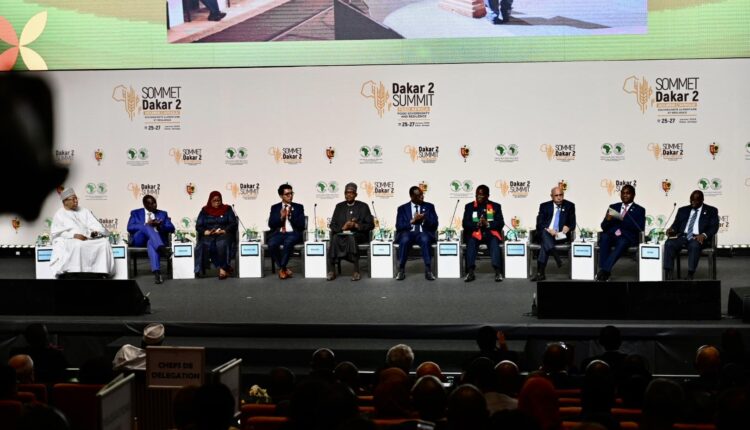
On 25 January, His Excellency Mr. Mohamed Ould Cheikh El Ghazouani, the President of the Republic, who is taking part in the “Dakar 2” Summit on food sovereignty and resilience in Africa, took part in the exercise of questions and answers like allhis peers present at the Summit by answering a question relating to the ambitious livestock development program in Mauritania and the public actions undertaken to make it a vector of food security and resilience.
The President of the Republic first of all pointed out that the “Dakar 2 Summit” carried important lessons, stressing that the agricultural and animal potential, on its own, is not enough to ensure food self-sufficiency.
He indicated that the continent, of which nearly 65% of the land is arable with significant water resources and a young population able to work, remains, despite this potential, dependent on food imports.
The President of the Republic stressed that his counterpart Macky Sall seemed to have meditated well on the situation in Africa following the COVID-19 pandemic and the war in Ukraine.
He added that the exchanges during this forum on ways to find how to feed Africa.
Regarding the question relating to the livestock sector, he pointed out that Mauritania had enormous potential in animal resources with 30 million head of ruminants for a population of less than 5 million people.
That means to take advantage of the potential of this very little exploited sector to improve its production and yields.
The President of the Republic indicated that Mauritania, taking this observation into account, had resolutely oriented itself toward the promotion of livestock sectors with a view to increasing national milk production to 120 tons per year in 2027 and
devoted 35% to industrial processing. We also plan, for the same period, to increase the production of red meat to increase it from 230,000 tons to 300,000 tons and to significantly increase poultry production, as he put it.
He said that the promotion of these livestock sectors would greatly contribute to food self-sufficiency and create many job opportunities, particularly for women and young people.