

Prime Minister Inspects Development Projects in Nouakchott, Calls for Faster Implementation and Improved Public Services
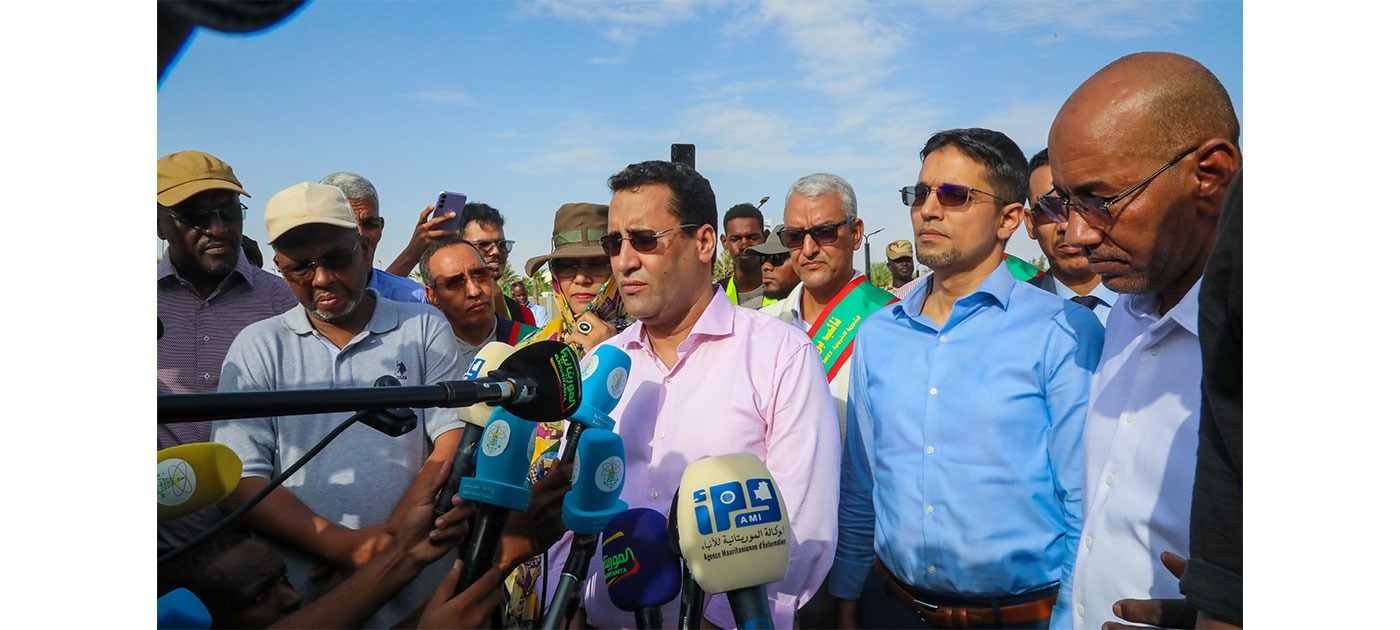
In implementation of the directives of His Excellency the President of the Republic, Mr. Mohamed Ould Cheikh El Ghazouani, the Prime Minister, Mr. El Moctar Ould Diay, conducted a field visit this Saturday to several healthcare, sports, and public service facilities in the capital, Nouakchott.
The visit aimed to assess on the ground whether completed projects complied with their specifications and terms of reference, as well as to evaluate the progress of ongoing projects, in accordance with the instructions of His Excellency the President of the Republic, Mr. Mohamed Ould Cheikh El Ghazouani, and his commitment to ensuring that projects are completed within the prescribed deadlines and according to the required specifications, guaranteeing that citizens benefit from them appropriately and on time.
The visit covered a number of health centres in the districts of Tevragh Zeina, Ksar, Teyarett, Dar Naïm, Toujounine, Riyad, and El Mina, in addition to the National Oncology Centre, the extension of the National Hospital Centre, the health school, El Mina Stadium, the multi-purpose sports hall in the Arafat district, and a public square located opposite the Mokhtar Ould Daddah International Convention Centre.
Speaking at the end of the visit, the Prime Minister explained that it was part of efforts to monitor development projects currently underway in Nouakchott, with the aim of assessing the actual progress of the works, discussing the main issues raised with citizens and their representatives, and ensuring that public investments were improving services and making citizens’ lives easier.
He added that the visit covered three main sectors: health, youth and sports, and housing and urban planning. He noted that field observations had revealed significant progress on a number of projects, while also identifying certain shortcomings and delays requiring corrective action and continuous monitoring.
He affirmed that he would continue these visits whenever necessary, given the scale of ongoing projects in the capital and the importance of ensuring that allocated resources were translated into tangible results benefiting citizens.
Regarding the healthcare sector, the Prime Minister explained that the visit included health centres whose construction had been ordered by His Excellency the President of the Republic in Nouakchott and throughout the country. These include 28 health centres in the capital and more than 40 centres under construction in the interior regions. He noted that 15 health centres had been accepted by the relevant sectoral committee, of which 12 were now under the responsibility of the Ministry of Health, where equipment installation had begun, while acceptance procedures for the remaining centres were being finalised.
He added that equipment for the health centres had arrived in Nouakchott, with only a few minor supplies outstanding. He explained that five centres had experienced construction delays, leading to the termination of contracts with the companies responsible for them due to their failure to meet their contractual obligations.
Regarding the National Oncology Centre, the Prime Minister explained that approximately two years ago, His Excellency the President of the Republic had ordered urgent measures to address deficiencies threatening the continuity of certain services, particularly those involving medical imaging and radiotherapy equipment.
He added that the CT scanner had been operational for three months, while the new radiotherapy machine had been installed. According to the centre’s officials, its programming and the training of technical teams to operate it were expected to be completed by November 15.
He stressed that the new machine’s entry into service would improve the quality of services provided to cancer patients, accelerate their treatment, and increase treatment accuracy.
The Prime Minister added that he had visited the extension of the National Hospital Centre, explaining that it constituted a complete new hospital facility with a capacity of approximately 150 beds.
He indicated that the project had experienced delays due to a combination of technical and financial problems that had not been adequately addressed during the initial stages. Monitoring had subsequently been intensified over recent months, and procedures for the provisional acceptance of the completed works had begun.
He added that instructions had been issued to the relevant ministerial departments to continue monitoring the project and accelerate implementation, expressing his hope that the facility would be completed, equipped, and operational by mid-November.
As part of efforts to strengthen the healthcare system’s capacity, the Prime Minister stated that the country had received the first batch of ambulances under a contract for the acquisition of 100 new vehicles, intended primarily for health centres and hospitals in the interior regions, alongside efforts to strengthen the capacity of the body responsible for medical assistance.
He specified that 44 ambulances had arrived so far, while the contract with the supplier who had failed to meet the deadlines had been terminated, allowing the Ministry to launch new procurement procedures to acquire the remaining vehicles. He considered the delivery of these vehicles an important boost to the country’s capacity to evacuate and provide care to patients, particularly given that the total number of ambulances nationwide had been fewer than 200.
He stressed that these projects represented only a small part of the broader and more comprehensive work undertaken in the healthcare sector since 2019, in implementation of the vision and directives of His Excellency the President of the Republic, given the importance of this sector and its direct impact on citizens, particularly low-income households that cannot afford treatment abroad.
In this context, he highlighted the inauguration of hospitals in Sélibaby and Atar, while the hospital in Tidjikja had reached the provisional acceptance stage, with its inauguration expected soon. Work was progressing at the hospitals in Aïoun and Aleg in preparation for their inauguration by the end of the year, while construction continued at the hospitals in Zouérate and Akjoujt.
He also mentioned the extension of the Specialised Hospital, formerly known as the Neurological Hospital, and the expansion of cardiology services. Studies were underway for the construction of a new mother-and-child hospital, while negotiations were progressing towards the signing of a financing agreement for a large, independent hospital dedicated to cancer treatment.
The Prime Minister noted that the number of health centres and health posts had doubled since 2019, alongside the expansion of health insurance coverage to include broad categories of citizens, particularly low-income individuals registered in the social registry and higher education students.
He also highlighted measures taken to improve the organisation of the pharmaceutical sector, strengthen oversight of the importation, transportation, and storage of medicines, and develop a digital system to track medicines from manufacturing through to their use.
He added that strengthening healthcare infrastructure required continued investment in human resources, noting that 1,200 healthcare workers, including doctors, nurses, midwives, and specialists, had been recruited as part of efforts to address staffing shortages and improve services.
He affirmed that the government would conduct a comprehensive assessment of the observations recorded during the visit, with the aim of correcting shortcomings, addressing delays, and improving project performance.
Regarding the youth and sports sector, the Prime Minister stated that he had inspected El Mina Stadium, which had undergone provisional acceptance, and the multi-purpose sports hall in the Arafat district, the first covered facility of its kind in the country.
He explained that the hall, with a capacity of approximately 600 seats, was nearly complete, while work was progressing steadily on the main stadium, which could accommodate around 1,000 spectators.
He stressed that these projects formed part of a broader programme to develop sports infrastructure, in implementation of the directives of His Excellency the President of the Republic to make the current presidential term a special term for youth, expand opportunities for sporting activities, and increase the number of facilities dedicated to sports.
He mentioned the inauguration of stadiums in Dar Naïm, Teyarett, Sebkha, and El Mina, alongside ongoing expansion and rehabilitation works at Riyad Stadium and other facilities, including Mellah Stadium.
He added that approximately 14 neighbourhood sports grounds had been completed in Nouakchott, while construction continued on more than 20 additional grounds in the capital, alongside similar projects in the interior regions.
He explained that these facilities were part of the commitment made by His Excellency the President of the Republic at the Youth Conference in November 2025 to establish 100 neighbourhood sports grounds nationwide.
He announced the upcoming delivery of covered multi-purpose sports halls in Kaédi and Kiffa, alongside plans to study the construction of similar facilities in Nouadhibou and Nouakchott.
Regarding the Olympic Stadium, he mentioned the installation of natural grass for the first time and ongoing renovation works to make the stadium ready to host international matches in less than a month, while expansion work at Cheikha Ould Boidiya Stadium continued.
The Prime Minister confirmed that his tour had also included the public square opposite the Mokhtar Ould Daddah International Convention Centre, where work was underway to develop the site and create a new urban space in the heart of the capital. He explained that the government was seeking to improve Nouakchott’s overall appearance, develop urban planning, and provide public and recreational spaces that met residents’ needs, following years in which shortcomings had accumulated amid competing priorities.
He stated that His Excellency the President of the Republic had emphasised, in his speech during his visit to the Adrar and Inchiri regions, the importance of developing cities and bringing them up to international standards. He added that urban rehabilitation efforts included preparing comprehensive urban development plans, particularly for the capitals of the interior regions, taking into account infrastructure requirements, sanitation networks, and development needs, in order to ensure the sustainability of completed projects and prevent work from having to be repeated due to inadequate prior planning.
He stressed that projects were planned to rehabilitate the city centre and its neighbourhoods and develop major road corridors, including Sheikh Zayed Avenue and the Nouadhibou Road, in addition to rehabilitating the Lehraith area in the Sebkha district, based on studies relating to land registration.
Speaking about the observations recorded during the visit, the Minister highlighted significant improvements in infrastructure and the presence of educational staff, while noting the persistence of certain challenges, particularly overcrowding and issues related to secondary education.
He also highlighted the role of road construction and connectivity projects, explaining that the construction of 136 kilometres of paved roads had helped connect neighbourhoods, improve mobility, and reduce congestion on urban routes.
He further mentioned improvements in water services following the commissioning of facilities at Idini and work carried out on distribution networks, despite persistent difficulties in neighbourhoods without distribution networks or in areas whose geographical characteristics required specific technical solutions.
He explained that electricity problems were among the most prominent issues raised by residents during the tour, noting that recent power cuts made it necessary to accelerate efforts to find definitive and sustainable solutions.
He stated that, despite efforts to address their consequences, the rainfall experienced in Nouakchott continued to affect some residents inside their homes. He noted that the Minister had drawn attention to the situation of residents in disaster-affected areas and that work was underway to prepare a plan to resolve the situation permanently.
Regarding urban cleanliness, he stressed the need to coordinate efforts among the contracted company, administrative and municipal authorities, elected representatives, and citizens to improve waste collection and preserve the capital’s overall appearance.
He affirmed that the state would continue to strengthen its presence on the ground and enforce the laws governing public spaces, in cooperation with civil society and political and administrative stakeholders, while commending initiatives that contributed to improving cleanliness and organising neighbourhoods.
He added that the government intended to prepare a communication for the Council of Ministers on these issues, with the participation of the relevant departments and under the supervision of the Minister of the Interior, while mobilising available resources according to the priorities of the 2027 budget, with the aim of intensifying efforts in Nouakchott and the cities of the interior.
He emphasised that cleanliness was not merely a matter of urban aesthetics but was directly linked to public health, development, and quality of life, calling on citizens and all active members of society to contribute to addressing this challenge.
He confirmed that the government would continue monitoring these issues and working to correct the shortcomings identified, in order to ensure sustainable improvements in essential services and strengthen the impact of public investment on citizens’ lives.
In conclusion, the Prime Minister stressed that the government would remain committed to implementing the directives of His Excellency the President of the Republic, relying on the competence of the public administration and the cooperation of citizens, the country’s elites, and political forces from both the majority and the opposition to address development challenges and fulfil the aspirations of the Mauritanian people.
At the various stages of the tour, the Prime Minister received briefings on the different phases of work at the facilities, the procedures being followed, the status of implementation, the deadlines set for completion, and the expected contribution of each project to development and the improvement of citizens’ living conditions.