

Members of the government: Effective and coordinated measures have been taken to mitigate the effects of the global fuel crisis
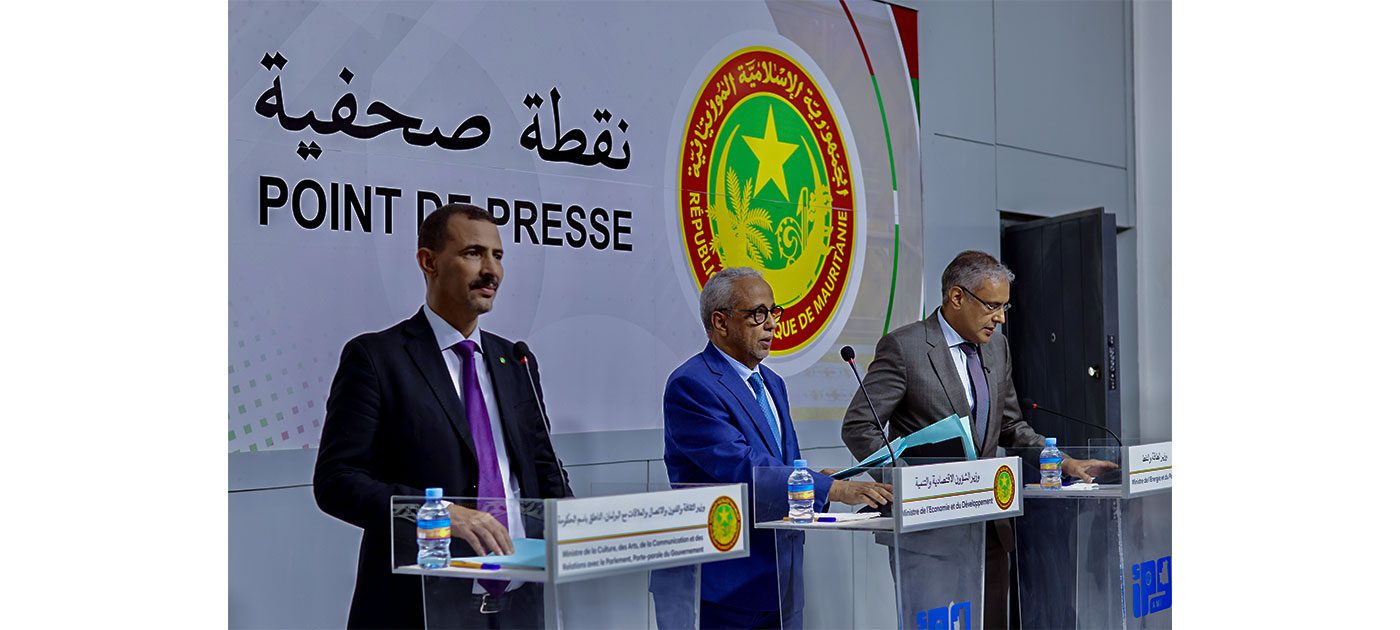
The Minister of Culture, Arts, Communication, and Relations with Parliament, the government spokesperson, Mr. Housseine Ould Medou, affirmed that the government, under the high directives of His Excellency the President of the Republic, Mr. Mohamed Ould Cheikh El Ghazouani, has adopted in recent weeks a proactive approach to dealing with the repercussions of the geopolitical crisis in the Middle East. This has been through taking a set of measures capable of limiting its impact on supply and provision chains, and addressing the rise in fuel prices.
This came during a press conference held Monday, in the press hall at the headquarters of the Mauritanian News Agency in Nouakchott, alongside the Ministers of Economic Affairs and Development, and Oil and Energy, to comment on the meeting chaired by His Excellency the President t at the Presidential Palace, this Monday, dedicated to studying the disruption of supply chains and the global increase in hydrocarbon prices. He noted that a ministerial committee has recently been formed to monitor the supply of essential goods to the market and take appropriate measures in a timely manner.
He pointed out that His Excellency the President of the Republic issued his directives to the government on the necessity of hastening the identification and implementation of effective and coordinated measures in order to contain the rise in fuel prices and mitigate its effects on the national economy.
He added that His Excellency the President of the Republic emphasized, during the meeting, the importance of maintaining citizens’ purchasing power and working to reduce the negative impacts of this crisis, especially on the most vulnerable groups, while ensuring that public policies are adapted to safeguard the country’s economic and social stability.
In this context, The Minister reviewed a number of measures taken, including rationalizing state expenditures and public spending, and working on preparing an amended finance law that considers the requirements of this stage, in addition to launching a wide awareness campaign to educate citizens on the necessity of rationing consumption.
The ministerial committee was also tasked with studying the review of the structure and prices of liquid and gaseous fuels, along with taking regulatory measures, including restricting the use of state-owned four-wheel-drive vehicles, except for ambulances and vehicles belonging to security and military agencies, to be used only when necessary.
These measures also include, the Minister added, rationalizing energy consumption in public facilities, while calling on citizens to adopt the same approach to preserve national resources.
In response to a question about the tragic incident that claimed the lives of Mauritanian citizens within Malian territory, he explained that the incident occurred outside the national borders, expressing condolences to the two victims, and affirming that Mauritania’s commitment to its territorial sovereignty is matched only by its concern for the safety and dignity of its citizens wherever they are.
He added that the authorities are making intensive efforts to ascertain the circumstances of this incident, while also working to mobilize citizens and raise their awareness of the risks associated with being in areas experiencing security disturbances.
For his part, the Minister of Economic Affairs and Development, Mr. Abdallahi Ould Souleymane Ould Cheikh Sidia, in his presentation, reviewed that the prudent policies adopted by the government, under the high directives of His Excellency the President of the Republic, Mr. Mohamed Ould Cheikh El Ghazouani, have enabled the state to achieve balanced financial margins, which contributed to funding ambitious development programs and strengthened its resilience in facing this exceptional and unprecedented situation.
He added that the current phase requires everyone to exercise the highest levels of awareness and responsibility, and to deal with the current circumstances with foresight and wisdom, in implementation of the directives of His Excellency the President of the Republic, in a way that limits the impact of the crisis on the national economy and the living conditions of citizens.
He explained that the rapid rise in fuel prices results in a series of economic effects, as they are a fundamental input in various productive activities, where the increase in their cost leads to a reduction in added value, negative impacts on economic growth, state revenues, and market dynamics, in addition to its direct effect on foreign currency reserves.
In this context, the Minister reassured citizens and residents that essential goods are available in sufficient quantities to cover several months.
Regarding the impact of this crisis on the budget, the Minister explained that reaching an oil price of $112 per barrel will cost the state, within the framework of fuel subsidies during 2026, about 168 billion old Ouguiya, an amount that includes subsidies for diesel, gasoline, cooking gas, and electricity production inputs, representing approximately 13% of total budget resources.
He pointed out that this level of support is nearly equivalent to the allocations for major social sectors, warning that it could lead to an expansion of the 2026 budget deficit to around 7% of the GDP, compared to 3.5% in the original estimates.
The Minister confirmed that His Excellency the President directed the preparation of an amended 2026 budget law, taking into account these variables related to growth, inflation, and subsidy levels, along with initiating austerity measures that enable the state to adapt effectively to this economic situation.
In turn, the Minister of Energy and Oil, Mr. Mohamed Ould Khaled, said that the recent geopolitical transformations have directly impacted global petroleum product prices, leading to significant increases that imposed additional challenges on the state budget.
He added that the government had, months ago, taken measures concerning fuel prices based on studies conducted at the beginning of the year, which indicated that global prices were around $60, with a forecasted decrease. This required fixing the price of diesel at 500 ouguiyas, so that the state bears any increase beyond this level, while if the price drops below 500 ouguiyas, the difference returns to the state treasury.
However, His Excellency the President directed that any decrease should directly benefit the citizen.
The Minister emphasized that Mauritania does not import crude oil, but rather relies on importing its derivatives, clarifying that the prices of these derivatives do not necessarily directly reflect crude oil prices, due to being affected by multiple factors, including refining and transportation costs and differences in demand levels between regions, as diesel consumption rises in regions such as the Middle East and Asia compared to Europe.
He pointed out that an increase in the price of crude oil by 5% does not necessarily mean a similar increase in gasoline or diesel prices, due to the absence of a fixed direct relationship between them. He added that Mauritania imports five main petroleum products: diesel, gasoline, fuel oil, kerosene, and cooking gas. He also noted that the state spent about 17 billion Ouguiya on fuel subsidies in the past three months, pointing out that the largest part of this support was recorded in March, coinciding with the outbreak of the war and the start of a sharp rise in global prices.
The Minister confirmed that fuel subsidies currently represent about 13% of the state budget, pointing out that a number of countries have taken similar measures to confront this crisis, some of which raised fuel prices, while other countries resorted to policies to rationalize consumption, such as reducing nighttime activities and encouraging remote work to reduce transportation costs.
He concluded by emphasizing the availability of petroleum products in the country and the existence of stock sufficient for several months, explaining that the current issue is not related to abundance, but to the rise in global prices.
He also reaffirmed the state’s commitment, in implementation of the directives of His Excellency the President of the Republic, to continue supporting citizens and mitigating the effects of these increases, while calling at the same time for rationalizing energy consumption during this period until prices return to their natural levels.
Regarding the Big Ahmeim Turtle Project, commonly abbreviated as GTA, the Minister explained that work is currently underway in the first phase of the project, and discussions regarding the transition to the second phase are ongoing.
He emphasized that the current international crisis, despite its negative effects on the public treasury in the short term, may have positive effects on Mauritania in the medium and long term, considering that it is a natural gas-producing country with a relatively distant strategic location from tension zones, in addition to its proximity to the European market, which could enhance investment opportunities in the energy sector in the upcoming phase.