

Agreement on Settling Kuwaiti Debt Issue
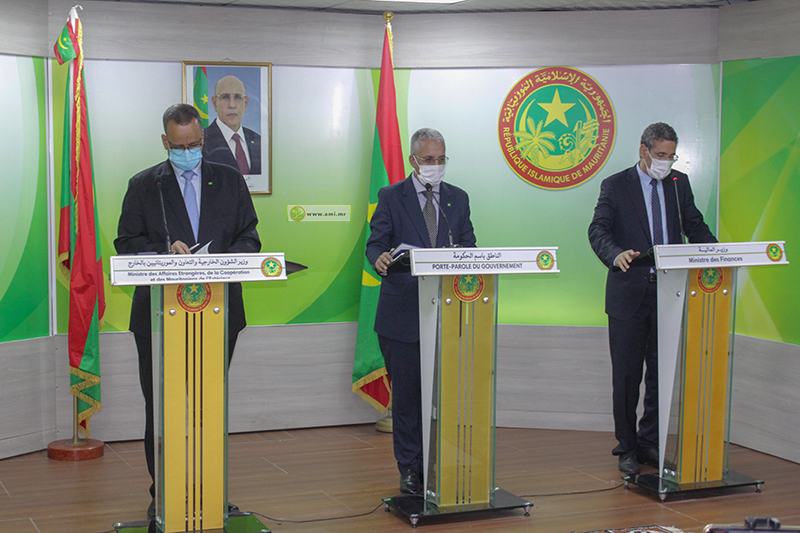
“A definitive agreement has been reached with the brotherly state of Kuwait for the settlement of its accumulated debt with Mauritania, through debt rescheduling. This agreement is the fruit of intense diplomatic efforts backed by His Excellency the President of the Republic, Mr. Mohamed Ould Cheikh El Ghazouani”.
This was stated on Thursday evening by the Minister of Foreign Affairs, Cooperation, and Mauritanians Abroad, Mr. Ismail Ould Cheikh Ahmed, during a news conference with his colleagues of Finance, Culture, Youth, Sports, and Relations with Parliament, Government Spokesperson.
Mr. Ould Cheikh Ahmed then reviewed the process leading to the agreement, the efforts of the government, through his visits to Kuwait with the Minister of Finance, last July, the message of the President of the Republic that he had conveyed to the Emir of Kuwait, and the recent visit to Mauritania by the Kuwaiti Minister of Foreign Affairs, and the message he conveyed to the President of the Republic, and all what that has engendered in terms of deepening relations between the two brotherly people.
Finally, the Minister recalled that previous governments have undertaken many steps over the past decades which have failed to find a solution satisfactory to both parties.
For his part, the Minister of Finance, Mr. Mohamed Lamine Ould Dhehbi, pointed out that the agreement signed between Mauritania and the State of Kuwait provides for the restructuring of the Kuwaiti debt, canceling 95% of the interest accumulated over three decades, and investing the rest in assets presenting profitable investment opportunities for both countries.
He added that the principal amount of the debt, which is $ 82,707,600 will be repaid over a period of 20 years, including a two-year grace period, and at an annual interest rate of 0.5%.
Mr. Dhehbi also cited the advantages of the agreement, compared to other initiatives; advantages that result from the fact that the value lies first in the 95% cancellation rate, which exceeds that of the two best-known debt restructuring initiatives:
a – Debt relief initiative for the poorest countries (HIPC) which took place at the start of the millennium, with a cancellation rate of 67%:
b- The Multilateral Debt Cancellation Initiative launched in 2006, whose cancellation rate was 90%.
The Minister of Finance also referred to the effects generated by this dossier, which has remained on the back burner for the past three decades, despite the excellent level of relations between the two countries.
“This passive debt has also affected confidence in the country’s ability to meet its obligations and weakened our country’s debt capacity indicators,” as he noted.
Regarding the origins of the debt, the Minister of Finance explained that it was contracted in the seventies of the last century, and consists of two loans and a deposit with the Central Bank of Mauritania:
1- A loan of 46 million dollars for the compensation of shareholders during the nationalization of MIFERMA;
2- A loan of 4.5 million dollars to finance the participation of SNIM in the capital of Samia;
3- A deposit with the Central Bank of Mauritania amounting to $ 36 million.
“The principal amount of this debt is currently $ 82,707,600. This amount, which was suspended about 30 years ago, has not been subject to any restructuring as part of past relief or cancellation initiatives”, as he concluded.
For his part, the Minister of Culture, Youth, Sports, and Relations with Parliament, Government Spokesman, Mr. Moctar Ould Dahi, indicated, in response to a question relating to the date of the beginning of the dialogue, and the role the government intends to play, that it is up to the opposition and the presidential majority to determine when the consultation process should begin.
It is the job of political parties. “Some people talk about four weeks. The President of the Republic is ready to receive all the parties”.
He explained that the term “dialogue” is suitable for the political situation in which the tension is high. In situations of appeasement such as the current one, the term “consultation” is most appropriate, as the different political actors have become partners rather than adversaries.