

President of Republic Launches Development Component for Ouadane
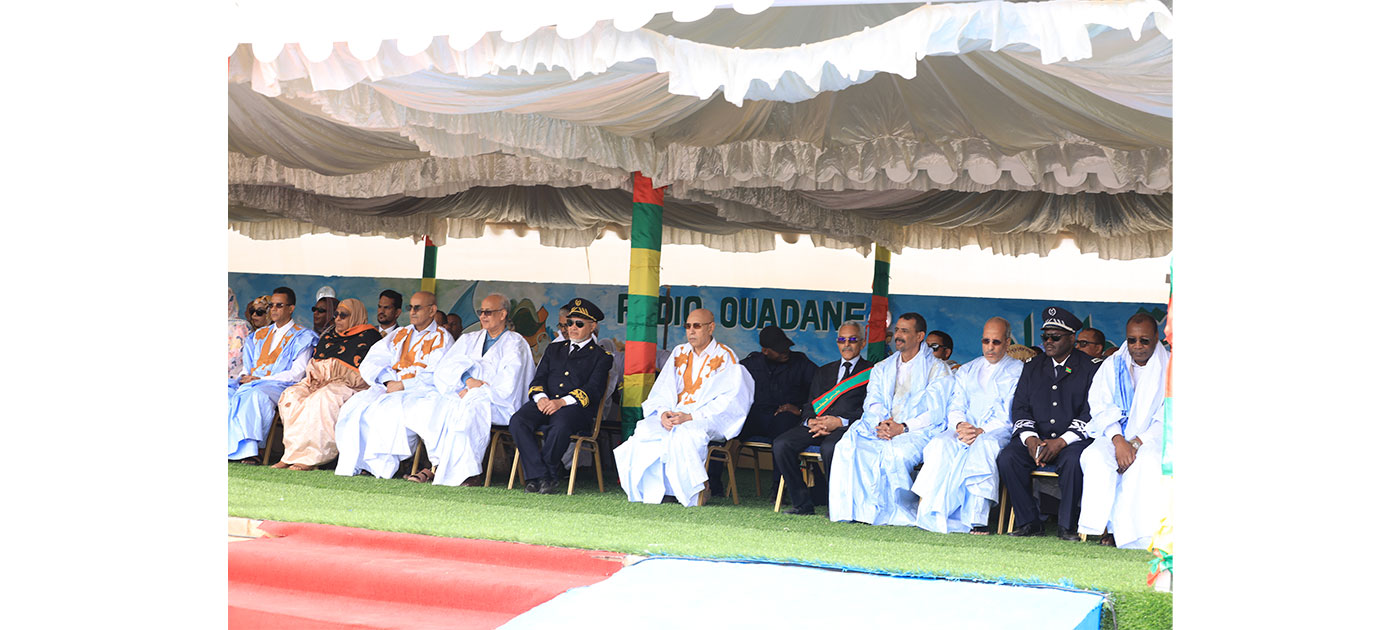
His Excellency the President of the Republic, Mr. Mohamed Ould Cheikh El Ghazouani, supervised the launch of the development component for the city of Ouadane this Friday, as part of the program for the 14th edition of the Heritage Cities Festival.
This component aims to improve the performance of basic services in Ouadane by constructing and renovating educational establishments, strengthening the performance of health facilities, expanding water and electricity networks, and building sports and cultural facilities. It also includes financing income-generating projects, strengthening the agricultural sector, combating desertification, supporting tourism facilities, and renovating public service buildings in the city, along with other interventions across various sectors.
During the launch ceremony, the Minister of Culture, Arts, Communication, and Relations with the Parliament, and Government Spokesperson, Mr. El Housseine Ould Meddou, presented a report detailing the various areas and positive outcomes expected from the project. He emphasized that the component includes the renovation of Ouadane School No. 1, the renovation and equipping of the high school, and the equipping of “Tinleba” Middle School. It also includes expanding classrooms in the schools of “Voum Lekhnag,” “Voum Ajar,” “Agava,” and “J’reijire,” equipping the education inspection office with air conditioners, computers, and chairs, and addressing the shortage of teachers and support staff.
In the health sector, the plan includes providing a dental chair with accessories, an electrocardiogram (ECG) machine, and protective equipment (masks, disinfectants, gloves, infrared thermometers). Additionally, it will involve organizing community awareness campaigns on hygiene, infectious disease prevention, and first aid, providing essential emergency medicines, and enhancing the stock of essential medicines for the Ouadane health center’s simplified system.
The plan also covers the provision of a new 800 KVA power generator, the development of the distribution network in the high school district, its extension to the new northern districts, the hybridization of the power plant with solar energy, and the installation of 10,000 linear meters of fencing. It further includes reinforcing small dams selected by the Ministry of Agriculture and Food Sovereignty, supporting local agricultural cooperatives with improved seeds, fertilizers, and soil improvement work conducted by tractors in the Adrar region.
Mr. Ould Meddou added that the component includes the launch of an oasis development and management project, which will equip 30 wells with solar pumps in the oases of Ouadane, Tebla, and Tanouchart. This project will also renovate two rock dams (one in Ouadane and one in Tellelba), build a refrigeration unit in Ouadane, and install partial irrigation networks for the oases of Ouadane and Tellelba, in addition to a collective irrigation system in the Tanouchert oasis.
The component also includes the opening of a veterinary clinic and pharmacy, the renovation of slaughterhouses in Ouadane and Tellelba, and organizing free medicine distribution and vaccination campaigns for livestock. Moreover, it will provide training and professional skill development for tourism professionals and youth in the hotel and catering sectors, along with a 50 million MRO fund to support the city’s inns (auberges).
The Minister also specified that the plan includes equipping the youth center with chairs, sound systems, and a large screen, as well as financing youth projects under the 2025 “My Future” (Mon Avenir) initiative. The program will organize National Handicraft Days in Ouadane, provide technical and logistical support to artisanal cooperatives, and offer short training sessions in sewing, electricity, plumbing, and refrigeration. Additionally, an institute for Islamic sciences will be established, with support for mahadras and mosques, and the recruitment of an imam and muezzin for the “Tinleba” mosque.
The city’s development component also includes renovating the governor’s (Wali) offices and residence, renovating the festival square and official platform, providing a cover and lighting for the platform, and developing an urban plan for the city. This plan involves maintaining the road connecting Chinguetti and Ouadane, constructing a new 100 m³ water tank, drilling two additional wells to increase water production, rehabilitating the existing network, and extending the network to cover the vulnerable districts of Ribat and Manara. A 50 m³ water tank and distribution network will also be constructed in Tanoucharte.
The government spokesperson emphasized that the component provides for the restoration of the ancient mosque and its enclosure, the “Street of the Forty Scholars,” the ancient wall, and houses in the old quarter. It also includes the redevelopment of “Rahba and Atwar” squares (constructing traditional premises for street vendors and demolishing existing structures), supporting manuscript libraries, installing solar street lighting in the old city, and constructing the headquarters for the national radio in Ouadane. The Heritage Authority will also build and equip a cultural village, and the Ouadane Culture and Heritage Exhibition will be accredited as a permanent exhibition.
Furthermore, the component will create a model nursery, support 25 projects for people with special needs, and implement a sand stabilization program in several oases. It will also include planting trees in educational institutions, supporting waste management, awarding prizes for Quranic memorization, and providing sports equipment to local clubs. Support will be given to 75 women’s cooperatives, involving over 950 women, as well as financing various income-generating community stores.
The Minister also stated that the development of Ouadane includes the creation of a digital space equipped with IT resources, field training for 40 individuals and 5 trainers, the creation of an interactive website for Ouadane, and digital assistance during “Guelb Richat” (Eye of the Sahara) events, while improving internet and communication services in the area.
Finally, the component includes financing community projects, such as a complex containing a poultry farm, fish shop, slaughterhouse, and grain unit—all powered by solar energy. Direct assistance will include providing a gas transport truck, distributing 500 gas bottles, 500 food baskets for vulnerable families, and 20 tons of wheat under the “Food for Work” program, as well as 4,000 meters of fencing for oases and 6 tons of wheat in exchange for stabilization work.
The launch activities took place in the presence of the Minister Secretary General of the Presidency, the Minister in Charge of the Cabinet of the President, the Minister Counselor to the Presidency, the Wali of Adrar, the President of the Region, the Hakem of Ouadane, and the Mayor of the Commune.