

At the 43rd UNESCO General Conference: The Minister of Culture highlights Achievements in the Fields of Culture, Arts, and Communication
Samarkand
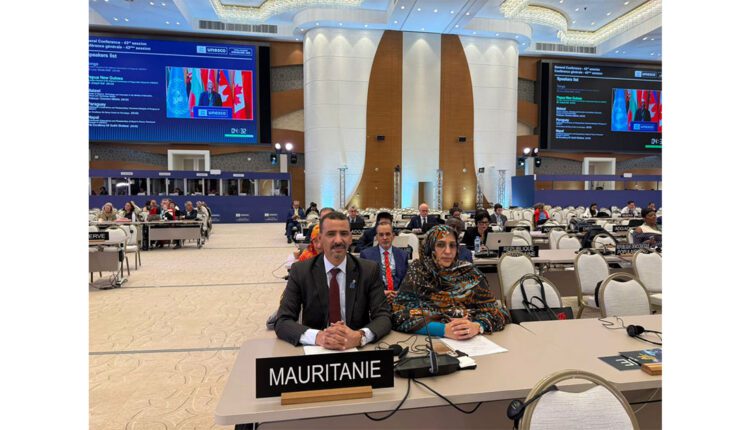
Samarkand (Uzbekistan), November 5, 2025 (AMI) – The Minister of Culture, Arts, Communication and Relations with Parliament, government spokesperson Mr. El Houssein Ould Medou, reaffirmed Mauritania’s commitment to its cooperation priorities with UNESCO, notably the protection of intangible heritage, the development of the creative economy, the digitization of cultural archives, the promotion of freedom of expression, and the strengthening of international partnerships to address common challenges.
This message was delivered by the Minister on Wednesday, November 5, 2025, before the 43rd General Conference of the United Nations Educational, Scientific and Cultural Organization (UNESCO), held in Samarkand, Republic of Uzbekistan.At the beginning of his speech, the Minister conveyed the greetings of His Excellency the President of the Republic, Mr. Mohamed Ould Cheikh El Ghazouani, and those of the Mauritanian people to the participants, emphasizing Mauritania’s pride in taking part in this international forum, which embodies the values of dialogue, cultural diversity, and human understanding.
He congratulated the Republic of Uzbekistan on the excellent organization of this session and praised the considerable efforts made by the UNESCO Secretariat to promote culture and dialogue, encourage creativity, and strengthen international cooperation in the fields of education, science, and culture.The minister highlighted Mauritania’s most significant achievements in the fields of culture, arts, and communication since 2019.
These achievements are part of the ambitious national vision promoted by His Excellency the President of the Republic, Mr. Mohamed Ould Cheikh El Ghazouani, which places culture at the heart of development, dialogue, human understanding, and the strengthening of peace and social cohesion. Mr. El Houssein Ould Medou explained that this vision has resulted in qualitative transformations affecting various aspects of education, culture, and media, notably:In the field of education: The reform of the educational system, through the launch of the “Republican School” initiative, aims to disseminate knowledge and ensure access to schools that provide education tailored to each child.
This initiative also required significant public investments, which allowed for the construction of new schools, representing half the number of classrooms that existed before 2019, and increased the number of teachers by more than a third. He explained that this strategy aims to spread knowledge and democratize information.In the field of culture and heritage, the minister stated that the following results have been achieved: – Adoption of a national approach linking heritage and development, identity and modernity, creativity and the cultural economy;
– Organization of the Festival of Heritage Cities in the historic cities of Chinguetti, Ouadane, Tichitt, and Oualata, whose development component generated more than 16 billion old ouguiyas over the last four editions, making culture a true driver of local development
;- Registration of the historic city of Goul on the National and Islamic Heritage List;-
– Listing of Mahdara and the Samba Gueladio epic as World Heritage sites, and recognition of the Soninke language as a cross-border language;- Listing of dozens of sites on the Islamic and national heritage lists, and launch of a national program for the protection of underwater heritage and an archaeological research program in the historic city of Azougui. Regarding support for cultural and creative industries, the minister explained that the following results were achieved:- Implementation of training programs for young people in the arts, creative industries, and marketing of cultural products;- Organization of the first Nouakchott International Book Fair, with wide Arab, African, and European participation, making Mauritania a regional cultural bridge;
– Organization of the first and second editions of the Mauritanian Music Festival, celebrating artistic diversity and national creativity;
– Active participation in major international fairs and festivals to strengthen the cultural influence of Mauritania on the world stage.
The minister also noted that, in the field of freedoms and media reforms, the following progress has been made:
– Launch of significant media reforms that have strengthened press freedom and guaranteed the public’s right to information;- Mauritania ranks at the top of Arab and African rankings in terms of press freedom and journalist safety, ranking 33rd globally in 2024 and among the top 50 in 2025;- Adoption of a policy of openness and ongoing dialogue with media stakeholders, and strengthening partnerships for the development of public policies in the sector.
Regarding social policies and culture as levers of cohesion, he stated:- The adoption of open social policies has made it possible to turn culture into a tool for strengthening social justice and spreading values of citizenship and solidarity;- Support for initiatives by young people and communities in the fields of theater, music, and visual arts, considered as spaces for expression, diversity, and convergence.
In the field of security, tolerance, and coexistence, the minister stated that a balanced approach has been adopted, combining prevention and dialogue, thereby helping to strengthen security, stability, and civil peace, and making Mauritania a regional model for peacebuilding through culture and the fight against extremist ideology.
In conclusion, the minister reaffirmed Mauritania’s commitment to cooperation priorities with UNESCO, particularly the protection of intangible heritage, the development of the creative economy, the digitization of cultural archives, the promotion of freedom of expression, and the strengthening of international partnerships to address common challenges. His Excellency concluded his speech by emphasizing that ‘culture is a future to be built, an inexhaustible symbolic capital, and a resource for development and human understanding,’ thereby renewing the commitment made to UNESCO and its partners to continue working for a more open, coherent, and creative world.
The session took place in the presence of H.E. Ms. Moulaty Mokhtar Lemhaimid, ambassador and permanent delegate of our country to UNESCO, as well as members of the Mauritanian delegation from the Ministry of Culture and the Permanent Delegation to the organization, participating in the work of this session, along with numerous Ministers of Culture, delegates from member states, and representatives of international and regional organizations.