

Government spokesperson: Water and Electricity in Nouakchott and Nouadhibou will be resolved Once and for All
Nouakchott
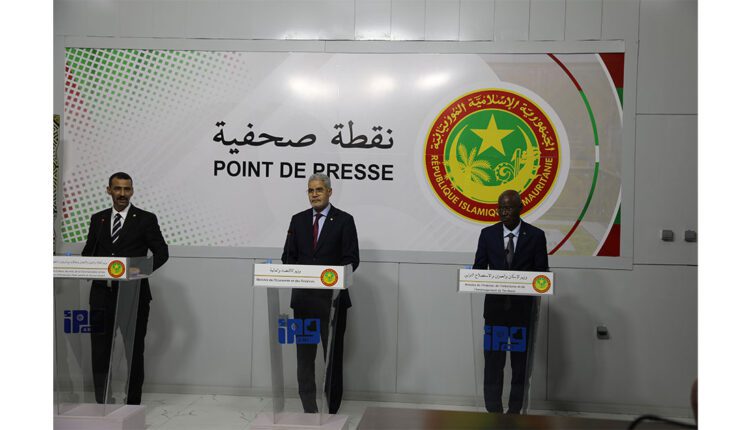
The issue of water and electricity in Nouakchott and Nouadhibou will be definitively resolved in no more than 16 months through structural projects that will double the production of Lake Azhar, Boulnouar, Aftout Coastal and Lake Edeni by 100%, said Minister of Culture, Arts, Communication and Relations with Parliament, Spokesperson of the Government, Mr. El Houssein Ould Medou.
In response to a question about the water shortage in Nouadhibou, while commenting on the results of the meeting of the Council of Ministers on Wednesday evening in Nouakchott, together with the Minister of Economy and Finance and the Minister of Housing, Urbanization and Territorial Reclamation, he pointed out that the water shortage may be due to scarcity sometimes or to the weakness of the network.
In response to a question about the failure of some political parties to obtain licenses, the government spokesperson stressed that the issuance of licenses is ongoing and there is no stumbling block in this area. The aim of the recently issued Political Parties Law is to license parties, pointing out that there may be some parties that have not completed the required legal procedures.
For his part, the Minister of Economy and Finance, Mr. Sid’ Ahmed Ould Bouh, said that the draft law authorizing the ratification of the financial protocol signed between Mauritania and France for the expansion of the Aftout Coastal Water Transmission Network aims to provide Nouakchott with drinking water in light of the demographic increase it is experiencing, in line with the vision of His Excellency the President of the Republic to provide the city with its water needs.
He added that the project will allow to increase water production in the capital by producing 75,000 cubic meters per day, to add to the 150,000 total production of water sources (Afout Coastal, Edeni), stressing that the loan (18 billion old ouguiyas) is very easy, as it will be repaid over 25 years with an interest rate of less than one percent.
He emphasized that the project consists of five components, which will enable the expansion of the Beni Naaj treatment plant through the construction of a third sedimentation basin, the construction of an intermediate pumping station in Tiguent, the rehabilitation of existing treatment plants, and the expansion of the filtration station at Kilometer 17.
Regarding the draft law authorizing the ratification of the financing agreement signed between Mauritania and the International Development Association (IDA) to finance the first phase of the Energy Resources Development and Mining Sector Support Project, the Minister highlighted that this project will improve the efficiency of the National Electricity Company by introducing clean energy (solar and wind energy) to compensate for the shortage of electricity.
The project consists of four components, which will enable the creation of a green hydrogen agency, the creation of a training course on green hydrogen within the oil school, as well as improving supply and quality, he said, adding that the financial cost amounted to about 34 billion old ounces spread over three phases.
Regarding the medium-term budget programming statement for 2026-2028, he said that revenues in this budget will move from 117 billion in 2026 to 135 billion in 2028, in addition to the share of taxes, while expenditures will reach 141 billion in 2028, while the deficit will remain at 1.06%, while the growth rate in the budget will be 4.6%, with inflation ranging between 2.3% and 4% in 2028.
The Minister stressed that Mauritania’s remarkable success at the Roundtable and its receipt of two billion dollars from the Arab Coordination Group are proof of the financiers’ confidence in the reform program of the President of the Republic and the confidence that Mauritania enjoys internationally.
For his part, the Minister of Housing, Urbanization and Territorial Reclamation, Mamoudou Mamadou Niang, said that the draft decree on the general urban regime aims to define the general rules governing the conditions of land use, noting that the draft consists of five chapters.
The first chapter (consisting of two chapters) deals with general provisions, such as the objective and field of application, which includes all urban municipalities, while the second chapter focuses on urban planning tools such as master plans, local urbanization plans, zoning plans, and special plans: Subdivision, renovation, restructuring, integrated development… and emphasizes the commitment to harmony, harmonious planning, and the mandatory use of architects, engineers, and topographers.
Part III regulates the exercise of the right of pre-emption by describing its scope and procedures, with reference to the restrictions imposed on full ownership, while Part IV deals with transitional provisions, as it relies on the article that provides for development procedures according to the identified needs, while Part V deals with final provisions that keep this system in force until the issuance of full regulatory texts.
Regarding the draft decree on the simplified general building regime, the Minister said that the aim of this project is to allow the application of the current law on urbanization immediately, before the issuance of all its implementing decrees, thus providing a practical framework for the operationalization of urban planning regulated by the simplified general building regime.
He added that the decree consists of six chapters, the first chapter deals with general provisions, the second chapter defines the scope of application of the system, which includes all buildings and works subject to building permits or authorization, in addition to any modification of structures or building facades, noting that the third chapter deals with design and construction conditions, intervening parties, and the quality of materials.
He pointed out that the fourth section deals with setting rules related to the receipt of works, insurances, guarantees and responsibilities, while the fifth section deals with transitional provisions for the concerned municipalities, while the sixth section deals with final provisions that keep the decree in force until the issuance of the full executive decrees.
The Minister stressed that the most important aspect of this decree is that it requires a single window for building permits, which is an essential step towards regulating the construction sector and addressing the urban chaos that is currently widespread, the effects of which are starting to show on th