

Government Spokesman: We will Never allow Prejudice to our Islamic Values and Measures will be Taken Against Violators
Nouakchott
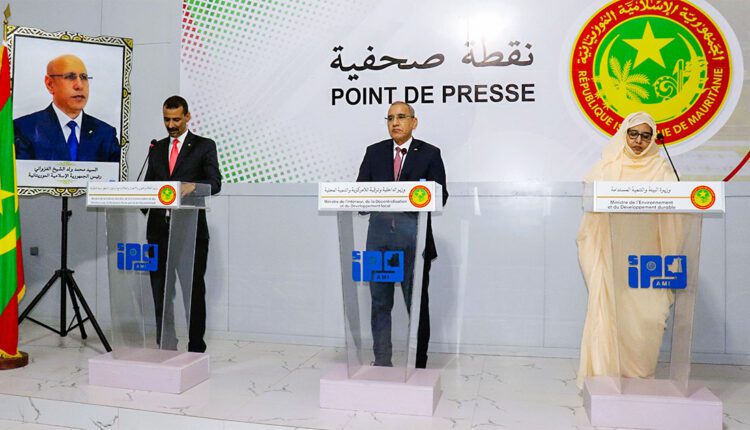
The Minister of Culture, Arts, Communication and Relations with Parliament, Government Spokesman, El Houssein Ould Medou, said that the Mauritanian state will never allow our Islamic values to be compromised and will take the necessary measures against violators.
This came in response to a question about what the questioner said was a disregard by some educational institutions for the Islamic values of society, while commenting on the results of the cabinet meeting on Wednesday evening at the speech hall at the headquarters of the Mauritanian News Agency in Nouakchott, accompanied by the Minister of Interior, Decentralization Promotion and Local Development, and the Minister of Environment and Sustainable Development.
In response to a question about the press card, the Minister said that the procedures related to its issuance have made advanced strides, but he preferred to expand consultation with journalists before its issuance, in addition to his previous consultations with them, given its link to the journalist’s career path.
He praised the recent achievements in the field of journalism, given the importance attached by His Excellency the President of the Republic, Mr. Mohamed Ould Cheikh El Ghazouani, to this field, both in terms of freedom, in which the country has achieved important points by leading this field in the Arab countries, or in terms of international partnerships, as Mauritania recently joined an international partnership in the field of journalism within 50 countries.
For his part, Minister of the Interior, Decentralization Promotion and Local Development, Mohamed Ahmed Ould Mohamed Lemine, said that the draft law amending some provisions of the 1991 legal order on political parties proposes changes in the field of political life to purify the scene of impurities and increase the performance of parties and make them credible, which was an old demand of political parties, due to the stalemate in the legal framework (since 1991).
He explained that the change is related to procedures in the Constituent Assembly of parties, as it is proposed to increase the Constituent Assembly from 20 people to 150 distributed over all states, half of which will be holders of certificates, and 20 of them are women, and proposes recommending 5,000 voters, and increasing the people who signed the establishment of the party from 7 to 15 individuals, including 5 women, in addition to the obligation of democratic rotation to renew a third of the leading bodies in each party congress.
With regard to the management of parties, the Minister said that the new draft allows the Minister of Interior to suspend the work of parties for 90 days when national security is compromised, and then the Minister issues an ultimatum to the head of the party requesting the correction of the error within 72 hours, and if he does not do so, the Minister submits a statement in the Council of Ministers proposing the dissolution of the party, pointing out that the dissolution of parties is not a goal for the government and does not want to reach it.
He stressed that when the party is dissolved, its leadership cannot establish a party five years before its dissolution, while deputies, mayors, municipal and regional councilors affiliated with a dissolved party can choose another party represented in these institutions and join it, noting that the currently licensed parties are not concerned with the procedures related to the establishment in the current project, but only concerned with adapting to its requirements.
Regarding the draft law that repeals and replaces some provisions of the law containing the Civil Status Code, the Minister said that this draft includes the opening of an administrative procedure in all civil status centers for any citizen who does not have a national number to obtain it.
He explained that the civil status will give the applicant a national number after confirming that he is Mauritanian, or reject his application if it does not find proof of this, based on an investigation opened in the matter, and the citizen whose application was rejected can go to the judiciary to prove whether he has the right to obtain a national number.
He pointed out that the amendment to the application of my identity for civil documents allows the possibility of sending the required documents remotely (guaranteed mail), instead of the existing obligation of the applicant to attend physically to one of the civil status centers.
For her part, the Minister of Environment and Sustainable Development, Mrs. Masouda Mint Baham Mohammed Laghdaf, said that she presented a brief statement to the Council of Ministers on the outcome of the achievements within the framework of the tasks of the Ministry of Environment and Sustainable Development for the last four months, and the future prospects of the ministry’s work for the year 2025, indicating that the ministry’s work during the past months focused on governance, preserving biodiversity and vegetation cover, combating environmental pollution, resilience to climate change, adhering to international resolutions and attending international forums.
With regard to biodiversity conservation, the Minister stated that a firefighting campaign was organized through which protective roads were opened, an aerial seeding campaign was launched, and plans were prepared to protect the social and economic infrastructure in 17 sites.
She pointed out that work has been done to stabilize the sand and restore degraded soil in many states of the country, and important agreements have been signed with climate financiers to address the phenomenon of climate change.
She added that in international forums, our country has been a distinguished presence in all the conventions of the parties, including the Convention on Biological Diversity in Cuba, the Conference of the Parties in Baku and the Conference of the Parties on Desertification in Riyadh.
With regard to environmental pollution, she indicated that many activities have been carried out, including visiting major companies, environmental monitoring of slaughterhouses and cement companies, and preparing environmental and social studies for more than 50 projects.