

Continental Conference on Education in Africa concludes in Nouakchott
Nouakchott
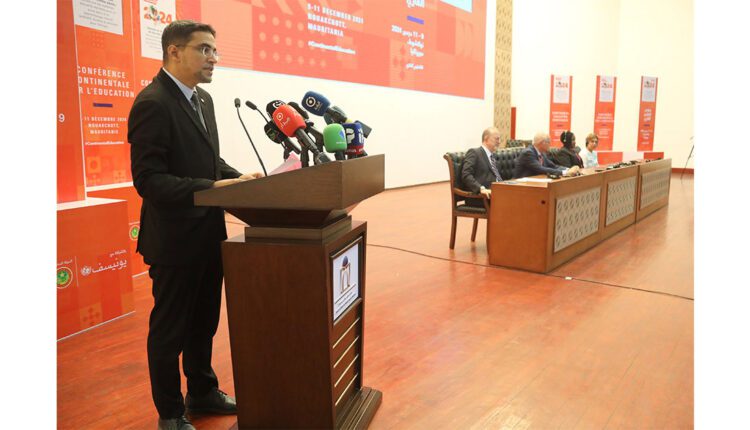
The Minister of Youth Empowerment, Employment, Sports and Civil Service, Mohamed Abdallahi Ould Louli, oversaw on Wednesday evening at the Palais des Congrès in Nouakchott the conclusion of the continental conference on education, youth and employment qualification, under the slogan “Africa is educated and qualified for the twenty-first century”.
The conference, held from December 9th to 11th, culminated in the “Nouakchott Declaration on Education”.
The Nouakchott Declaration called for compulsory and free education, giving priority to girls in the technical and vocational fields, and advocating for education for the period (2025-2034), to be the decade of education transformation in the African Union countries.
The Nouakchott Declaration called for empowering every child with his right to education, strengthening the status of teachers and making them capable of performing their mission, in addition to strengthening the teaching of scientific subjects to benefit from new technologies, modernizing the educational infrastructure in order to raise the quality of education, and enabling rural youth to access education, while harmonizing the content of education with the needs of the labor market.
In a speech on the occasion, the Minister of Youth Empowerment, Employment, Sports and Civil Service stressed that the conference was a unique opportunity for the participants to exchange experiences and ideas on ways to win the bet of the current stage, and to imagine ways to face the existing and expected challenges to ensure a comprehensive and quality modern education that responds to the aspirations of future generations in achieving a future based on good citizenship and the acquisition of noble values, knowledge and skills of the times.
He praised the pioneering ideas and creative and serious proposals of the conference and the perseverance to contribute constructively to shouldering the concerns of African countries and their legitimate ambition to provide quality, equitable and inclusive education for all school-age children and provide the reasons for inclusive lifelong learning.
On behalf of the Mauritanian government, he thanked all participants for their efforts in this regard, stressing Mauritania’s readiness to consolidate and develop cooperation relations in order to serve African countries and enable them to move at a steady and confident pace on the path of progress.
Ms. Nasi Clank, Minister of Education of the Republic of Malawi, highlighted that everyone came to play a role in educational policies in the countries of the African continent, where they shared the experiences of several countries that reviewed the status of their education.
She noted the need to create better education policies to harness the energies of their youth in industrial requirements, and to increase investment capacity and educational infrastructure.
She thanked the Mauritanian government, the African Union and UNICEF for organizing this meeting, which is of great importance to the countries of the continent.
For his part, Commissioner for Science, Technology and Innovation of the African Union Commission, Mohamed Ben El Husseini, said that the African region places many hopes on education, noting that the Nouakchott Declaration will strengthen and improve the situation of education in Africa.
For his part, Mr. Edouard Ted Chiba, Deputy Executive Director of the United Nations Children’s Fund (UNICEF), stressed that the presence of four heads of state from the African continent reflects their commitment and support and makes education a priority, praising the rich discussions on curricula, education programs and all related issues, as an urgent priority for African countries, adding that the start of the implementation of the Nouakchott Declaration will enable the development of education in the next decade.
The aim of the conference was to ensure that every child had the right to education.
It is noteworthy that the conference, organized by the Ministry of Education and Education System Reform, in partnership with the African Union Commission and the United Nations Children’s Fund (UNICEF), was attended by several presidents and more than 30 ministers, in addition to permanent representatives of 26 countries