

Nouakchott Summit:Final Communiqué
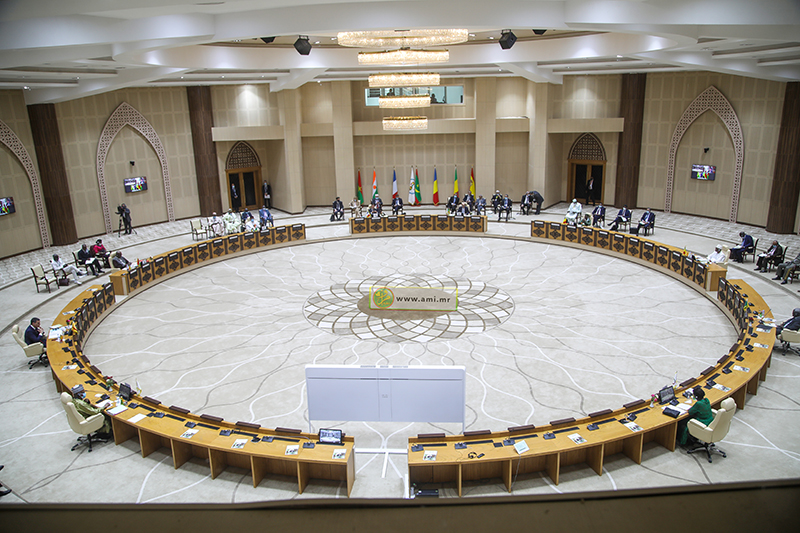
At the invitation of his Excellency the President of the Islamic Republic of Mauritania, Mohamed Cheikh El GHAZOUANI, President-in-Office of the G5 Sahel, the heads of the G-5 Sahel member states and the President of the Republic of France met today, 30 June 2020, in Nouakchott to evaluate the implementation of the road map agreed upon during the PAU summit (France) held on 13 January 2020.
The summit was attended by:
– H.E Emmanuel MACRON, President of France
– H.E. Idriss DEBY ITNO, President of Chad
– H.E Issoufou MAHAMADOU, Président of Niger ;
– H.E. Ibrahima Boubacar KEITA, President of Mali;
– H.E. Roch Marc Christian KABORE, President of Burkina Faso.
– H.E. Pedro SANCHEZ, Prime Minister of Spain;
In addition to:
– H.E. Moussa Faki MAHAMAT, Chairman of the African Union Commission;
– H.E. Madame Louise MUSHIKIWABO, General Secretary of La Francophonie
The summit also witnessed the participation, via videoconference and recorded video, of:
– H.E. Charles MICHEL, President of the European Council;
– H.E. Angela MERKEL, German Chancellor
– H.E. Giuseppe Conte, Prime Minister of Italy;
– H.E. Antonio GUTERRES, United Nations Secretary General
5. This Summit marks a new stage in the follow-up of the common commitments made in Pau. It is part of an international context marked by major developments, in particular the persistence of terrorist attacks in the Sahel and the deterioration of the security situation in Libya, which poses real risks for stability in the Sahel and in the sub-region. This stability is also put under considerable strain by the COVID-19 pandemic, of which the economic and social impact is already being cruelly felt.
6. Beyond its heavy human and health results, the pandemic seriously affects the economies of the already fragile G-5 Sahel countries, with a risk of serious contraction of the Gross Domestic Product (GDP) which can range, for certain States, from 7% to 8% in 2020. The physical organization of this Summit in such circumstances is evidence of resilience and perseverance in the face of this unprecedented crisis. While reaffirming their determination to mobilize all the means necessary to overcome this scourge, the Heads of State express their solidarity with the grieving families and wish all the patients a speedy recovery.
7. While thanking all the partners who have already demonstrated their support for the Response Plans drawn up by the G-5 Sahel countries, the G5 Sahel Heads of State seized this opportunity to renew their call to write off the external debt of the G-5 Sahel countries, as formulated in the ‘Nouakchott Declaration on the COVID-19 pandemic’,formulated at the end of the extraordinary session of the Summit of G-5 Sahel Heads of State on 27 April 2020.
8. Examining the implementation of the Pau Road Map in connection with the evolution of the situation in the G-5 Sahel area, the Heads of State commended the efforts made by all of the actors; both the Sahelian states and their international partners. They paid a vibrant tribute to the civilian and military victims of the ongoing conflicts in the Sahel. The G5 Sahel Heads of State recalled that allegations of abuses by elements of the defense and security forces will be investigated and, if the facts are proven, they will incur exemplary sanctions.
9. The Heads of State welcomed the official launch of the “Coalition for the Sahel” on 28 April, during a videoconference meeting that joined the European Union and the G-5 Sahel and the holding of the first ministerial meeting of this coalition on 12 June 2020. They saluted the strong participation of all the G-5 Sahel partners in this meeting, and called for the consolidation of this Coalition, and for determining its architecture and the tools for its governance, in close collaboration with the G-5 Sahel Executive Secretariat.
10. The fight against terrorism continues with determination and better overall coherence.
G-5 Sahel Heads of State welcomed the commitment of additional Barkhane Force personnel over the past six months and the operationalization of the Joint Command Mechanism facilitating coordination between the G-5 Sahel Joint Force and Barkhane Force. They welcomed the resumption of sustained operations in the Three Borders area, the successes achieved by national forces, the Joint Force and international forces. In addition, they welcomed the neutralization of the head of AQIM on 3 June 2020 in the Tessalit area by the Barkhane Forceand its allies.
The Heads of State once again praised the success of the lightning operation ‘Boma Anger’ in the Lake Chad area in April 2020 against the Boko Haram factions which impose another front on Chad and in Niger, also deserving the attention of the international community.
The Heads of State also welcome the adoption by ECOWAS of a 2020-2024 priority action plan to eradicate terrorism in the ECOWAS region, encourage its effective implementation and welcome consultations with stakeholders. At the same time, the Heads of State greatly appreciate, as part of this action plan, the provision of support to Mali, Burkina Faso and Niger, in order to participate in securing the three borders of the LIPTAKO Zone.
The Heads of State nevertheless noted the persistence of a second front in the Lake Chad area in Niger and in Nigeria and a strengthening of local terrorist capacities in these areas, calling into question the results obtained during the ‘Boma Anger’ operation. They also noted the spread of the terrorist threat to Côte d’Ivoire following the recent attack on the Ivorian Kafologarrison.
The Heads of State expressed concern over the spread of the terrorist threat in the subregion and stressed the urgency of collective and forceful action to eradicate it.
The Heads of State noted with satisfaction the progressive revitalization of the framework for exchange, analysis and coordinated use of information through the process of institutionalization of National Platforms for Cooperation in Security Matters (PCMS). In the same vein, they invited the G-5 Sahel Executive Secretariat to work, in cooperation with the departments concerned in the G-5 Sahel member countries, to operationalize the Intelligence Fusion Center (CFR) in Niamey.
11. The building of the military capacities of States continues and remains crucial.
The Heads of State praised the European Union’s commitment and decisive role in the areas of advice, training, equipment, and infrastructure. These efforts are valued and made consistent within the framework of the Partnership for Security and Stability in the Sahel (P3S).
While welcoming the commitment and contributions of other partners, notably the United States, the Heads of State stressed the need to continue and strengthen the equipment support for the Defense and Security Forces of the G-5 Sahel member states Sahelet for the Joint Force. They also encouraged the widening and diversification of support activities from all partners to all G-5 Sahel member countries, including training, according to each country’s needs and specificities.
Tout en saluant l’engagement et les apports des autres partenaires, notamment des Etats-Unis, les Chefs d’Etat ont insisté sur la nécessité de poursuivre et de renforcer l’appui en équipements des Forces de défense et de sécuritédes États membres du G5 Sahelet de la Force conjointe. Ils ont également encouragé l’élargissement et la diversification des activités de soutien de tous les partenaires à tous les pays membres du G5 Sahel, y compris en matière de formation, en fonction des besoins et spécificités de chacun.
12. The return of the State and administrations to fragile areas is under way.
The Heads of State took note of the progressive redeployment of the administration services and the return of some displaced persons to their places of origin, thanks to the security operations. They noted that more efforts need to be made, not only for the effective return of populations, but also for the implementation of development programs suspended or delayed due to the outbreak of the coronavirus pandemic.
They underlined the importance of launching, as soon as possible, initiatives at regional, national, and local level, in favor of inter-community dialogue, reconciliation and the treatment of substantive questions on the sharing of resources or land disputes.
The Heads of State support the European Union’s permanent and multifaceted commitment through internal security force capacity building missions (EUCAP) in partnership with United Nations agencies, particularly the United Nations Office on Drugs and Crime (UNODC) and the Office of the High Commissioner for Human Rights (OHCHR), and believe that this commitment must be strengthened for all of the G5 Sahel countries.
13. Resource mobilization for the development of the G5 Sahel space continues.
While welcoming the efforts made so far by certain partners, the Heads of State recall the importance of the Priority Investment Program (PIP) for the populations of the Sahel and for the fight against terrorism and invite the international community to release all the funds promised at the Nouakchott Summit on 6 December 2018.
The Heads of State also welcomed the establishment of an integrated territorial approach consistent with the Integrated Priority Action Framework (CAPI) of the G5 Sahel, adopted at the February 2020 Summit in Nouakchott, and call for its diligent implementation.
In addition, the Heads of State commended the new dynamic spurred by the holding of the General Assembly of the Sahel Alliance on 25 February 2020 in Nouakchott, and welcomed the continued implementation of the projects of the Program of Emergency Development (PDU) by the Sahel Alliance.
Aware that the crisis in the Sahel is also a development issue, the Heads of State welcomed the holding, on 16 June 2020, of the meeting of Ministers in charge of development of the member countries of the G5 Sahel which examined execution of the PIP. They instructed those ministers to speed up the implementation of development programs, in coordination with G5 Sahel partners.
14. While welcoming the positive dynamics initiated, the Heads of State highlighted the need to intensify the fight on all fronts of national and international forces against terrorist groups and called for the further implementation of the Pau Roadmap and the G5 Sahel Joint Force Action Plan.
In this regard, the Heads of State reiterated their commitment not to tolerate any violation of human rights, and to respect international humanitarian law. To this end, they undertook to strengthen the judicialization of the fields of operations, in particular by continuing to ramp up the provost component of the national armies and the Joint Force, and the adherence of all the defense and security forces to the Human Rights Compliance Framework.
15. The Heads of State of the G5 Sahel pleaded for an increased military commitment by the international community in the global fight against terrorism in the Sahel. They expressed their gratitude for the crucial support provided by France and the United States, as well as that of MINUSMA for the benefit of the G5 Sahel Joint Force. They welcomed the prospects of deploying the Takuba Force first soldiers in the summer of 2020, a brigade from Britain in support of MINUSMA in 2020, and a contingent of 3,000 men from the African Union. They also hailed the renewal and strengthening of MINUSMA’s mandate.
16. Aware that the action of the G5 Sahel Joint Force is part of a long-term perspective in the fight against terrorism in the Sahel, the G5 Sahel Heads of State welcomed the proposals made by the Secretary General of the United Nations for its reinforcement and reiterated their requests for a sustainable financing of the Force, as well as granting it a mandate under Chapter VII of the charter of the United Nations. In the meantime, they welcomed the logistical support provided by MINUSMA within the framework of a financing mechanism coordinated by the European Union and requested new contributions to support the action of the national and regional forces of the G5 Sahel so that ‘they acquire their autonomy and take ownership of the situation on the ground’.
17. The Heads of State reiterated their support for the implementation of the Agreement for Peace and Reconciliation in Mali, resulting from the Algiers Process. On the security side, they welcomed the resumption of the Disarmament Demobilization Reintegration process (DDR) and the return of the first units of the reconstituted Malian Armed Forces (FAMAR) to the North, which remains to be finalized in Kidal. Regarding the institutional and development aspects, they noted significant but insufficient progress, and called for the continuation of the efforts of the various parties.
The Heads of State also welcomed the ECOWAS initiative to send a ministerial mission to Mali to find a peaceful solution to the worrying situation in the country. They condemned all forms of violence and urged the parties to engage in dialogue. Furthermore, they encouraged ECOWAS to continue efforts to achieve the social appeasement essential for implementing reforms and fighting terrorism.
18. The Heads of State noted with satisfaction the positive dynamic of the G5 Sahel in the implementation of the development and security strategy (SDS) and the prospect of the outcome of the reform of the G-5 Sahel Executive Secretariat in 2020.
19. The Heads of State expressed their deepest gratitude to His Excellency Mohamed Cheikh El GHAZOUANI, President of the Islamic Republic of Mauritania, to the Government and people of Mauritania, for the generous hospitality, the authentically African welcome and the attention they received during their stay in Nouakchott. They also congratulated him on the important measures put in place to protect participants in this context of the COVID-19 pandemic.
20. The next Summit will be held in 2021 in a G5 Sahel country. The Sahel Coalition will be associated with it. The follow up of commitments will involve the Ministers in charge of development in addition to those of Foreign Affairs and Defense.
Done at Nouakchott, on 30 June 2020