

President of Republic Receives IMF Mission
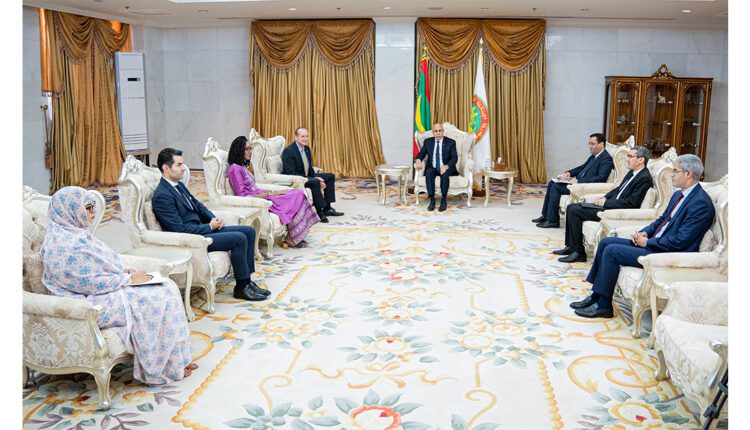
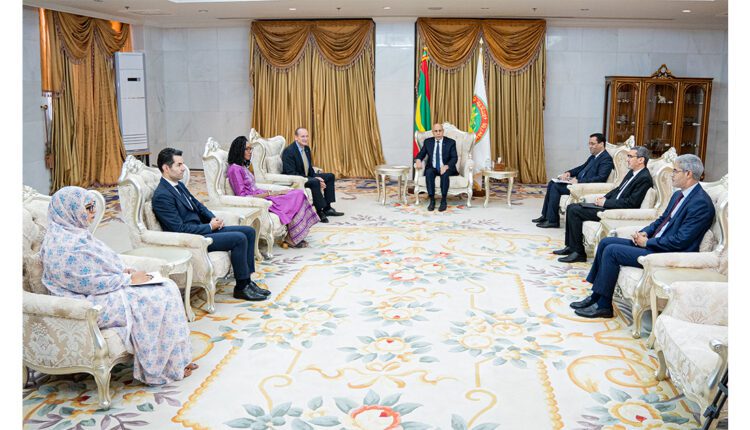 On 28 October, in Nouakchott, His Excellency Mohamed Ould Ghazouani, the President of the Republic, received a mission from the International Monetary Fund (IMF) led by Mr. Felix Fischer, the IMF Mission Chief for Mauritania.
The meeting focused on cooperation between Mauritania and the IMF and ways to strengthen and develop it in the interest of the economic development of our country.
Shortly after the meeting, Mr. Felix Fischer old the Mauritanian news agency that in 2023, economic growth should slow down to 4.8% compared to 6.4% in 2022, due to a return to normal in the activity of the extractive sector and the lagged impact of the tightening of monetary policy in 2022. Inflation, he said, is following its downward trend and should slow to 4.5% at the end of 2023 against 11% at the end of 2022 thanks to the fall in food and energy prices, budgetary consolidation, and the lagged impact of the tightening of monetary policy in 2022.
He affirmed that the non-extractive primary balance, including donations, should reduce to 3.8% of GDP against (7.5% in 2022) before adding that the current account deficit should reduce to 12.1% of GDP (compared to 16.6% at the end of 2022) and international reserves should stabilize around $1.9 billion (or 6.4 months of imports excluding extractives) in 2023.
“Economic perceptions remain uncertain and an escalation of geopolitical tensions could affect Mauritania by causing new shocks in terms of trade, as Mr. Fischer put it.
He noted that more frequent climate disasters could deteriorate infrastructure, arable land, and agricultural production, thus keeping food insecurity relatively high.
“Delays in the start of gas exploitation as well as unfavorable price fluctuations in commodity markets could reduce budget revenues, increase external financing needs, and worsen the debt profile in the medium term” as he indicated, before ensuring that the implementation of future phases of the GTA gas project would improve economic growth and the balance of payments. Mr. Fischer assured that in this context the economic and financial program of the authorities is on track and its execution has been satisfactory before emphasizing that all the performance criteria at the end of June 2023 have been achieved and the majority of the structural benchmarks from March 2023 to September 2023 were observed.
Among other things, a tax policy unit was established and an action plan based on the governance diagnosis was published on time. He revealed that the structural benchmarks on the submission to Parliament of the medium-term budgetary framework as well as the operationalization of the interbank exchange platform were reached late.
The IMF official finally thanked, on behalf of his team, the Mauritanian authorities and his other interlocutors for their warm welcome, the constructive discussions, and the excellent cooperation.