

Gambia Islamic Summit Concludes With Banjul Declaration
Banjul
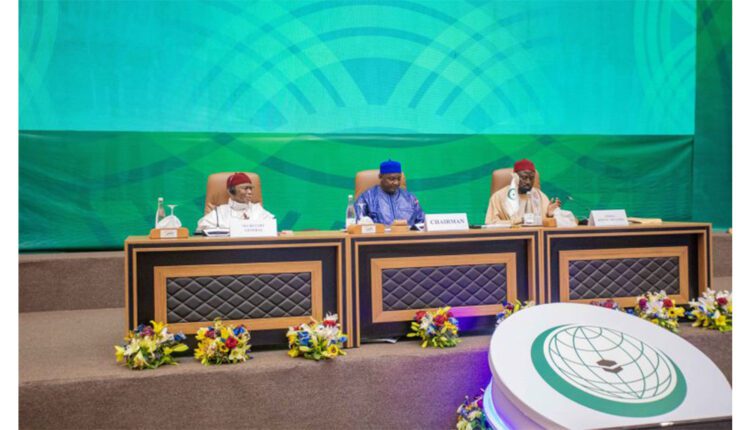
The Fifteenth Session of the Islamic Summit Conference concluded its work on Sunday (5 May 2024) in Banjul, Republic of The Gambia, and adopted the “Banjul Declaration”.
The Summit was held over two days (4-5 May 2024), in the presence of the Heads and Leaders of the OIC Member States.
In his speech at the conclusion of the Summit, Gambian President Adama Barrow, Chairman of the Islamic Summit said that the fifteenth session of the Summit represents a new beginning for The Gambia to promote peace, justice and continuous dialogue inside and outside the Islamic Ummah.
In the “Banjul Declaration” issued by the summit, the leaders and heads of state of the Organization of Islamic Cooperation affirmed their solidarity in confronting the humanitarian catastrophe in the Gaza Strip due to the continuous Israeli aggression for more than seven months without relentlessness or taking into account the most basic moral and humanitarian values, calling for an immediate and unconditional ceasefire of the comprehensive aggression against the Palestinian people in the Gaza Strip.
They called on the countries of the world to act to stop the crime of genocide committed by the occupation against the Palestinian people in the Gaza Strip, and to implement the precautionary measures ordered by the International Court of Justice, stressing the need to exert all efforts to accelerate the delivery of humanitarian aid, and to reject any attempts to displace the Palestinian people from their land.
The leaders also stressed the need to enable the Palestinian people to realize their legitimate national rights as recognized by the international community, including their recognition of the Palestinian state on the 1967 borders with Al-Quds Al-Sharif as its capital, and support for the State of Palestine’s full membership in the United Nations.
The leaders commended the solidarity of African peoples and governments with the struggle of the Palestinian people, specifically the OIC Member States, and their firm position to end the historic injustice inflicted on the Palestinian people.
They stressed the importance of resorting to dialogue and mediation in the settlement of disputes in order to provide an atmosphere free of tension among the countries of the Islamic Ummah, stressing the importance of strengthening preventive diplomacy in order to contribute effectively to peace, the protection of lives and resources and the realization of the hopes and aspirations of our peoples for sustainable development.
The leaders expressed their solidarity with Muslim communities and communities in a number of non-OIC countries suffering from persecution, injustice and aggression, reaffirming continued political, moral and diplomatic support for the people of Kashmir, and calling on the UN Security Council to take effective measures to implement its resolutions on Jammu and Kashmir to enable the people of Kashmir to exercise their inalienable right to self-determination through a referendum under the auspices of the United Nations.
They also expressed their deep concern at the increasing systematic persecution of Muslims and other minorities in India that has led to their political, economic and social marginalization, and urged the Government of India to take the necessary measures to protect their lives and property and prevent any similar acts in the future.
They commended the Islamic Republic of Pakistan, the Kingdom of Saudi Arabia, the Republic of Turkey, the Islamic Republic of Iran and other Member States for their pioneering efforts at the UN General Assembly to adopt the resolutions designating 15 March as the “World Day against Islamophobia” in 2022 and the “Measures to Combat Islamic Hatred” on 15 March 2024.
The leaders called on Member States and others to take all necessary measures, including legislative and policy measures, to combat religious intolerance, negative stereotyping, hatred and incitement to violence and violence against persons based on their religion or belief.
They affirmed their support for a peaceful, stable and prosperous Afghanistan, stressing the need to address the challenges faced by the Afghan people, such as humanitarian challenges, human rights, security and terrorism, narcotics and social challenges.
They stressed the importance of full respect for the human rights of all Afghans and the need to protect the fundamental rights of Afghan girls and women, in particular the right to education and work, and called for further engagement with the de facto authorities on these issues.
The leaders commended the Republic of The Gambia for its pioneering efforts at the level of the International Court of Justice on behalf of the Organization of Islamic Cooperation (OIC) to hold accountable those who committed genocide and atrocities against the Rohingya Muslims.
The leaders condemned in the strongest terms the repeated incidents of burning copies of the Holy Quran in a number of European countries, calling on the countries concerned and the international community to take comprehensive and necessary measures to prevent the recurrence of such acts and to address the alarming growth of Islamophobia.
The leaders commended the Kingdom of Saudi Arabia, under the wise leadership of the Custodian of the Two Holy Mosques, King Salman bin Abdulaziz Al Saud, and His Royal Highness Crown Prince Mohammed bin Salman bin Abdulaziz Al Saud, for their tireless and strong support and generous guidance to the OIC and the Islamic Ummah in general in order to achieve the global goals of peace, justice, security and sustainable development.
Besides the Banjul Declaration, the Islamic Summit also issued a comprehensive final communiqué on various political, economic, humanitarian, cultural, social and media issues and affairs of the OIC countries.
In its final communiqué, the Summit praised the outcomes of the international forum organized by the Union of News Agencies of the Organization of Islamic Cooperation (UNA) entitled “Media and its Role in Fueling Hatred and Violence: The Dangers of Disinformation and Bias” in Jeddah on November 26, 2023, in cooperation with the Muslim World League and with the participation of all official news agencies in the OIC Member States, and a number of international media and intellectual and religious institutions.
The Islamic Summit noted the special theme included in the forum on “Bias and Disinformation in the International Media: The Palestinian Question as a Model”, which sought to address the bias against the Palestinian cause in some Western media that prevents the violations of the Israeli occupation from being exposed and enabling the Palestinian people to obtain their rights.
The summit also issued an independent resolution on the “Question of Palestine and Al-Quds Al-Sharif”, in light of the dangerous and unprecedented developments in this issue due to the crimes of brutal Israeli military aggression against the Palestinian people, especially in the Gaza Strip.