

Minister of Agriculture Meets With CILSS Delegation
Normal
0
21
false
false
false
FR
X-NONE
AR-SA
/* Style Definitions */
table.MsoNormalTable
{mso-style-name:”Table Normal”;
mso-tstyle-rowband-size:0;
mso-tstyle-colband-size:0;
mso-style-noshow:yes;
mso-style-priority:99;
mso-style-parent:””;
mso-padding-alt:0in 5.4pt 0in 5.4pt;
mso-para-margin-top:0in;
mso-para-margin-right:0in;
mso-para-margin-bottom:8.0pt;
mso-para-margin-left:0in;
line-height:107%;
mso-pagination:widow-orphan;
font-size:11.0pt;
font-family:”Calibri”,sans-serif;
mso-ascii-font-family:Calibri;
mso-ascii-theme-font:minor-latin;
mso-hansi-font-family:Calibri;
mso-hansi-theme-font:minor-latin;
mso-bidi-font-family:Arial;
mso-bidi-theme-font:minor-bidi;
mso-fareast-language:EN-US;}
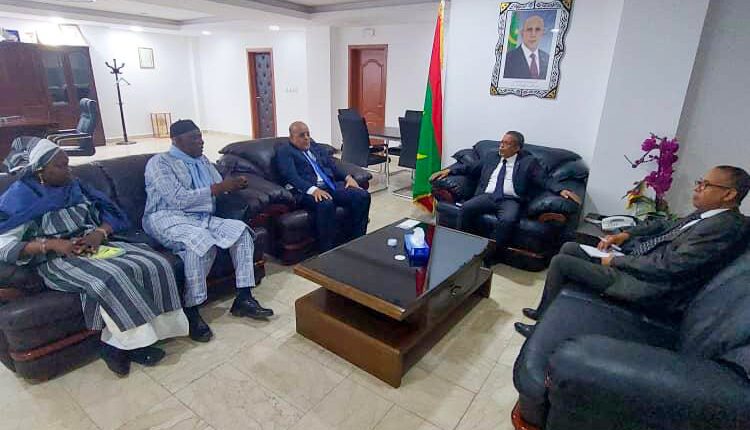
The development of cooperation between Mauritania and the Inter-State Committee for the Fight against the Effects of Drought in the Sahel (CILSS), particularly in the field of agricultural development, was on the agenda of the meeting that joined the Minister of Agriculture, Mr. Yahya Ould Ahmed EL Waqf, with a CILSS delegation led by Mr. Mohamed ABdellahi Babah, the Director General of the Sahel Institute.
The meeting reviewed the ministry’s strategy in the field of agricultural mechanization for the semi-rainfed sector to activate its pivotal role in the supply of agricultural production, particularly in rainfed areas.