

COP27: President of Republic Affirms Mauritania’s Determination To Reduce Carbon Emissions
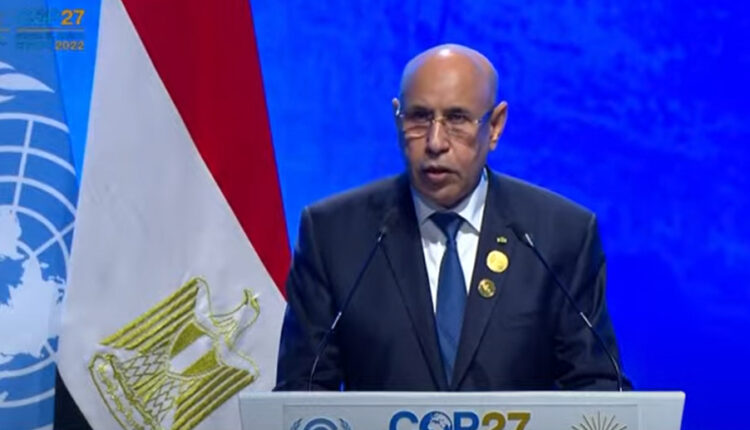
On 7 November, in Sharm El Sheikh, His Excellency Mr. Mohamed Ould Cheikh El Ghazouani, the President of the Republic, affirmed Mauritania’s determination to reduce carbon emissions by 11% and to work to increase the level of renewable energies, in all of its energy consumption to reach 50% by 2030.
In a speech before the Climate Summit (COP27), His Excellency added that these efforts would be reinforced by a large-scale program, being launched, aimed at the development of green hydrogen, which will provide our country with an alternative and sustainable source of clean energy, calling on all of Mauritania’s technical and financial partners to participate in the execution of this project.
Here is the full translation of this important speech:
“In the Name of Allah, the Merciful, the Beneficent;
Prayers and peace be upon his messenger;
Mr. President,
Majesties,
Excellencies and Highnesses,
Ladies and gentlemen,
I would like, first of all, to express my deep gratitude for the kind invitation I received from my dear brother, His Excellency Abdel Fattah al-Sissi, the President of the sisterly Arab Republic of Egypt, and for hosting, in the city of Sharm El Sheikh, the United Nations Conference on Climate Change, known as COP 27, as well as for the perfect organization of this summit, thanking His Excellency, the government and the people of Egypt for the warm welcome and the hospitality which we received.
I also express my high consideration to Mr. Antonio Guterres, the UN Secretary General, and all his collaborators for the efforts made to encourage and coordinate all the actions carried out to face environmental challenges.
Ladies and Gentlemen,
No need today for speeches to diagnose the alarming ecological situation of our planet, its destructive consequences on the social and economic level, and what it constitutes as a permanent threat to the future of the earth and human life in general, all things observable in various aspects of life. What matters today, and which bears the seal of extreme urgency, is the taking of the necessary measures to stop this deterioration of the environment causing multidimensional negative consequences. And among the most important strategies consensual today to deal with climate degradation is the construction of development systems less dependent on carbon, by gradually moving toward clean and alternative energies to achieve a sustainable ecological transition.
The balance of the ecological burden indeed showed the discrepancies. At a time when developing countries contribute little to the emissions implicated in the greenhouse effect, they are, unfortunately, the most affected by what this greenhouse effect generates, such as climate change. These countries are, despite everything, making significant efforts to reduce these emissions and deal with their unfortunate consequences on the environment.
It is within this framework that we have decided, in the Islamic Republic of Mauritania, as it appears in our proposal made in Glasgow, to contribute significantly to the resolution of the international problem of the environment by reducing carbon emissions by 11 % and by increasing the level of renewable energies, in all of its energy consumption, to reach 50% by 2030.
Our efforts in this direction will be reinforced by a large-scale program, currently being launched, aimed at the development of green hydrogen, likely to provide our country with an alternative and sustainable source of clean energy. To this end, I call on all of Mauritania’s technical and financial partners to participate in the execution of this project. In addition to our efforts to promote clean energies, which today cover 40% of all energies used, our country is relentlessly pursuing the fight against desertification within the framework of the Great Green Wall Initiative and the Interstate Committee for Drought Control in the Sahel (CILSS).
I take this opportunity to launch an appeal for more help to the African climate commissions for what they bring as an appreciable contribution to the achievement of Agenda 2063, as they are a source of hope, particularly the climate commission for the Sahel and its climate fund, in managing and adapting to the effects of climate change.
Following the above, our country is making great efforts to build the capacities of our citizens to show greater resilience in the face of the negative effects of climate change, by fighting against poverty and precariousness, and by working to promote the rural sector and improving access to basic services.
Ladies and Gentlemen,
Nonchalance in the face of what the world is experiencing as large-scale climate challenges risks costing humanity dearly, and it is our collective responsibility to engage in a new dynamic combining all individual and collective efforts to achieve the desired ecological transition reflecting our solidarity, with each other, to face the difficult social and economic consequences caused by climate change.
While renewing the appeal launched to all the partners for an increase in aid to developing countries, and to facilitate access to financing after their adoption, I wish great success to the work of this conference on the climate, congratulating our brothers in the United Arab Emirates for the organization of the next COP28.
Thank you.