

Government spokesperson: The Prime Minister’s statement covers the five key points of the President’s election program ‘My Ambition for the Nation’
Nouakchott
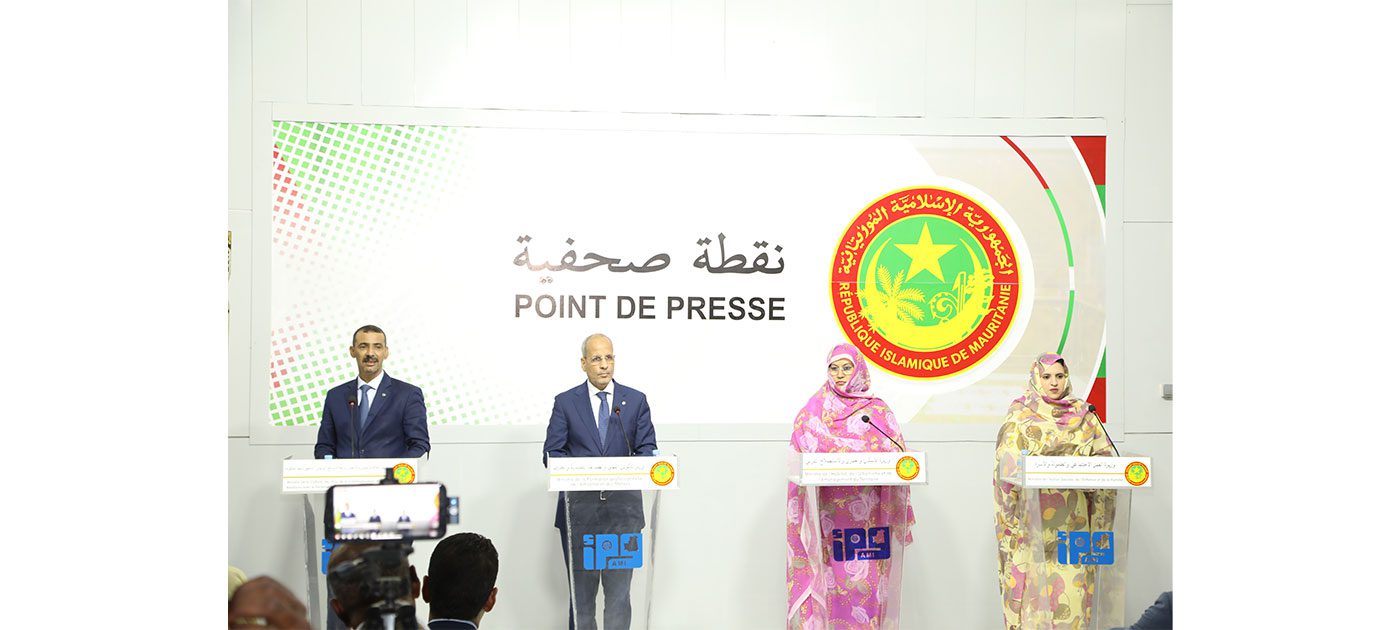
The Minister of Culture, Arts, Communication, and Relations with Parliament, government spokesperson Mr. El Houssein Ould Medou, stated that the Prime Minister Mr. Mokhtar Ould Djay presented during the Cabinet meeting today, Wednesday, a statement outlining the broad lines of the government’s achievements in 2025 and the prospects for work in 2026.
He explained, during his comments on the results of the Cabinet meeting this evening at the press hall of the Mauritanian News Agency headquarters in Nouakchott, accompanied by the Honorable Ministers of Vocational Training and Traditional Crafts, Housing, Urban Development and Land Reclamation, and Social Affairs, Childhood and Family, that this statement covered the five main pillars of the electoral program of His Excellency the President of the Republic, Mr. Mohamed Ould Cheikh ELGhazouani, “My Ambition for the Nation.”
The government spokesperson denied that the sector was aware of what was being circulated regarding the obstruction of the Youth Summit, confirming that the ministry had not received any matter in this regard, emphasizing that everything related to youth in this era will not be obstructed except for objective reasons and valid circumstances.
In response to a question about the sit-in by education service providers,the Minister affirmed that protesting is a legitimate right and no employee will be dismissed because of it, while at the same time highlighting that what could lead to dismissal is repeated absenteeism from work.
He clarified, in response to a question about renting houses for government offices, that His Excellency the President of the Republic, since assuming office, has given instructions to speed up work in order to complete the construction of all government offices, noting that only three ministries still occupy rented premises and will soon move to their official headquarters.
For his part, the Minister of Vocational Training and Traditional and Handicraft Industry, Mr. Mohamed Maâl-Ainine Ould Eyyih, explained, in his commentary on the draft decree establishing and organizing a public institution of an administrative nature called the National Agency for the Promotion of Handicrafts, that this decree aims to implement the national policy in the field of handicrafts and to establish its organizational and institutional framework.
He added that the decree also provides for the dissolution of the National Program for the Promotion of Traditional Industry, whereby the agency will replace the program in all rights and obligations, and all its movable and immovable properties will be transferred to it.
He pointed out that the text also specifies the methods for managing and operating the Traditional Industry Support Fund, as it is an integral part of the agency.
In response to a question about the situation of vocational training teachers, the Minister clarified that the teachers are divided into two categories; one category is subject to a system similar to that of secondary education and automatically benefits from the same privileges, and the other category is bound by employment contracts with vocational training institutions, which enjoy the status of public institutions with an administrative nature and a certain degree of autonomy.
He confirmed that the teacher is given top priority in the sector, emphasizing that the ministry is working to improve the conditions of vocational training teachers.
For her part, Her Excellency the Minister of Housing, Urban Planning, and Land Reclamation, Mrs. Naha bint Hamdi Ould Mouknass, explained in her comment on the draft decree concerning the establishment of a new industrial zone that this project represents a pivotal step in the framework of implementing the national manufacturing strategy towards 2030.
She added that the government has committed, in this context, to doubling the number of processing industrial units, especially in sectors where the country has competitive advantages, including agriculture, livestock, fishing, and renewable energy.
She confirmed that this commitment would have been impossible to achieve if reliance continued on the current industrial area in Dar Al-Naeem or the old industrial area in the port, due to their non-compliance with environmental standards, limited space, and lack of suitable infrastructure.
The Minister explained that the activities permitted within the new industrial zone include production and manufacturing industries, logistics and transportation, industrial services, energy and environmental sectors, in addition to technology and innovation fields.
She added that establishing this zone will provide a suitable framework to host modern and competitive industrial activities, encourage local processing of national raw materials, create sustainable job opportunities, enhance value-added exports, and improve the business climate through better organization of the industrial sector.
In response to a question about the draft decree, Her Excellency the Minister explained that it stipulates the creation of a buffer zone around the industrial area, with a minimum width of 500 meters, within which no housing may be constructed, in order to avoid the issues witnessed in some previous industrial areas where industrial activities and residential neighborhoods overlapped, resulting in industrial emissions and frequent complaints from residents.
She added that, under this decree, the construction of administrative offices or residences is prohibited within the industrial zone, which is exclusively designated for industrial activities, noting that the existing factories in Dar Al-Naeem and the old industrial area at the port are not required to move to the new industrial zone. However, this move remains an available option for them, given the organizational, environmental advantages and suitable infrastructure offered by the new location.
Regarding the fate of the houses surrounding the resort project and Riyadh Lake, Her Excellency the Minister clarified that the affected residents will be supported. The houses located within the project’s impact zone have been identified, and procedures for compensation and relocation have begun, with families being moved to areas with better planning and services.
She pointed out that the progress in restructuring the city of Kiffa since 2023 has reached about 40%, and this process will continue as planned, noting that it requires coordination and joint intervention among several sectors, including the Ministries of Housing, Real Estate, Finance, and Interior, with the next stages of the process set to commence in the near future.
In turn, Her Excellency the Minister of Social Work, Childhood, and Family, Mrs. Savia bint N’taha, stated that she was honored today to brief the Council of Ministers on the results of the nighttime field campaign to protect children from street risks. She pointed out that this campaign falls within the framework of the preventive approach adopted by the state to support the family and protect childhood, in line with the directives of His Excellency the President of the Republic, Mr. Mohamed Ould Cheikh El Ghazouani, which emphasize that the family represents the natural and fundamental framework for protecting the child.
Her Excellency the Minister confirmed that this campaign is based on a comprehensive social and educational approach, focusing on raising awareness about the dangers of the streets, early preventive intervention, and providing temporary shelter when necessary, while working to return children to their family environment whenever the appropriate conditions are met.
She added that the government is committed to implementing these interventions with full respect for the rights and dignity of the child, in accordance with national legislation and relevant international obligations, adopting the principle of the best interests of the child, and avoiding any coercive or security-based approach in addressing this phenomenon.
The Minister indicated that the initial data showed a positive response from families, alongside what reality reveals about the complexity of the phenomenon and the intertwining of its causes, which confirms that the protection of children is a collective responsibility that requires effective coordination between the various concerned sectors, families, and civil society.
She explained that the strategic goal is to move from a temporary campaign to a permanent national program to protect children, based on prevention and sustainable family integration, which enhances social cohesion and protects the future of children.
In response to a question about the nature of this campaign, its usefulness, and the benefits it brings to children the Minister affirmed that the primary goal of this field campaign is to protect the child first and foremost, and to ensure their presence in the most suitable environment for them, which is primarily the family.
She added that this campaign came in response to an in-depth and long-term field study carried out by the social work sector, which included monitoring the places where children are present on the streets, diagnosing their situations, distinguishing between children from the same areas and those coming from other states, in addition to analyzing the social, familial, and economic reasons behind this phenomenon, which enabled the preparation of a plan based on scientific and realistic foundations.
As I explained, the field results showed that the majority of the targeted children have families and live with them, and that the issue is not primarily related to children who are separated from their families, but rather to children who study and live with their families, yet spend time on the streets, especially during nighttime, which exposes them to serious risks.
It indicated that the choice of nighttime for launching the campaign came in response to the nature of the phenomenon, as some children are present on the streets without the accompaniment of their guardians or adequate care, which exposes them to various forms of danger, including exploitation, which compromises the child’s safety and dignity, as well as putting their life at risk.
She concluded by emphasizing that the ultimate goal is to transform these efforts from a temporary campaign into a permanent national program to protect children, one based on prevention and continuity, ensuring long-term protection of childhood.