

Market Gardening: Qualitative Successes Moving Towards Self-Sufficiency
Rosso
In recent years, the agricultural sector has undergone significant transformations, following the attention given to it by the President of the Republic, His Excellency Mr. Mohamed Ould Cheikh El Ghazouani, who, in his speeches and directives, emphasizes that ‘achieving food self-sufficiency is a matter of national sovereignty and security.’
In accordance with this strategic direction, the government has engaged in ambitious strategies and programs to achieve self-sufficiency in the most consumed foodstuffs and to reach the country’s level of food sovereignty.
The 2025-2026 vegetable farming campaign, which will be launched by the President of the Republic on Wednesday from Rosso (Trarza), is part of this dynamic, aimed at consolidating the achievements made in recent years in terms of increasing agricultural production, cultivated areas, improving productivity, modernizing irrigation, and involving young people.
According to data from the Ministry of Agriculture and Food Sovereignty, the total area planned for cultivation in the vegetable sector this season is estimated at 12,000 hectares, with an expected gross production of 240,000 tons, representing a self-sufficiency rate of 84% in the most consumed vegetables, compared to 48% during the last 2024-2025 campaign.
According to the same source, the area dedicated to vegetable cultivation jumped from 2,094 hectares in 2019 to 8,935 hectares during the 2024-2025 season, while vegetable production experienced a steady increase over the past six years, rising from 31,410 tons in 2019 to 134,025 tons during the 2024-2025 season, an increase of 426%, which represents a qualitative leap reflecting the strong political will to achieve food sovereignty.
Market gardening is mainly concentrated in the Aftout area (Keur Macène, Rosso, N’tékane, and R’kiz) in the Trarza region, Dar El Barka in Brakna, and Foum Legleita in the Gorgol region, with a growing demand for market gardening throughout the national territory in the form of women’s cooperatives or family gardens. There are more than 30 varieties of vegetables and fruits.
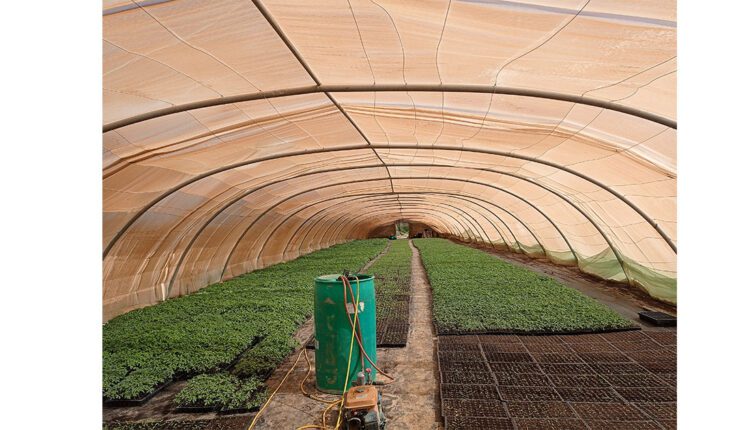
To ensure the success of this campaign, a number of measures have been taken: 800 tons of potatoes, 7,920 kg of vegetable seeds, 70 kilometers of fences to protect market gardens from stray animals, 35 greenhouses, a set of solar and diesel motor pumps, the rehabilitation and equipping of 40 model farms.
Two cold storage rooms for preserving vegetables, one with a capacity of 2,400 tons and the other 1,000 tons, are under construction, while a complex with an exceptional capacity is being built at kilometer 18 of the Nouakchott-Rosso road.
Regarding the prospects on which the sector will focus to address the challenges of food sovereignty based on agricultural products, the emphasis will be on the development of promising hubs through the implementation of significant projects, notably in the irrigated sector, the development of 220 hectares for the expansion of the Mbouri farm for the integration of unemployed graduates, 8,043 hectares in the Sokam plain, 3,000 hectares between Rosso and Boki for youth integration, and the rehabilitation and expansion of the Boki model farm.
The construction of two canals in Brakna and Gorgol, the development of a master plan for the bank of the Senegal River, the construction of a 3-hectare vegetable market in Nouakchott, the creation of an agricultural hub in Tiguent, and a study for the opening of three agricultural input sales centers in R’kiz and Keur Macène in Trarza and Guerrou in Assaba will also be considered.
In an interview with AMI, the Director General of the National Rural Development Company (Sonader), Mr. Hamada Ould Didi, indicated that due to global food crises, the State has focused its efforts on creating a national production space through the reclamation of numerous agricultural areas and the establishment of equipment for managing river and rainwater.
He specified that this strategic approach, which continues to this day, has enabled the revival of several vital sectors, particularly the vegetable-growing sector, which has become a destination for domestic private investment, requiring the implementation of technical procedures to ensure the organization of the sector and producers within economically advantageous groups.
He noted that, in accordance with the vision of the President of the Republic, His Excellency Mr. Mohamed Ould Cheikh El Ghazouani, to harness our natural resources, Sonader has established partnerships with a number of private investors through the creation of three economic interest hubs, one of which is in the Aftout Sahili and the other two on the riverbank east of Trarza. These three hubs will serve to organize producers in order to facilitate access to public services and direct communication with the State on issues related to agricultural development, in addition to organizing production, marketing, and regular supply to the national market, particularly during peak production periods, which has allowed meeting 40% of the national market’s vegetable needs.
Mr. Hamada Ould Didi stated that the measures taken by the State, namely the removal of customs duties on agricultural equipment and the reduction of customs duties on agricultural inputs to 3.5%, have allowed greater involvement of the private sector and stimulated private investors in the field, which has enabled the achievement of self-sufficiency in certain vegetable products and the export of surplus, as 100,000 tons of Mauritanian watermelons have been exported to European and African markets.
Dans le domaine de l’agro-industrialisation, le directeur général de la Sonader a confirmé que des plans sont en cours pour établir un pôle agricole (ville agro-industrielle) qui se concentrera sur les agro-industries, le stockage, la réfrigération et la logistique, ce qui permettra, dit-il, d’augmenter la valeur ajoutée du produit et d’encourager les exportations.
For his part, the President of the National Union of Horticulture Professionals, Mr. Moulay Ammar Ould Moulay Idriss, stated that the Mauritanian watermelon ranked first among Mauritanian agricultural exports in 2023 and broke records in terms of quantities and financial revenues, highlighting the importance of this product in foreign markets.
He indicated that the total Mauritanian watermelon exports in 2023 are estimated at 400,000 tons, with revenues reaching 5.5 billion ouguiya, which, according to him, demonstrates the ever-growing economic importance of this sector for farmers and exporters.
Mr. Moulay Ammar Ould Moulay Idriss emphasized that the European markets importing this product are Spain (140,000 tons), France (100,000 tons), and Italy (60,000 tons), in addition to exporting about 100,000 tons to African countries.
He explained that Mauritanian watermelons are characterized by their early ripening compared to their competitors from the northern Mediterranean coast, and that they have a concentrated sweet taste and a strong rind that makes them easy to transport over long distances.