

Ministry of Interior: Human Rights Watch report on the National Measures Taken Regarding Irregular Migrants lacks Objectivity and Credibility.
Nouackchott
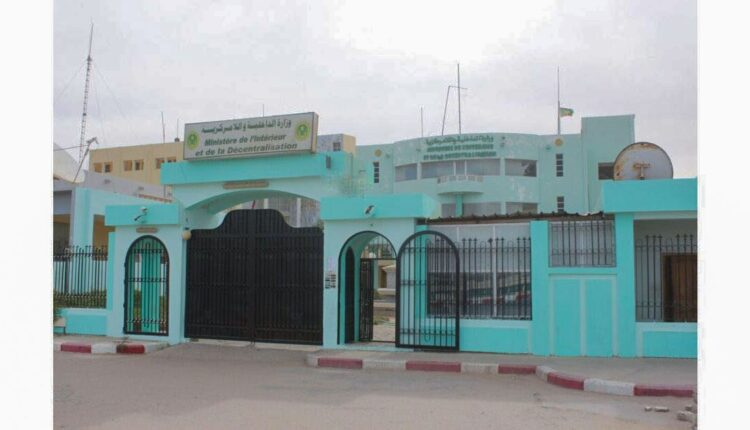
The Ministry of Interior, Decentralization, and Local Development confirmed in a statement issued today, Friday (August 29, 2025), that the latest report from Human Rights Watch regarding the national measures taken concerning irregular migrants lacks objectivity and credibility, and contradicts tangible ground realities.
The ministry also confirmed that Mauritania applies the legal and regulatory framework related to combating irregular migration, in line with the spirit of laws and international agreements related to human rights and the protection of migrants.Below is the text of the Ministry of Interior’s statement:
The Ministry of Interior, Decentralization Promotion, and Local Development expresses its deep regret regarding the inaccurate claims and allegations contained in the recent report issued by Human Rights Watch concerning the national measures taken. This report lacks the principles of objective and transparent investigation that such organizations should adhere to.
The ministry draws the attention of national and international public opinion to the fact that Mauritania is implementing the legal and regulatory framework related to combating irregular migration, in accordance with the spirit of the relevant laws and international agreements on human rights and the protection of migrants, by doing the following
:- Opening five temporary reception and accommodation centers for irregular migrants in the regions of Nouakchott and Nouadhibou
:- A center in the Arafat district (southern Nouakchott)
– A center in Dar Naim (northern Nouakchott)
– A center in Sebkha (western Nouakchott)- A center in Nouadhibou- A center specifically for women in southern Nouakchott.
And the establishment of two new centers specifically for immigrants arriving by sea, the first in Nouadhibou and the second in Nouakchott, is scheduled to be received and operational by the end of September 2025. These centers are overseen by teams from the National Agency for the Registration of the Population and Secure Documents, and the National Office for the Fight Against Irregular Migration and Human Trafficking, through new digital programs (Crossing, Homes), to ensure the verification of foreign identities and prevent the deportation of anyone in a legal situation.
These centers have been equipped with the necessary facilities, including drinking water, electricity, health points with medical staff and medicines, ambulances, supplies and means of living, new air-conditioned buses, in addition to security units to accompany to the border points.
In order to ensure transparency and openness, these centers were opened for visits by foreign ministers, ambassadors, consuls, and leaders of communities from sister countries, all of whom expressed their satisfaction with what they witnessed. National bodies such as the National Human Rights Committee, the National Observatory for Women and Girls, and the National Committee Against Torture also made similar visits and expressed their satisfaction with the respect for human rights and the legal management of the various stages of the process.
None of the foreign individuals concerned have proven that they were in a legal situation or that they were subjected to torture, harassment, or humiliation by the Mauritanian authorities, nor did any of them claim to have been deprived of their belongings upon departure. Records have been opened in each center, which the individuals sign to confirm that they received all their rights and were not subjected to any humiliation or mistreatment before being deported to their country.As part of national and international efforts to combat irregular migration associated with human trafficking, the following has been achieved:
-Dismantling smuggling and human trafficking networks and referring the perpetrators to justice,
– thwarting hundreds of attempts at irregular migration,
– arresting dozens of individuals for attempting to travel with forged or borrowed identities, and rescuing several thousand irregular migrants from friendly and brotherly countries who were at risk of death due to poor traveling conditions at sea, in addition to burying around nine hundred bodies washed ashore.
In this context, the prominent role of the Coast Guard is recorded as they rescued and sheltered these migrants when their boats malfunctioned. The last incident occurred on the morning of August 27, 2025, near the Emhijrat center, where dozens of migrants were rescued and dozens of bodies were recovered. Search operations are still ongoing today for the remaining victims.Moreover, Mauritania is the only country in the region that has opened refugee shelters since 1991, with the Ambarah camp on the border with Mali currently hosting one hundred and fifty-three thousand Malian refugees, considering the prevailing humanitarian conditions in the region. It is noteworthy that the total number of refugees in the entire region has reached approximately three hundred thousand refugees.
Mauritania reiterates that combating irregular migration represents a shared global challenge that requires international cooperation based on justice and mutual respect for the sovereignty of states. The measures taken fall within this framework and aim to protect all parties and ensure safe and orderly migration, in complete harmony with the principles claimed by Human Rights Watch to defend. It would have been more appropriate and fair for all relevant organizations and bodies, especially Human Rights Watch, to acknowledge the significant efforts made by Mauritania, which these entities are always aware of, to confront waves of irregular migration and human trafficking, in a context marked by the closure of traditional routes in North Africa and the Mediterranean, and by our country’s transformation into a transit point for the flow of migrants from Africa, Asia, and Latin America towards the unknown.
Mauritania remains open to any official entity wishing to understand the legal procedures adopted in the management of irregular migration, in respect of its legal and ethical framework, as is the case in other countries around the world.Furthermore, it is worth noting that the responses provided by the government on July 16, 2025, in reply to the organization’s letter dated July 1, 2025, should be taken into account.In conclusion, Mauritania reaffirms its steadfast commitment to human rights and constructive cooperation with its partners, within a framework of mutual respect, while firmly rejecting any allegations or reports that lack objectivity and credibility and contradict documented field realities.