

Minister of Culture speaks to (MNA) about the significant transformation taking place in the sector and its promising prospects.
Nouakchott
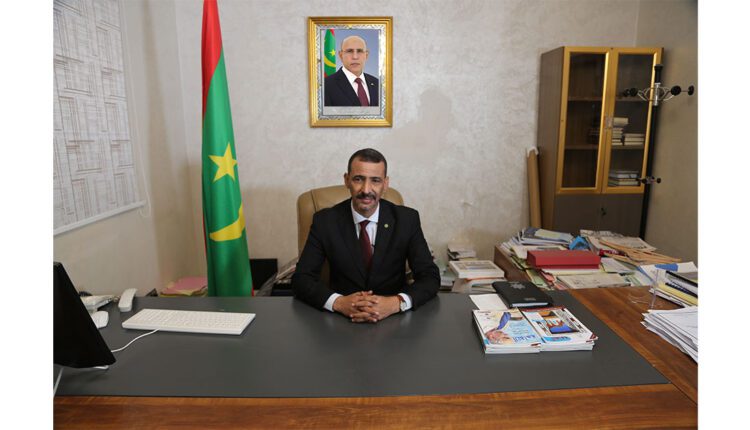
The Minister of Culture, Arts, Communications, and Relations with Parliament, the government spokesman, Mr. El-Hussein Ould Medou, stated that the sector’s participation in evaluating the achievements made during the previous and current term comes in response to the directives of His Excellency the President of the Republic, Mr. Mohamed Ould Cheikh El Ghazouani, and is based on his programs “My Commitments” and “My Ambition for the Nation.”
The Minister of Culture speaks to (MNA) about the significant transformation taking place in the sector and its promising prospects.
The Minister of Culture, Arts, Communications, and Relations with Parliament, the government spokesman, Mr. El-Hussein Ould Medou, stated that the sector’s participation in evaluating the achievements made during the previous and current term comes in response to the directives of His Excellency the President of the Republic, Mr. Mohamed Ould Cheikh El Ghazouani, and is based on his programs “My Commitments” and “My Ambition for the Nation.”
Heclarified in a meeting with the Mauritanian News Agency that the accountability process requires focusing on the key areas that are priorities for the sector, foremost of which are culture, arts, communication, and relations with Parliament.
He emphasized that the sector gives special importance to the cultural dimension, based on its role in enhancing cultural identity and valuing the national heritage, highlighting that the Heritage Cities Festival has seen development in its content and organization, where it was supported by a developmental component that benefited the four ancient cities (Chinguitti, Ouadane, Oualata, and Tichit) with funding amounting to nearly 3 to 4 billion old ouguiyas annually.
He added that the ‘Diowol’ festival was created as a new station to celebrate the cultural heritage, and that 24 historical works were published concurrently with the version of the Chinguitti festival, which discussed the history of ancient cities and their cultural, religious, and commercial relations with their surroundings.
The Minister of Culture, Arts, Communication, and Relations with Parliament stated that international recognition of Mauritanian heritage includes the inclusion of “the Mahadra,” the epic of “Samba Gueladio,” and “the Soninke language” in UNESCO’s intangible cultural heritage, in addition to registering 15 elements within the tangible and intangible heritage in the organization of ISESCO and ALECSO, the latest of which is the site of “Azouki.”
He pointed out that archaeological research operations have resumed for the first time in decades, starting with the Azuki site, with a plan to expand them to include historical cities and ancient kingdoms such as Aoudaghost and Koumbi Saleh.
He pointed out that preparations are underway for the “cultural sovereignty” that will embody contents establishing a national policy that enhances Mauritania’s cultural uniqueness. Work is also continuing on the establishment of the “cultural city” in Nouakchott, which will include a cultural palace, theaters, a heritage village, museums, and national monuments, as part of the urgent program for the development of the city of Nouakchott.
He pointed out that archaeological research operations have resumed for the first time in decades, starting with the Azuki site, with a plan to expand them to include historical cities and ancient kingdoms such as Aoudaghost and Koumbi Saleh.
He pointed out that preparations are underway for the “cultural sovereignty” that will embody contents establishing a national policy that enhances Mauritania’s cultural uniqueness. Work is also continuing on the establishment of the “cultural city” in Nouakchott, which will include a cultural palace, theaters, a heritage village, museums, and national monuments, as part of the urgent program for the development of the city of Nouakchott.
In the field of cultural diplomacy, the Minister of Culture, Arts, Communication, and Parliamentary Relations confirmed the launch of a project to collect the scattered elements of Mauritanian heritage around the world, pointing out the recovery of the painting “Theodore Gericault” about Mauritania, and working to recover the library of the scholar Mohamed Mahmoud Ould Talameed from Egypt. An open exhibition about Mauritania will also be organized at the Arab World Institute in Paris next January.
His Excellency referred to two new projects: the establishment of a heritage city in Wadan, and a heritage complex for the fighter Bakr Ben Amer in the Wilaya of Tauant, in addition to creating two cultural venues in Adrar and Taguant.
In the field of arts,the Minister of Culture stated that the sector has undergone a qualitative transformation since the establishment of the Institute of Fine Arts, the creation of the President’s Award for the Arts, and the ministry’s expansion to include arts in its name. Additionally, the first music festival was organized, and the ministry is working on organizing a second edition of it in the Niamey region, as well as the establishment of a national choir and orchestra, which will be integrated into the Institute of Fine Arts.
He clarified that a special law for art professionals has been approved, and the Supreme Council for them is now being appointed. In addition, consensual elections for musicians have been organized, as a step to address the structural issues that hinder government work in this field.
In the field of communication, the Minister of Culture, Arts, Communication, and Relations with Parliament confirmed that Mauritania has made remarkable progress in expanding freedoms and improving the conditions of journalists, as the reforms began under the direction of the President of the Republic to form the Supreme Committee for Reforming the Media Sector, which presented its recommendations to the government and were adopted.
He added that the laws governing the media have been reviewed, including the law on the Supreme Authority for Press and Audiovisual, the Professional Press Law, the Press Card Law, the Public Support Law for the Press, the Advertising Law, and the Audiovisual Law.
He stated that the salaries of workers in public media have been doubled, and the status of collaborators has been regularized by formalizing more than 1,850 workers, which has resolved an issue that lasted for decades.
As part of the infrastructure improvement, the honorable minister revealed a project to create a media city that includes a press house, a journalists’ training center, and an audio-visual production center, covering an area of 9 hectares near the ‘Al-Mourabitoun’ conference palace.
He highlighted that these achievements have contributed to Mauritania attaining respectable positions globally, ranking 33rd in press freedom, 10th worldwide in journalist safety, and 1st in the Arab world in the 2025 ranking.He confirmed that work is underway to form a press card committee, which will help enhance professionalism and regulate access to the journalistic field.
At the conclusion of his presentation, the Minister of Culture, Arts, Communication, and Relations with Parliament emphasized that the government’s relations with Parliament have witnessed significant development, embodied in the respect for the principle of separation of powers, and the enhancement of the oversight and legislative role of the deputies, through promoting fluidity, responding to oral questions, establishing parliamentary committees, and activating parliamentary diplomacy.
He pointed out that the amendments to the electoral laws contributed to increasing youth representation in Parliament, reflecting the government’s openness to the legislative authority, as confirmed by the President of the National Assembly at the end of the last parliamentary session.