

Minister of Health: For the First Time in the Country’s History, the Sector is Currently working on Drafting a Comprehensive National Healthcare Law.
Nouakchott
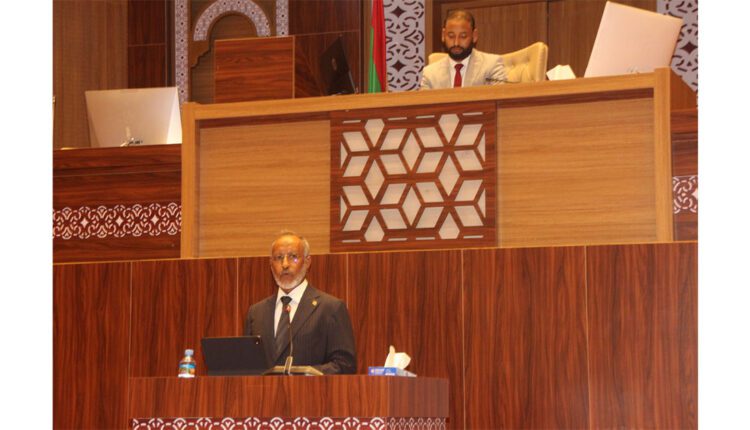
The National Assembly devoted its public session held yesterday evening, Thursday, under the chairmanship of Sayed. Mohamed Fih Al-Baraka Abba, Deputy Speaker of the Assembly, to hearing the responses of the Minister of Health, Mr. Abdoullah Ould Wedih, to two oral questions accompanied by debate, submitted by the following members of parliament: Kadiata Malick Diallo and Mr Ahmed Mohamed Al-Hassan.
Deputy Sayed Ahmed Mohamed Al-Hassan questioned the assessment of the health system in our country and what the policies adopted by the health sector have added in terms of improving the readiness of health facilities in terms of equipment and bringing health services closer to citizens.
He also asked about the measures taken in the field of drug quality control and what health insurance funds have added to improve health services for insured persons
Mrs Kadiata Malick Diallo highlighted in her question that children hold a special place in our Arab and African societies, where care for the elderly often depends on the presence of children. Those who are deprived of children, especially women, suffer greatly and face harsh social stigma, she said, noting that public health policy and insurance systems exclude infertility treatment from their coverage.
She asked, “Don’t you think infertility is a real public health issue? Shouldn’t we fix this problem and recognize infertility as a disease that needs special care, just like other chronic or specific diseases, to ease the suffering of some of our citizens?”
In response to a question from MP Sayed Ahmed Mohamed Al-Hassan, the Minister of Health emphasized that reforming the sector is one of the priorities of His Excellency the President of the Republic, Mohamed Ould Cheikh El Ghazouani, who pledged in his program “My Ambition for the Nation” to provide a fair, equitable, and resilient health system that responds to the specific needs of citizens and addresses the structural challenges at hand.
He emphasized that the government has developed a multidimensional reform plan to achieve this, which includes, among other things, expanding and developing health infrastructure and strengthening its technical platforms; as well as the scope of the health insurance network with a view to extending it to all citizens, in addition to establishing a secure and efficient drug supply system, as well as doubling salaries and allowances and launching a continuous training plan.
He reviewed the achievements made in recent years in terms of health infrastructure, including the construction of dozens of basic health facilities in various parts of the country, stressing that the sector is currently working on completing several strategic projects, including the expansion and construction of new hospitals, new headquarters for the National Institute for Public Health Research, the National Blood Transfusion Center in Nouakchott, and the National Laboratory for Drug Quality Control, as well as the reconstruction and equipping of 22 health centers and 80 health posts in the interior districts.
The Minister also reviewed the projects that the sector is working on launching, such as the start of work on the Salman bin Abdulaziz University Hospital, and the restoration and rehabilitation of the following hospitals: Cheikh Zayed, Al-Sadaqa, and the National Center for Heart Diseases, the establishment of a national center for mental health and addiction treatment, preliminary approval for the construction and equipping of a national hospital for mothers and children, and the construction of regional centers affiliated with the National Blood Transfusion Center in Nema, Kaedi, Atar, and Nouadhibou.
The Minister of Health affirmed that during the second half of this year, the Ministry will continue to implement all priority activities as defined in the national roadmap, by strengthening training, providing medicines and tests, expanding awareness campaigns, and activating community action mechanisms, in order to achieve the goals set for 2029.
He also confirmed that the sector is currently working, for the first time in the country’s history, on preparing a national healthcare law that will lay the foundations for comprehensive structural reform of healthcare institutions, noting that this law is based on four main strategic pillars: reforming the human resources system, strengthening the regulatory and functional governance of hospitals, modernizing their financing models, and improving the governance of infrastructure, medical supplies, and maintenance services.
He added that this law aims to enable healthcare facilities to perform their duties as required, by ensuring quality healthcare services that are accessible to citizens and equitable in terms of access.
In response to a question from MP Kadiata Malick Diallo, the Minister said that in order to address the challenge of infertility, the sector is seeking to improve treatment services by conducting a national survey to collect data on this phenomenon, developing a national plan based on actual data on the national situation, establishing an integrated medical unit for the treatment and medical care of infertility in one of the central hospitals in the capital, introducing an infertility care component into the national reproductive health program, and supporting the initiative of the First Lady, Dr. Mariam Mohamed Fadel Dah, who recently launched a national awareness campaign on infertility. and under her patronage, the “Safe Motherhood Observatory” was also established during the current year, among other initiatives.
He added that a study is currently underway to evaluate the experience and progress of the National Health Insurance Fund and the National Health Solidarity Fund, based on which the necessary measures will be taken in line with the health requirements of citizens, given that this is one of the priorities of His Excellency President Mohamed Ould Cheikh El Ghazouani.