

The President of the Republic presents a detailed report on the participation of the African Union (AU) at the G20 Summit in 2024
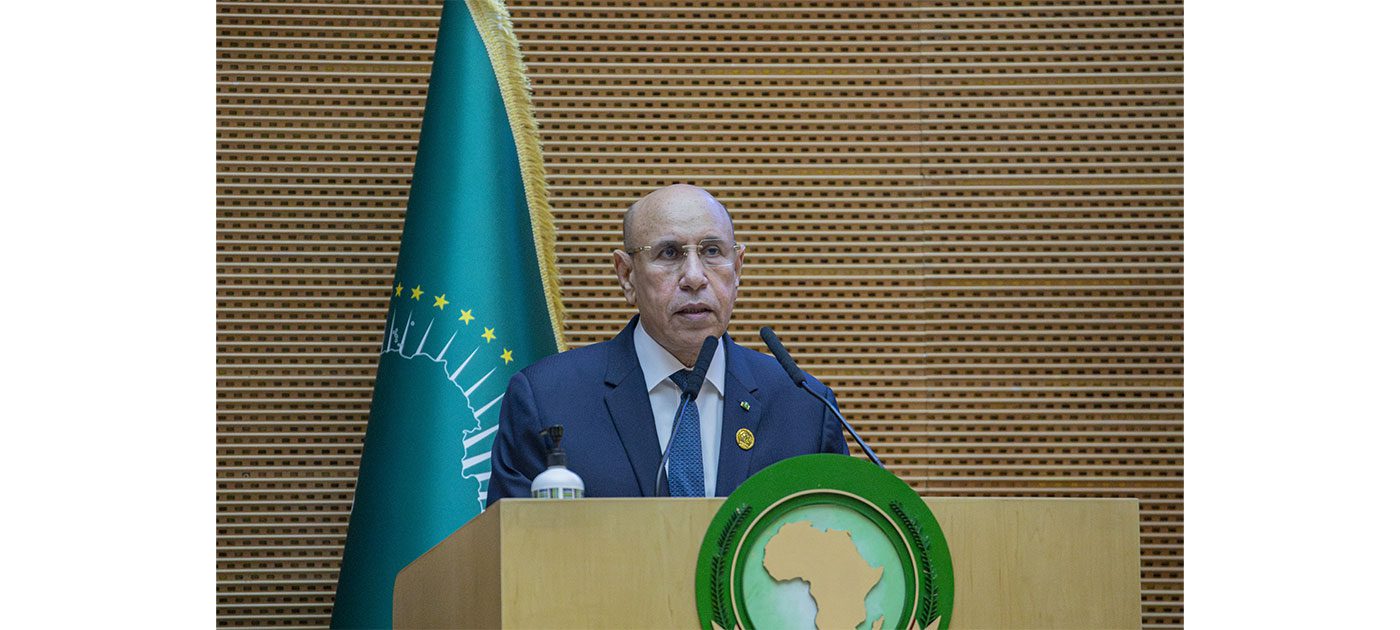
The President of the Republic, His Excellency Mr. Mohamed Ould Cheikh El Ghazouani, presented a detailed report on Sunday, at the 38th Summit of the Conference of Heads of State and Government of the African Union (AU) in Addis Ababa on the African Union’s (AU) participation in the G20 Summit in 2024.
The President of the Republic stated that this summit has gained historical importance, as it represents the first participation of the African Union as a full member, demonstrating the continent’s growing role in global economic governance and constituting a great step forward. He added that he led the AU delegation to the G20 Leaders’ Summit in Rio de Janeiro on November 18-19, 2024.
Throughout the year, the AU also participated in ministerial meetings, working groups, and G20 sherpa meetings, ensuring that African interests are integrated into the global agenda.
His Excellency the President emphasized that this first participation coincided with the Brazilian presidency of the G20, which structured its work around three main priorities: social inclusion and the fight against hunger and poverty, energy transition and sustainable development, as well as the reform of global governance institutions. He noted that he focused on six strategic areas, namely: the implementation of Agenda 2063, the reform of the international financial architecture, food security and agriculture, energy transition, trade and investment, health, and vaccine production. He highlighted that the summit’s highlight was the launch of the Global Alliance Against Hunger and Poverty, of which the AU is a founding member.
The issue of combating hunger and poverty occupied a central place in the discussions, with alarming figures: in 2023, 733 million people worldwide suffered from hunger, and in Africa, one in five people (1/5) was affected. If no immediate action is taken, estimates predict that 300 million Africans will be chronically undernourished by 2030.
The G20 recognized the need to make the common debt framework more effective, transparent, and faster, leading to significant progress for some African countries. This commitment paved the way for more ambitious reform of African debt governance and better coordination with international financial institutions.
In terms of economic development, the G20 reaffirmed its support for the African Continental Free Trade Area and the G20 Initiative on Industrialization in Africa, aimed at strengthening local production and the competitiveness of African industries. Similarly, the fight against illicit financial flows, which deprive Africa of nearly $80 billion per year, was reaffirmed as a priority.