

Government spokesman: Authorities will Strictly Enforce set Prices for Essential Items
Nouakchott
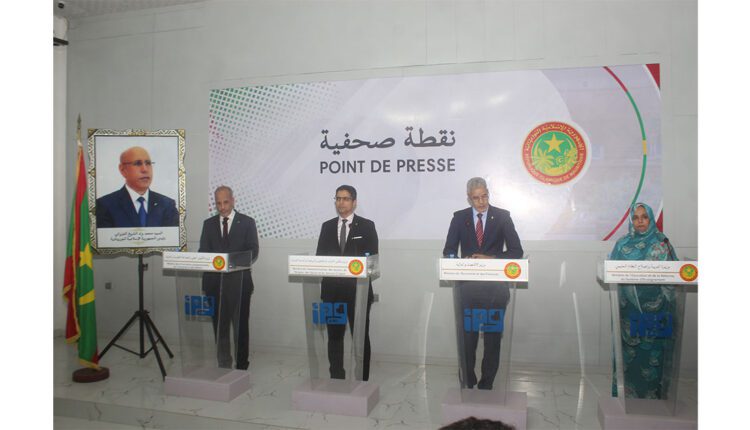
The Minister of Vocational Training, Traditional Industry and Crafts, acting Spokesperson of the Government, Mohamed Maalainine Ould Eyih, confirmed that the authorities will strictly enforce the prices of basic items to serve the citizen, noting that these prices were set after a discussion between the Ministry of Trade and Tourism and the Trade and Agriculture Federations, where both parties agreed on the profit margin allowed to retailers after accounting for transport costs.
This came in response to a question about what the questioner described as the resentment of some traders in Nouadhibou against the decision to set the price of these items, while commenting on the results of the meeting of the Council of Ministers on Wednesday evening in Nouakchott, together with the Ministers of Youth Empowerment, Employment, Sports and Civil Service, Economy and Finance, and Education and Reform of the Educational System.
Commenting on the joint communiqué on the pilot project to create 200 jobs in the agricultural sector, the Minister of Youth Empowerment, Employment, Sports and Civil Service, Mr Mohamed Abdallah Ould Louly, said that the selection of beneficiaries for these jobs will be done in a transparent manner, as applicants who hold Mauritanian nationality must have a high technical degree and have no work commitments, and a degree in agriculture is a preferential advantage.
Of these, 87 will be selected immediately, he added.
He stressed the importance of the project in creating new jobs and developing the agricultural sector, especially in the field of rice cultivation, as the government will allocate 20% of the 4,117 newly reclaimed hectares in R’kiz and M’bekhjek, 608 hectares in R’kiz and 122 in M’bekhjek, part of which will be allocated for wheat cultivation by Sonader.
The Minister pointed out that this project comes within the framework of the attention given by His Excellency the President of the Republic to youth issues in his electoral programme, as the government committed to creating 500 job opportunities in its programme presented to the National Assembly, so a ministerial committee was formed for this purpose to coordinate efforts and supervise the implementation of this important pilot project.
For his part, the Minister of Economy and Finance, Mr. Sid’Ahmed Ould Bouh, said that the draft law containing the amended Finance Law for the year 2024 comes in the context of the renewed confidence that the Mauritanian people placed in the President of the Republic by re-electing him for a second term and after the formation of a new government that committed before Parliament to implement the programme of His Excellency the President of the Republic through the general policy statement of the government.
The Minister explained that the amended draft Finance Law for 2024 is balanced in terms of revenues and expenditures at one hundred and seven billion, seven hundred and fifteen million, five hundred and forty-three thousand, two hundred and fifty-five ouguiyas (107.715.543.255). 715.543.255) ouguiyas, compared to one hundred and eight billion, one hundred and twenty-nine million, eight hundred and fifty-one thousand, seven hundred and thirty-three (108.129.851.733) ouguiyas for the original fiscal year 2024, a decrease of (-0.38%). The amendment also saw a reduction in the deficit of the previous budget.
He outlined the main objectives of the budget amendment, such as mobilising the necessary resources to keep pace with the projects included in the electoral programme of the President of the Republic, especially in the field of energy, water and sanitation, while keeping pace with the financial restructuring of government sectors, which saw the creation of new sectors and the merger of others into ministerial sectors.
The main objectives of the amendment include maintaining the commitments signed with the World Bank, updating revenue projections and confirming those related to expenditures, and accelerating the implementation of projects, he said, pointing to international contexts, such as the development of the international economy and its impact on the local economy in terms of growth and inflation.
This year, the amended draft budget law is characterised by the allocation of funds for excellence in the education and health sectors for the first time in the country’s history, as well as the release of significant budgetary margins to support projects relevant to the lives of citizens, he said
Regarding the draft law on public-private partnership, the Minister explained that the objectives of the draft law include easing the conditions for the mechanism of awarding contracts through negotiation in cases where no suitable offers are found in open competition, in cases of projects classified as public benefit or public service projects, and adding more flexibility, transparency and control in obtaining licences and approving them, as they require prior approval by the Council of Ministers.
For her part, the Minister of Education and Reform of the Educational System, Houda Mint Babah, said that the opening of the 2024-2025 academic year, which will be on Monday (7 October 2024), will be marked by the continuation of achievements in consolidating the Republican School by limiting the first three years of primary education to public education, reducing the preparatory stage to three years, and introducing two new subjects, technology and informatics, in addition to the introduction of two new subjects.
In the field of human resources, she stressed that the sector will work on several axes, such as valuing the role of field teachers and distinguished teachers in the educational process, as it will witness adjustments for distinguished teachers in transfers, while the ministry will strictly apply the law to violators, and the sector will work to reform the national exams process, in addition to adjusting the school map.
She added that training will be enhanced by training 80% of teachers of science subjects, online classes will continue and will be enhanced by the digitisation of textbooks and the free distribution of paper books to the first three years of primary school, calling on parents to take advantage of these digital enhancements in this area.
In the field of governance and management, the Minister said that decentralisation in education will be strengthened in partnership with the Ministry of Interior and partners in the educational process, as a ministerial committee has been formed to develop this aspect, highlighting the importance of the republican school and its pillars, such as the unification of school uniforms to eliminate social disparities and promote a sense of belonging to the country and consolidate the values of citizenship.