

President of the Republic, AU Chairperson participates in a Workshop on Peace and Security on the Sidelines of the China-Africa Summit
Beijing
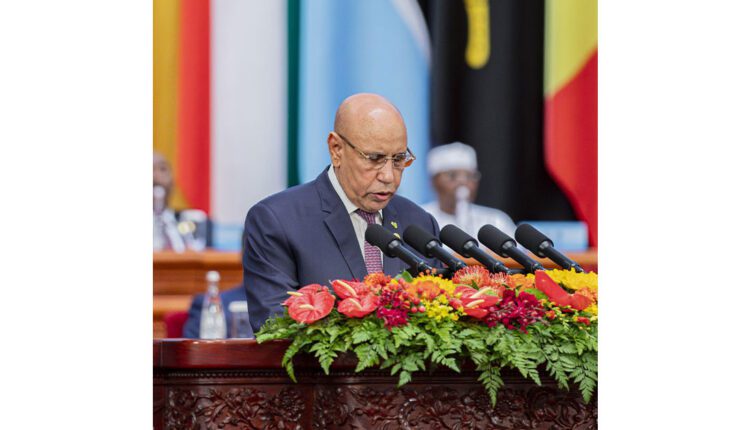
HE President of the Republic and Chairperson of the African Union (AU), Mohamed Ould Cheikh El Ghazzouani, delivered a speech on Thursday at a workshop on peace and security organised on the sidelines of the Forum on China-Africa Cooperation (FOCAC) summit in Beijing, in which he highlighted the almost organic link between development and security issues, which requires intensifying security cooperation and developing economic relations between Africa and China to build a prosperous common future.
He added that Africa and China are keen to elevate their co-operation relations to a strategic level, noting that the discussions at today’s workshop will shed more light on the road to peace, security and development in Africa and the People’s Republic of China.
The following is the text of the speech of H.E. the President of the Republic, President of the African Union:
‘’- His Excellency Mr Cai Qi, Member of the Political Bureau of the Standing Committee of the Communist Party of China
– His Excellency Mr Denis Sassou Nguesso, President of the Republic of Congo.
– Honourable Heads of State and Government, dear brothers and friends.
– Ladies and Gentlemen.
It is a real pleasure to be with you today at this workshop to discuss with you a topic of vital importance to our countries, our continent and the future of the world as a whole: Peace and security.
Peace and its direct corollary, security, is a necessary condition not only for the continuity and permanence of any social or political organisation, whatever it may be, but also for sustainable development and prosperity.
Today, the world has become a single village due to globalisation, intensified exchange and trade, and the digital revolution, where issues of peace and security can no longer be dealt with or resolved, in the long run, at the level of individual states.
Every conflict, wherever it occurs and whatever form it takes, always has a strong geopolitical dimension, both in its causes and effects, and therefore the security of the parties is highly interconnected.
No country can be secure in the long term if other countries around it are not secure. We cannot build our security at the expense of the security of others, but our security requires the security of all, so together, and only together, can we build lasting peace and security, and thus shared prosperity.
This is the meaning and importance of the set of values that underpin the China-Africa partnership and form the backdrop for the various initiatives launched by President Xi Jinping, which are essentially the values of mutual respect, friendship among peoples, bringing civilisations closer together, rejecting violence, and working together for peace and prosperity for all.
Excellencies and Honorables.
Ladies and gentlemen.
If there is one continent today that truly needs the co-operation of all, and therefore the effective solidarity of the international community to address the security challenges it faces, it is the African continent.
For more than a decade, Africa has witnessed an increase in the number of hotspots of tension. Worse still, it has become a theatre for various forms of terrorist, social, political and ethnic violence that spreads day by day to new areas, destabilising states and throwing entire regions out of control, turning them into a breeding ground for violent extremism and trafficking of all kinds, such as the Sahel.
This insecurity is the result of the destructive convergence of poverty, poor governance, underdevelopment and lack of prospects, because it is at the confluence of these factors that instability and violence germinate and flourish.
Eager to overcome the enormous challenges to their peace and security, African states have set themselves the goal in Agenda 2063 of silencing the continent’s guns.
The AU is working towards this goal through its peace and security architecture, based on the Peace and Security Council and its many support mechanisms, including the Continental Early Warning System (CEWS) and the African Standby Force (ASF).
The same applies to initiatives to coordinate efforts to combat insecurity developed within the Regional Economic Communities (RECs).
In addition, there are sub-regional initiatives such as the G5 Sahel, which has mobilised a large number of international support initiatives. Admittedly, the G5 as a structure is no longer functioning, but the spirit of pooling resources and concerted efforts remains, and that is what is important.
There are also bodies created to bring peace to specific conflicts, such as the African Union’s dynamic High Commission chaired by my friend and brother, Denis Sassou Nguesso, the co-chair of this workshop.
Excellencies and Honorables
Ladies and Gentlemen
Addressing the challenges of insecurity in Africa inevitably requires:
– Continue to strengthen efforts to pool resources in the fight against violence and insecurity.
– Mobilise strong and effective solidarity from the international community.
– Calm political life and overcome social rifts and inter-ethnic animosities through dialogue and consensus.
– Accelerate the process of continental integration, improve governance and build sustainable and inclusive economic development.
In all these areas, Africa can count on the strong and enduring support of its most trustworthy partner, the People’s Republic of China.
Our common desire, strongly expressed this morning at the Forum on China-Africa Cooperation, to elevate our cooperative relations to a strategic level, as well as our clear recognition of the strong organic link between development and security issues, requires us to intensify our security cooperation while developing our economic relations in order to build a prosperous common future together in security and stability.
I am convinced that our discussions at this workshop, based on the excellent results of the speech by His Excellency President Xi Jinping earlier today, will shed more light on the path to peace, security and development in Africa and the People’s Republic of China.
Thank you very much.’