

Minister of Economy: “Joining the African Solidarity Fund Will Boost the Private Sector”
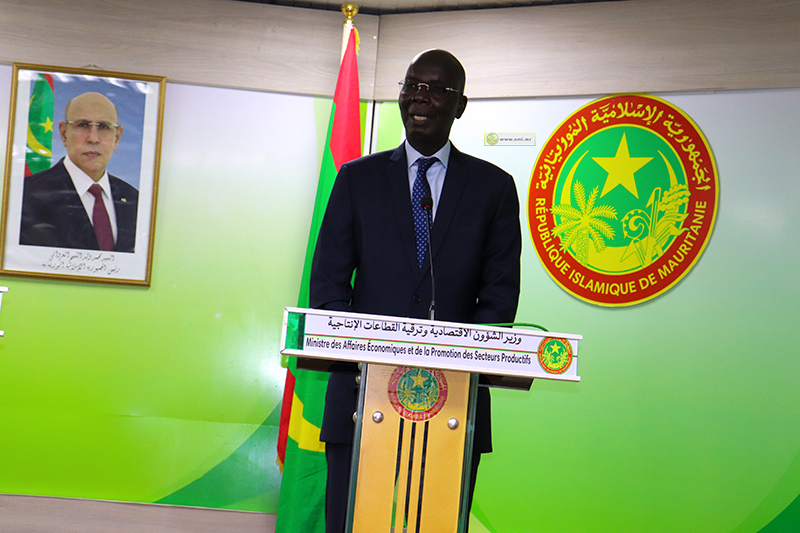
On 27 April in Nouakchott, Mr. Ousmane Mamoudou Kane, the Minister of Economic Affairs and Promotion of Productive Sectors presented the broad lines of the bill authorizing the ratification of the Agreement establishing the African Solidarity Fund (ASF) on 21 December 1976 and its subsequent amendments. The minister, who was speaking during the government’s weekly news conference, also gave a briefing on his recent stay in Washington.
Detailing the ins and outs of the project, the Minister said that the ASF is an international institution created by a group of countries on the continent in 1975 and that it has been operational since 1979. The fund, which currently includes 14 countries, is essentially dedicated to supporting the private sector in African countries. According to the Minister, the ASF particularly provides financing guarantees, which the private sector could raise from national and international banking systems.
The adoption of the bill today demonstrates Mauritania’s desire to join the current 14 countries and to be ahead of many other African countries that are preparing to join the ASF. The interest for it is that Mauritania can provide its private sector with an instrument that will allow it to mobilize financial resources from Mauritanian and international banks.
Currently, recalls Mr. Ousmane Mamoudou Kane, the private sector and the Mauritanian banking system do not yet have this guarantee instrument which is reliable and modern, noting that Mauritania is already a member of the African Import-Export Bank (AFREXIMBANK), which provides a lot of funding in countries with the necessary instruments to secure these funds. Therefore, joining the ASF will complete this system. Eventually, the Mauritanian private sector will be equipped with an essential instrument to secure major financing from Mauritanian and international banks.
Answering a question about the real usefulness of the ASF, the Minister indicated that it is not only an institution that provides expertise and advice. He insisted on the fact that the ASF is primarily a financial institution that provides guarantees for loans raised from Mauritanian and foreign banking systems.
For him, the economy of a country must be based in a sustainable way on the private sector, adding that we need a strong and efficient private sector that plays the game of the competition. The State does what it can at the regulatory level to facilitate its development, but from time to time the private sector needs support that the State offers it with complementary instruments to develop further.
In addition, Mr. Ousmane Mamoudou Kane raised the mission he carried out in Washington. These are working sessions with the Bretton Woods institutions (World Bank and the International Monetary Fund) which bring together their shareholders, including Mauritania twice a year, as he put it.
According to the Minister, the October meeting is very important and more legal, because it approves documents and takes decisions of very strong legal value. But the April meetings are also important insofar as they allow each country to review all its cooperation with the institutions.
Thus, the Mauritanian delegation met with the IMF team working on Mauritania. The discussions mainly focused on a program which is being developed, as the minister put it. He pointed out that the negotiations started in March and will continue until they find a happy conclusion.
At the World Bank level, the economic team met with the International Finance Corporation, which finances the private sector. The objective is to see to what extent it can further support the Mauritanian private sector, through its assistance and expertise but also its financial means. The minister revealed that with the vice-president of the West and Central Africa region, the portfolio of projects financed by the World Bank in Mauritania has been studied. He also stressed that the meeting made it possible to identify the priorities of the State, for which it seeks the support of the World Bank.
In addition, Mr. Kane said that his stay in Washington was also an opportunity to have bilateral meetings with the American government. Interesting perspectives emerge from these discussions, commented the Minister. Before closing this chapter, he noted that Mauritania was praised for the way it successfully dealt with its Kuwaiti and Saudi debt.
Finally, the Minister answered a question relating to the Doing Business ranking. He indicated that this instrument of the World Bank had a troubled period, insofar as there was an audit. He recalled that the board of directors had decided to stop producing the Doing business as it was done before. It has been on hiatus for over a year. It will be necessary to define another instrument, other ways of doing things to resume the activity that Doing Business was doing, as the minister put it.