

Government Spokesperson: Ramadan Exhibitions Are a Key Pillar in the Public Authorities’ Plan to Support Citizens During Ramadan.
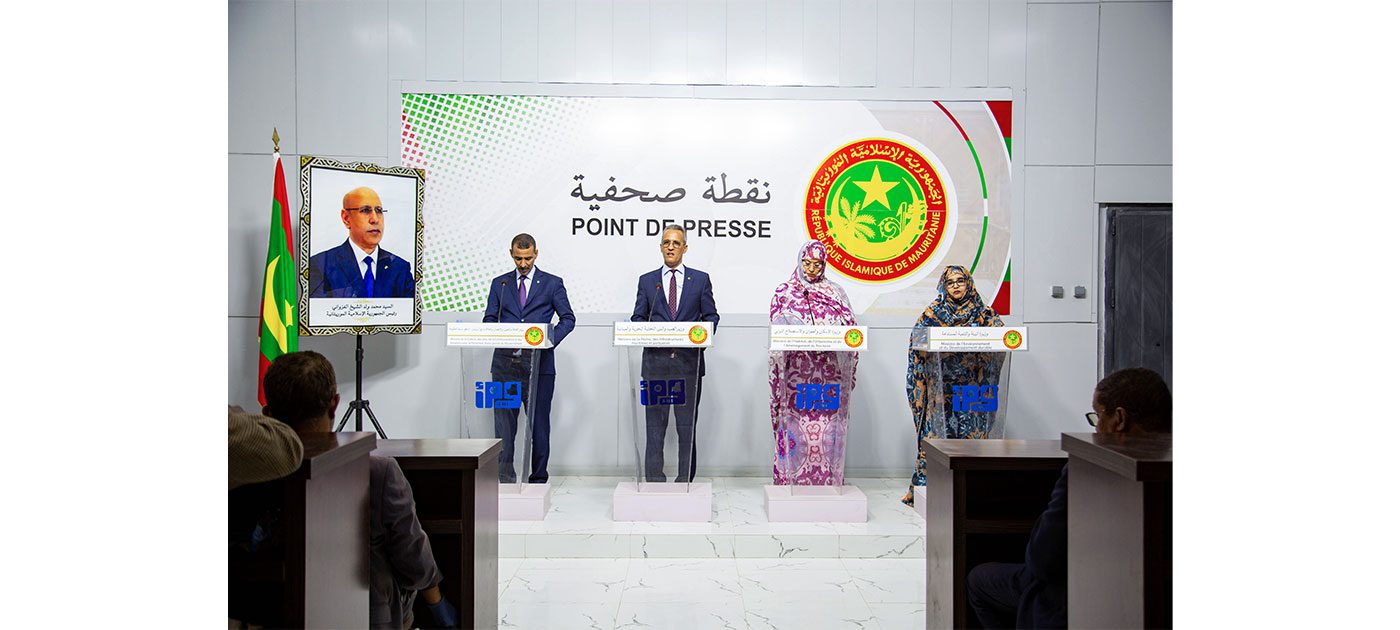
The Minister of Culture, Arts, Communication, and Parliamentary Relations, Government Spokesperson Mr. Housseine Ould Medou, stated that Ramadan exhibitions are a key pillar in the public authorities’ plan to support citizens during the holy month. He pointed out that this year they have witnessed qualitative improvements, including expanding the coverage to reach 9 exhibitions (an average of one exhibition per district), supporting prices by opening dozens of subsidized shops locally in cooperation with the National Union of Mauritanian Employers, in addition to setting price ceilings.
He explained, during his commentary on the results of the Cabinet meeting held this Wednesday evening in the press hall at the Mauritanian News Agency headquarters in Nouakchott, accompanied by the esteemed Ministers of Fisheries, Maritime and Port Infrastructure, Housing, Urban Planning and Land Reclamation, and Environment and Sustainable Development, that this initiative achieved tangible success last year, as it contributed to reducing the prices of basic commodities by between 12% and 32%, enabling families to save about 55 billion old ouguiyas, alongside providing direct support to the most needy groups.
In response to a question regarding young migrants, he affirmed that the Mauritanian government pays great attention to this segment of citizens abroad and works hard to motivate them and assist them in regularizing their legal status and achieving professional integration in their countries of residence.
Regarding a question about the rule of law and freedom of expression, the government spokesperson emphasized that ‘no one is above the law,’ and that freedom of expression is a guaranteed right, but it remains guided by legal regulations that criminalize defamation, insults, and attacks on sanctities or national principles.
In turn, the Minister of Fishing and Marine and Port Infrastructure, Mr. Mokhtar Ahmed Bouceif, in his remarks on the statement concerning the exploitation, management, and development of the NDjiago port, noted that this port is located in a strategic area and is expected to alleviate pressure on the Nouakchott and Nouadhibou ports, pointing out that the new approach to managing this facility is through public-private partnership, with the government deciding to grant its management to private sector partners (major international companies) to ensure efficiency and professionalism.
He affirmed that the goal of this approach is to compensate for the state’s original investment costs, bring in technical expertise and financial capacity to operate the facility, and transform the southern region into a comprehensive economic and industrial hub.
He reviewed the expected benefits of this partnership, such as supporting the gas sector by providing a logistical base close to promising gas fields and facilitating exports by enabling farmers and explorers to export their products directly instead of resorting to costly international routes.
In response to a question regarding the high price of fish, the Minister explained that this is due to a shortage of labor and the increasing demand for this essential commodity, confirming that the sector is currently working on increasing production and improving its methods in the future.
He also highlighted the opportunities provided by traditional fishing (more than 200,000 direct and indirect job opportunities), calling on Mauritanian youth to move towards this vital sector.
For her part, the Minister of Housing, Urban Development, and Territorial Planning, Mrs. Naha Hamdi Mouknass, explained, commenting on the draft joint decree concerning building permits, that this decree specifies the procedures and conditions related to obtaining each type of building permit in a digital format, as well as the methods for paying the associated fees.
She indicated that the ministry, in cooperation with the Ministries of Interior and the Promotion of Decentralization and Local Development, Digital Transformation and Administrative Modernization, and Real Estate, State Property, and Land Reform, has established a unified digital window available online to manage the issuance of building permits.
She explained that this decree works to improve the services provided to citizens, enforce strict adherence to the laws and regulations in the field of urban planning and construction, and safety standards, as well as to organize the framework for land use in urban areas and facilitate citizens’ access to public services.
In response to the question regarding overlapping competencies between the Ministry of Housing and the Ministry of Real Estate, the Minister stated that there is no overlap, but rather complementarity in competencies and performance, with continuous and consistent coordination in service of the citizens.
As for the Minister of Environment and Sustainable Development, Ms. Massouda Baham Mohamed Laghdaf, she clarified that the executive decree of the law related to solid waste management, issued in 2023, comes to strengthen the legal framework related to environmental preservation, which His Excellency the President of the Republic, Mr. Mohamed Ould Cheikh El Ghazouani, attaches great importance to, having made it one of the pillars of his program ‘My Ambition for the Nation.’
She explained that the draft decree consists of four chapters: concerning the planning of waste management, organizing the responsibility of waste producers, studying the methods and ensuring treatment, and the sustainable financing of this process.
In response to a question about the delay in issuing the environmental law decree, the Minister stated that solid waste management is very complex as it involves several government sectors (household waste falls under the Ministry of Interior, biomedical waste under the Ministry of Health, etc.), which is why it is necessary to involve all relevant sectors in the consultation on this decree.
Regarding the inspection of major industrial and mining institutions, she affirmed that no institution is above the law, highlighting that a number of these institutions (MCM, Taziazet) have been inspected and warnings sent concerning issues related to solid waste management, the proportion of chemical materials (especially cyanide), and air pollution.