

The International Date Festival in Kiffa: Promising Economic and Tourism Opportunities for the Region
Kiffa
The fourth edition of the International Festival of Mauritanian Dates will kick off tomorrow, Friday, in the city of Kiffa.
The three-day festival is organized in collaboration with the Ministry of Agriculture and Food Sovereignty and the Khalifa International Award for Date Palm and Agricultural Innovation.
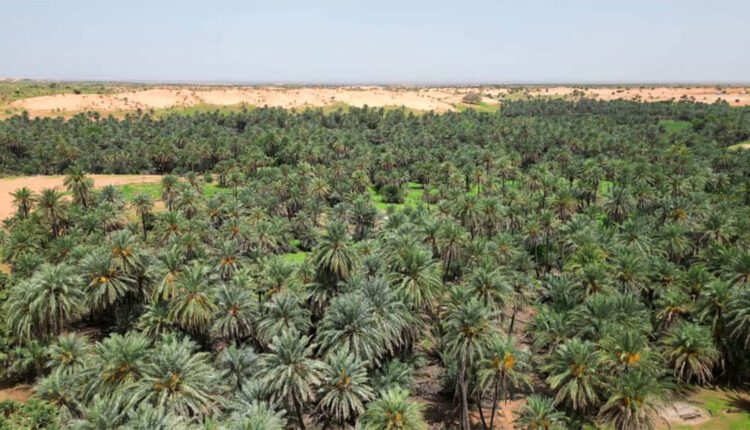
The organization of this event in the city of Kiffa reflects the oasis-like nature of the Assaba region, which is home to many palm oases and whose inhabitants have been linked to palm trees as an integral part of the local culture and civilization that has flourished over the centuries.
The Ministry of Agriculture and Food Sovereignty has mobilized all its resources and logistical capabilities to ensure the smooth organization of this annual event and to contribute to the comfort of visitors to this beautiful city, which has been decked out in its finest attire to welcome all national and international delegations.
The measures taken included organizing field visits to the city of Kiffa to ensure that it had sufficient hotel facilities and hospitality services to host this important festival. These visits convinced the visiting team that the city was indeed capable of hosting the festival.
The governor of the province formed specialized local committees to prepare for this festival, which includes competitions to encourage positive competition, an exhibition of Mauritanian and international dates, a scientific symposium, and cultural, artistic, and folkloric evenings.
The square opposite the regional council of the district was chosen to host the exhibition tents, and a scientific committee was formed to prepare and supervise the competitions organized during the festival and to organize the accompanying lectures and scientific seminars.
 The Secretary General of the Ministry of Agriculture and Food Sovereignty, Mr. Ahmed Salem Ould El Arbi, Chairman of the Festival Organizing Committee, explained that this year’s edition is distinguished by the introduction of an award for the best palm farm outside the traditional oasis areas and the organization of three cultural, artistic, and folkloric evenings.
He added that the committee supervising the organization of the festival is working hard to overcome the problem of accommodating local exhibitors by reducing overcrowding in homes by providing 20 good houses. He pointed out that the transportation and logistics committee is also working to provide comfortable and safe transportation for guests through a fleet of high-quality four-wheel drive vehicles.
He mentioned that a team from the technical committee toured the production areas during the period from July 3 to 15 in order to determine the quantity of dates that will be displayed in the various pavilions of the exhibition.
He explained that the expected number of exhibition pavilions is 61, including 14 pavilions for foreign exhibitors and 47 pavilions for national exhibitors and the Ministry of Agriculture and Food Sovereignty, noting that the number of exhibitors is around 102.
He said that the most important varieties of Mauritanian dates to be exhibited include “Lahmar,” “Salmadina,” “Skani,” “Mahboula,” “Lmadina,” “Tantargal,” “Barhi,” and “Majhul.”
He pointed out that the appropriate and necessary packaging for 1.5 tons of dates will be provided directly by local exhibitors during the festival by providing 1,000 transparent storage boxes with a capacity of 1 kg, 1,000 transparent storage boxes with a capacity of 0.5 kg, and 120 cardboard boxes with a capacity of 25 kg.
According to the latest census conducted by the Union of Oasis Associations of Assaba in 2022, the total number of palm trees in the province of Assaba is 429,455, with an annual production of 3,272 tons.
There are 115 oases in the state and 14 model fields covering an area of 248 hectares within the Oasis Development and Development Project program. Nineteen oases are participating in the Kiffa Exhibition on Mauritanian Dates at the district level, showcasing several locally produced varieties.
The exhibition includes fourteen pavilions from different countries, including Jordan, Egypt, Ethiopia, Lebanon, Mexico, the United Arab Emirates, and Pakistan.