

Investment Promotion Agency makes Presentation on Investment Opportunities Between Mauritania and Algeria
Nouakchott
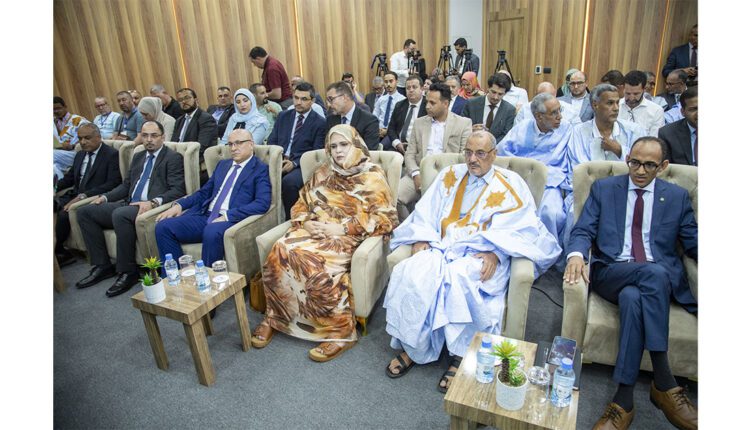
The Mauritanian Investment Promotion Agency (MIPA), in cooperation with its Algerian counterpart, organized on Saturday evening in Nouakchott, as part of the Mauritanian-Algerian Economic Forum, a session to present the investment opportunities available between Mauritania and Algeria.
The session was chaired by HE Minister of Trade and Tourism Ms. Zainab bint Ahmednah, Minister of Internal Trade and Control of the Algerian National Market, in the presence of a number of senior officials and businessmen from the two countries.
The Assistant Director General of the Investment Promotion Agency, Habiballah Mohamed Ahmed, gave a detailed technical presentation on the business climate in Mauritania and reviewed the promising economic opportunities and capacities in the country, noting that the visit of the Algerian Minister of Trade at the head of a sectoral delegation to Nouakchott is a new opportunity to enhance trade exchange, especially in the field of bilateral investment.
He noted that Mauritania and Algeria have trade relations and bilateral and regional agreements aimed at supporting and incentivizing investment between the two sides.
In his presentation, the Assistant Director General of the Investment Promotion Agency pointed out that Mauritania has enormous economic potential in many fields, including agriculture, where it has about 513,000 hectares of arable land that annually produces a range of agricultural crops such as cereals (557,645 tons of rice, wheat, yellow and thin corn), 100,000 tons of vegetables, and 41,838 tons of dates, adding that despite these resources, Mauritania still imports more than 70% of its food needs.
He explained that the agriculture sector enjoys tax incentives and customs exemptions that encourage the development of investment projects, offering great opportunities to boost local production and reduce dependence on imports.
Regarding animal development, the Assistant Director General of the Investment Promotion Agency said that Mauritania has an estimated livestock wealth of 29.3 million heads, which contributes about 10% of GDP, with meat production reaching 248,247 tons, milk and its derivatives 580,000 tons, leather 4,988 tons and 12 million units of broiler chickens, highlighting that this sector is also characterized by tax and customs incentives aimed at supporting livestock projects and processing their products.
He pointed out that Mauritania has a 750-kilometer waterfront on the Atlantic Ocean and an exclusive economic zone covering 234,000 square kilometers, including a continental shelf rich in fish wealth, noting that the fishing sector contributes 2.8% of GDP and provides 370,000 direct and indirect jobs, with annual fish exports amounting to 614,000 tons worth $744 million.
In the field of minerals, he explained that Mauritania is a major producer in Africa thanks to its large reserves of iron, gold, copper and other minerals, as the country hosts more than 900 mineral indicators, especially in the states of Tiris Zemmour and Inchiri, supported by a qualified infrastructure for transportation and processing, and the country has promising resources in the field of natural gas and renewable energy (solar and wind), and is strongly seeking to develop green hydrogen projects, which is the first country to adopt its own code globally, making it a promising destination for investors in the field of energy.
He pointed out that the large Turtle Ahmim field shared with Senegal is a strategic project to launch gas production, along with the onshore Taoudeni basin and the offshore coastal basin.
The session also witnessed the presentation of the report of the ninth session of the Mauritanian-Algerian Business Council, which was presented by Mr. Othman Ould Taleb Akhiar, on the sidelines of the Algerian exhibition in Nouakchott.
The report praised the efforts of the two governments in strengthening economic and trade relations and the need to achieve the desired goals through the implementation of joint initiatives, such as the Tindouf-Zouerate road, the Algeria-Mauritania sea line, the opening of the Algerian bank in Nouakchott and the establishment of a free trade zone
The report called for signing a product exchange agreement, establishing a technical committee to remove obstacles to the flow of goods, expediting the conclusion of a land transportation agreement, and facilitating financial transactions related to joint investment and services.
The report also recommended establishing a legal and regulatory framework for the import and export of livestock and their derivatives, supporting companies of the two countries in commercial administrative procedures, encouraging participation in trade events, exhibitions and forums, activating the maritime line and removing obstacles to its regularity, and facilitating the granting of residency to Mauritanian citizens in Algeria, as is the case for Algerian citizens in Mauritania.