

President of the Republic Chairperson of the African Union reviews Mauritania’s Experience in Combating Extremism and Terrorism to Students of Sciences Po in Paris
Paris
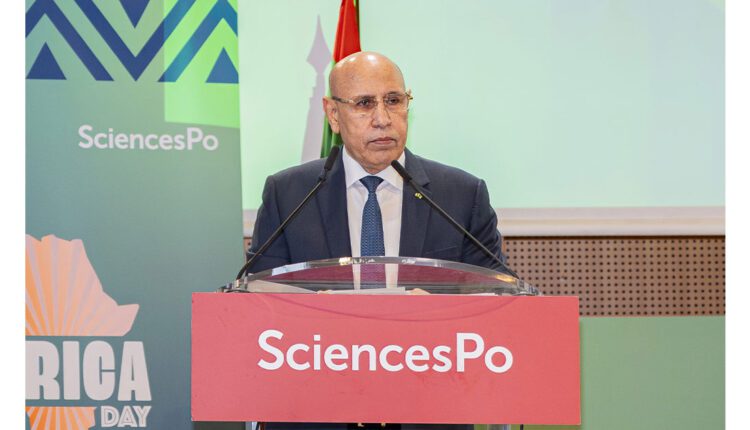
His Excellency the President of the Republic and Chairperson of the African Union, Mr. Mohamed Ould Cheikh El Ghazouani, delivered a lecture on Thursday evening at the Émile Boutmy University Auditorium in Paris, to students of the Institute of Political Science, under the title “Preserving a peaceful country in the conflict zone”, during the Africa Day Forum held on the sidelines of the Francophone Summit in Paris.
His Excellency gave a detailed presentation on Mauritania’s experience in combating extremism and terrorism, both in terms of approaches and measures applied at the national level, and in terms of strategies and collective actions taken in this context, highlighting the main lessons learned from this experience that support the country’s approach in dealing with issues of terrorism and insecurity at the national and regional levels.
The following is the text of the speech of His Excellency the President of the Republic before the students of the Sciences Po in Paris:
“Thank you,
Thank you to Ms. Nachouat Maghouar, Director of France Africa, for her kind introduction.
I would also like to thank Mr. Louis Vassy, Director of the Institut d’Etudes Positaires de Paris, and Ms. Arancha Gonzalez, Dean of the Paris School of International Affairs, as well as all those who have contributed in one way or another to enabling me to speak today at this prestigious institution, the Centre for Knowledge, Science and Excellence.
I would also like to thank the students who are here today, and tell them how happy I am to be able to exchange views with them on issues that are vital to my country, my continent, and indeed the world.
Objective of the intervention
I have been invited to speak to you about my country’s experience in combating extremism and terrorism, and I will try to provide you with an overview of approaches and measures taken at the national level, and of strategies and collective actions taken in that context.
I would also like to take this opportunity to highlight the key lessons learned from this experience, which now form the basis of our approach to dealing with issues of terrorism and insecurity at the national and regional levels.
Finally, as I address you, the elite of tomorrow, I would like to say a few words about the major global challenges that you will be responsible for addressing.
For the general situation
As you know, terrorism and extremism exist almost everywhere in the world today. For our continent, and especially for the Sahel region, they constitute the main challenge that our States must face, individually and collectively, in order to maintain the stability and security necessary to achieve our development goals.
Terrorist violence, with its transnational nature and its close association with non-State actors, has undermined our traditional security strategies that often revolve around defending territorial integrity against possible aggression by a third State, and which today provide only a very partial response to multifaceted security challenges.
Extremism and terrorism are historically and culturally alien to our continent, and the history and culture of my country is a vivid example of this.
For centuries, Mauritania has been, and continues to be, a place where sub-Saharan and northern peoples have mingled and intermingled, producing a magnificent cultural marriage that today forms the bedrock of the identity of our people. We are in Mauritania, we are both north and south of the Sahara, we are white and black, we are Arabs, Amazighs and Africans.
Nevertheless, the extremism and terrorism that have crept into our continent maliciously in recent decades, taking advantage of a destructive confluence of poverty, poor governance, underdevelopment, social tensions and violent collapses of constitutional legitimacy, have finally spread to our country.
As a result, like most countries in our region, we have witnessed deadly acts of terrorism on our territory: attacks on military barracks and on innocent civilians, Mauritanians and foreigners, hostage-taking… In short, we have witnessed all the usual forms of terrorism.
Mauritania Strategy
This tragic situation has seriously endangered the security and stability of our country. To deal with it effectively, we have designed and implemented an integrated, multidimensional approach that encompasses security, cultural, ideological, social, political and economic issues.
On the security front, we first had to deal with the most pressing problems, namely, restoring security and stability by waging a merciless battle against terrorist groups. To achieve this, we have strengthened our armed and security forces through:
– Continuous improvement of the operational capabilities of our armed forces and security units: adapting their equipment and operational training to the terrorist threat,
– Implement an appropriate intelligence chain to prevent terrorist acts,
– Creation of several special units dedicated to asymmetric threat (mobility, diversity and flexibility),
Strengthen systematic coordination with regional and international partners to ensure more flexible information exchange.
On the cultural and ideological level, our scholars and jurists have engaged in a free and open religious debate with groups of young people who have engaged in terrorist acts, with the aim of convincing them of the completely wrong nature of extremist theories and of the moderate and tolerant nature of Islam.
As a result, the vast majority of these radicalized young people have been put back on track.
Just as the Government has set up a support programme for repentant youth to ensure their reintegration into active life and prevent them from relapsing into crime, we have set up an extensive media programme to raise awareness and protect our youth from extremist propaganda and spread the values of tolerance, moderation and openness to the other, which are the essence of Sunni Islam.
At the social level, we have worked to promote national unity and social cohesion, and we have developed a legal arsenal to combat hate and racist speech or incite violence and extremism. We have also worked to strengthen the rule of law, consolidate human rights and individual and collective freedoms, and promote press freedom by liberalizing the audiovisual sphere and decriminalizing press offences.
On the other hand, always within the framework of better protecting our youth from extremism, we have strengthened our strategy for youth integration and employment, as well as an active policy aimed at ensuring broad participation of youth and women in political life and the management of public affairs.
On the economic front, we have worked to dry up the sources of financing for terrorists by imposing strict control over the movement of funds, systematically rejecting any form of compensation for the release of hostages and engaging in a relentless fight against all forms of trafficking that are likely to be a source of terrorist financing.
At the same time, we have made improving the living conditions of vulnerable or disadvantaged segments of our population an essential part of our development strategies.
We have therefore put in place an extensive social safety net aimed at helping low-income citizens and strengthening their resilience to the dangers of daily life. This has increased their purchasing power and improved their access to basic services, health insurance and adequate housing.
Overall, we have worked to strengthen national unity and support social cohesion by focusing our programmes and strategies on combating poverty and fragility and on building sustainable and inclusive development.
At the political level, we have favoured openness and continuous dialogue with all actors in the national political arena, and we have strengthened our institutions and democratic system.
Moreover, aware that the situation in the countries of our region has a direct impact on each other, we in Mauritania have quickly become firmly convinced that lasting victory over terrorism can be achieved only through close cooperation and strong solidarity at the regional, continental and international levels.
In 2014, in Nouakchott, we established the G5 Sahel Organization with our most directly threatened neighbours (Mali, Burkina Faso, Niger and Chad), which mobilized several international support initiatives.
The Group of Five Sahel States is an institutional framework for subregional cooperation in the field of security and development aimed at pooling our resources and concerted efforts as part of an approach based on the principle that security and development issues are inseparable.
On the security front, this agreement has enabled us to significantly improve coordination among our armed forces headquarters, pool our intelligence networks, and significantly improve our collective ability to anticipate the terrorist threat and prevent or respond to it collectively and in a coordinated manner.
Besides the security aspect, a priority investment programme has been put in place, a large part of which is devoted to development, with the support and assistance of our partners (France is at the forefront, thanks in particular to the leadership of His Excellency President Emmanuel Macron).
Unfortunately, for reasons of their own and by a sovereign decision that we respect, our brothers from Mali, Niger and Burkina Faso withdrew from the Group of Five States, thus ending the operational status of the Organization.
However, we remain convinced that the Group of Five is a valid idea in principle, because in a battle claiming to be effective against terrorism, it is impossible to dispense with a framework for coordination and pooling of resources, regardless of their formal structure or name.
In the spirit of coordination, effective solidarity and pooling of resources, today, as the current Chairman of the African Union, we are working today to revitalize and strengthen the Peace and Security Council and its numerous support mechanisms, among others, the continental early warning system and the African standby force.
We also strongly support efforts in Africa to strengthen the rule of law and combat corruption and electoral fraud in order to build genuine democracies capable of ensuring the peaceful, stable and transparent transfer of power and establishing the legitimacy of power.
Too often, those in power tend to compensate for the lack of legitimacy by resorting to violence, leading to greater insecurity and social and political instability.
I am convinced that it is particularly necessary and urgent to work to pacify political life and to overcome social divisions and inter-ethnic animosities through dialogue and consensus.
In this context, I believe that the social capital and local knowledge of African societies in conflict prevention, management and resolution is crucial.
We need to strengthen and improve the role of communities, social leaders, civil society and grassroots community-based organizations.
It seems to me that exploring cultural crucibles and ancient methods of social mediation is a worthwhile avenue.
At the same time, we must work to give everyone equitable access to conditions that enable a decent life, to offer our young people the prospects for a future far more promising than the tragic race of endless clandestine migration or the resort to illicit trafficking of all kinds and organized crime.
Overall, the package of security, cultural, social, political and economic measures implemented in Mauritania within the framework of our integrated security strategy, together with our efforts at the regional and continental levels, has so far enabled us to avoid terrorist acts on our territory (no terrorist act has been committed on our territory since 2011) and to ensure security and social peace, which has significantly improved the implementation of our strategy of accelerated growth and shared prosperity.
However, we remain fully aware that when it comes to terrorism and extremism, there is no such thing as the absence of danger, and that the struggle for stability, security, cohesion and social peace is a daily battle that requires constant action and vigilance at all levels.
Lessons learned
What we have learned from our experience in combating terrorism and extremism is the need for a multidimensional approach that prioritizes the coordination of regional and international efforts not only to address the violent manifestations of extremism, but also and above all to its roots.
This approach must be based on the principle that the struggle for security and the struggle for development go hand in hand and have a mutually beneficial effect, and that terrorism will never be defeated if, in parallel with security action, tremendous efforts are not made to achieve universal access to quality education and genuine rule of law, create jobs, create conditions for a dignified life for people with dignity and respect, improve governance, and promote sustainable and inclusive development.
On the other hand, we have become convinced that, as a result of globalization and intensification of trade, the global village that has become our world is no longer issues that can be dealt with or resolved, in the long run, at the level of individual States.
Every conflict, wherever it occurs and in whatever form, always has a strong geopolitical dimension, both in its causes and effects. Sustainable security for all requires security for all.
However, one of the main sources of instability, conflict and insecurity in the world lies in the tendency of States to seek to build their own security at the expense of the security of others, using all means to strengthen their military and economic power and weaken the power of others. Worse still, they make the achievement of this goal the fundamental value on which they sacrifice all other common human values.
They only looked at the atrocities that human beings can commit when they ignore, under the guise of the right to deal with a real or perceived security threat, all the rules and values of international humanitarian law, leading to genocide, war crimes and crimes against humanity.
Worse, this is often done in the absence of a large part of the international community. It is as if the universality and sanctity of fundamental human rights, which are strongly emphasized in speeches and speeches, are suddenly limited in practice to the rights of its people and allies.
This is an unacceptable policy of double standards that negatively affects our trust in our shared values and in our global governance institutions, and weakens our solidarity, which is so necessary if we are to face together the many challenges that threaten our common future.
You, dear students, are the elite of tomorrow, who will have to face the multiple security, economic and environmental crises that are plaguing our world today.
Never succumb to apathy and defend the equality of human beings and their inalienable rights around the world as if they were your own.
I am all the more justified in urging you to do so because we are now in the cradle of human rights. It was here in Paris that the Declaration of the Rights of Man and of the Citizen in 1789 and the Universal Declaration of Human Rights in 1948 were born.
Never forget, as stated in the first preambular paragraph of the 1948 Universal Declaration of Human Rights, that the practical recognition of the inherent dignity and equal and inalienable rights of all members of the human family is the foundation of freedom, justice and peace in the world.
We must always bear in mind that the greater the disparities in wealth, knowledge and power within and between States, the less manageable it is possible to deal with the problems of migration, insecurity and instability around the world.
Only by raising awareness of our common destiny, through solidarity, through the development of multilateralism and the reform of global governance institutions, will we be able to dispel the doubts that hang over our common future and the future of our planet.
Thank you.”