

President of Republic: “We Pay Special Attention to Low-income and Vulnerable Groups and Have Worked To Integrate Them Economically and Socially, Improve Their Living Conditions, and Enhance Their Access to Basic Services”
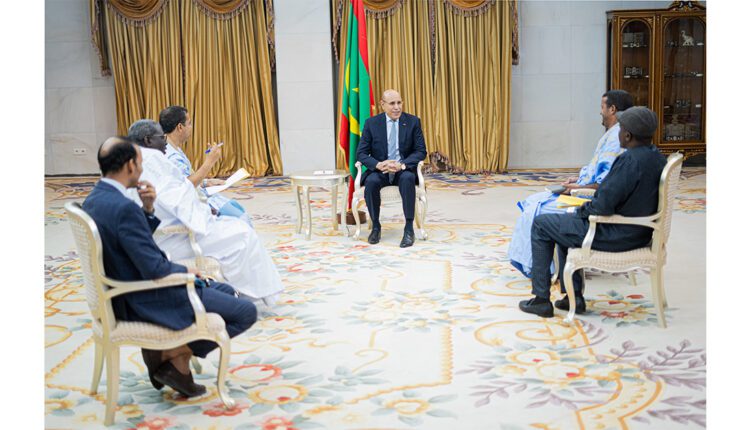
On 30 October, in Nouakchott, His Excellency, Mr. Mohamed Ould Cheikh El Ghazouani, the President of the Republic, gave an interview to five privately-owned media institutions, namely Alakbar, Sahara, Sahara Media, Cridem, and Le Rénovateur, where he answered the questions of each of them.
The questions of the press institutions covered the situation in Mauritania and its surroundings.
Below is a translation of the interview:
Question: The State Inspectorate revealed large figures in the field of corruption, and some assert, based on the numbers and data, that during your term, corruption has increased compared to the previous years. Are you satisfied with your efforts to fight this phenomenon? Do you think it has fallen back, or is it more than it was? What indicators or figures do you have? Why did they not publish the reports of the Court of Accounts as required by law? (Alakhbar news agency).
His Excellency Mr. Mohamed Ould Cheikh El Ghazouan, the President of the Republic:
Before going into the details of the answer to this question, I would like to express my surprise at the inference of some about the magnitude of the effort made by the Court of Accounts, the General Inspectorate of State, and other regulatory bodies, and the administrative imbalances it reveals as evidence against the government instead of being in its favor. If the government had not been serious about fighting corruption, it would not have directed the General Inspectorate to unveil it and not have cooperated with the Court of Accounts and facilitated its task.
Corruption and the circumvention of public funds or their disbursement outside the objectives for which they were allocated is a global phenomenon that even countries with a legal system, administrative practice, and long-standing experience in this field have not been spared.
Of course, I do not think you expect me to deny the existence of this phenomenon for two reasons: first, because it is impossible in any country in the world, as I mentioned earlier, and second, because I am not interested in demagogic discourses that cover up the facts. What I can deny is that it has worsened and increased its prevalence in the last four years.
Contrary to what the operative part of your question suggests, the magnitude of the figures you have spoken about does not constitute evidence that this phenomenon had exacerbated but rather conclusively indicates the effectiveness and seriousness of the work of the control bodies that have been fighting this incurable disease that has been spreading in the country for several decades. Like any disease, the better the detection system performs, the more the true extent of the disease spreads in reality.
As soon as I took office, I took the initiative to adopt a new approach in the fight against corruption based on institutionalization, rigor, and continuity while ensuring that the fight against corruption is not the same as corruption in which accounts are settled with some, others are protected, and more harmful corruption is covered up in private locations.
Although much remains to be done in this area, I believe that we have made significant progress in laying the foundations for good governance necessary for the preservation and use of public property for the benefit of the citizen and for the economic and social development of the country.
I think that you and any journalist can observe several things that have occurred in the dynamic of fighting corruption, including the upgrading of the State General Inspectorate and the strengthening of its staff and ethics through taking the oath, and that the reports of the Court of Accounts that you asked about are published for the first time in the history of the country. In this context, I have ordered to consider the possibility of publishing its report annually instead of every three years to take all appropriate measures against those accused of abuses while they are still in office and to stop imbalances and abuses without delay.
I seize this opportunity to provide the public with an updated overview of the work of only one of the control and detection agencies, the one you mentioned by name in your question. The total expenditures that have been subject to inspection since the General Inspectorate of State became under the authority of the Presidency of the Republic amounted to MRU 24,181,338,865, of which MRU 2,569,094,307 or (10.6%), knew management errors in its implementation. These management errors, which caused financial damages at the state expense of the state, represent (35%) of the management errors discovered, i.e., MRU 907,210,877. This amount was recovered in different ways depending on the expenditures stage. These methods include recovery by paying into the public treasury if the amounts in question had already been paid, and non-payment in the opposite case, in addition to obliging contractors to repair the defects observed in the facilities that the state contracted with them to complete. It is noteworthy that several of those included in the Inspectorate’s reports were referred to the judiciary.
It is true that I actually recommended that this be done without defamation and away from media exploitation. Moreover, I can confirm that whenever I receive a final report on any institution with specific recommendations, I make the appropriate decision immediately, whether administrative or legal.
Finally, I reiterate our determination to continue and intensify efforts to combat corruption, rigorously and institutionally, with the literal implementation of the recommendations of the reports of control bodies. By its very nature, corruption undermines the foundations of development by wasting State resources, hindering projects from achieving their goals, violating equitable distribution of wealth, and breaching the rule of law, thus weakening the confidence of individuals in it and hitting the social fabric at the core.
Fortunately, the new national strategy to combat corruption opens the door for all actors and living forces to contribute to the fight against this incurable disease, and we expect the press, in particular, to play its role in this area with professionalism, impartiality, and responsibility.
Question: Since coming to power, you have launched what has been termed “political appeasement”, but some believe that this appeasement killed the opposing act and was at the expense of freedoms and immunities: public freedoms through the use of excessive force by the security services to disperse dozens of demonstrations, the arrest and conviction of demonstrators and bloggers, and immunities, such as the immunity of the former president, and that of MP Mohamed Bouye Cheikh Mohamed Vadel? (Independent News Agency)
His Excellency Mr. Mohamed Ould Cheikh El Ghazouani, the President of the Republic:
Concerning the first part of your question, indeed, for me, the approach of political appeasement between partners in the homeland is a firm conviction, a firm choice, and a national responsibility. The instability witnessed in many regions of the world is primarily due to the interruption of the link between partners in the homeland, the prevalence of the logic of exclusion, and the provision of appropriate conditions for treason, defamation, and exclusion.
I have sought political and social appeasement from the beginning and tried to embody it in direct contact with most actors, parties, currents, and legal figures. From the first day I assumed this responsibility, I took the initiative to contact everyone, and I did not exclude anyone. I asked my political majority and the government to adopt a new discourse in which there is no place for prejudice and abuse. My conviction is that with direct meetings, calm discussion, and consultation, and with a little concession and flexibility, we can agree and unite visions on many issues. If it is not possible, we have to understand and excuse each other if there are topics where we could not unify positions. In short, it has become clear that we can compete in the service of the country and not struggle to harm it. How can such an approach be described as killing the opposing act?
Therefore, I can emphasize that the calm, the difference in respect, and the differences in positions without tension and betrayal that have marked our political arena over the past four years, as much as it was a pledge and commitment that I made and made great efforts to achieve, is a national gain for all of us. Of course, this calm would not have been possible without the willingness and response of all partners and their effective contribution to the restoration of what was spoiled by the tense and charged atmosphere that prevailed in our political and social arena during previous stages. They have my sincere thanks and great gratitude. I assure you that I will continue along the same lines and make every effort to maintain the methodology of openness and constant consultation with all actors.
Regarding the second part of your question, which relates to the restriction of freedoms and the lack of respect for constitutional and legal immunities, the key to this will necessarily be the reality of what happened and the extent to which the law is respected in each case. The right to demonstrate, the right to protest, and the right to expression are guaranteed by the Constitution and laws, but at the same time, they are regulated, restricted, and regulated by laws.
We cannot disagree that the ultimate goal for all of us is for our State to be a State of law and a state of institutions. Only freedoms, guaranteed by laws and protected by institutions, endure. That’s my conviction, and I have worked to embody it in reality.
Your question would have been more relevant if you had given specific examples in which one of those rights was violated without respect for legal procedures and procedures. Several demonstrations, marches and various protests were organized without fear or restriction, simply because they respected the relevant legal procedures. On the other hand, if the organization of other activities is prohibited, it is either because the legal conditions are not met or because they pose a direct threat to public security and tranquility. Of course, under no circumstances can any acts that may prejudice stability, security, tranquility, and the sanctity of public and private property be accepted, and if the application of the law is accompanied by certain abuses, they are condemned and rejected.
As for the question of non-respect for constitutional and legal immunities, I will not be able to delve into it. As head of the executive branch, and out of respect for the principle of separation of powers, I have been careful to avoid any interference from my side in the past, and I will not comment now or make decisions of independent authorities acting in accordance with their vision and understanding to exercise their legal powers.
Question: The political parties in the country – with a few exceptions including the ruling Insaf Party – unanimously falsified the recent legislative, regional and municipal elections, and that they set back the democratic experience decades. (Independent News Agency)
HE Mr. Mohamed Ould Cheikh El Ghazouani, the President of the Republic:
We held those elections after an inclusive political dialogue and on the basis of a political agreement between all national parties, the opposition and the majority. It was organized and conducted in a participatory manner, as agreed by all parties. What the Government has been entrusted with and committed to is to provide the appropriate conditions and the necessary logistical means to organize the process within the specified deadlines. I have not heard any comment on that from you or anyone else.
The Independent National Electoral Commission supervised the entire process. As you know, this committee was formed on the basis of a proposal submitted by all parties and represented equally the opposition and the majority. Although the law gave me a choice from among 22 proposals submitted, I personnally agreed to the parties’ options as received and did not exercise my right to change anything.
It is natural that some parties may not be satisfied with the results obtained and might have recorded breaches and abuses. But the shortcomings are always subject to correction by the relevant and authorized bodies. In general, according to the Independent National Elections Commission and the competent judicial authorities, what was talked about did not amount to challenging the credibility of these elections.
I emphasize that what I have said above does not mean that there are no deficiencies, but they do not amount to the description given in your question.
On the contrary, I believe that things should be described as they happened, useful lessons should be drawn from the shortcomings recorded, all of which should be a motivation to improve our electoral system and consolidate the accumulated experience of our democratic institutions. For our part, we will remain ready for everything that would help enhance and develop our electoral mechanisms in a consensual way.
Question: Attention is starting to turn to the presidential elections next year, what did you prepare for these elections after your majority disintegrated – or was affected – because of the ten-year file? Do you expect the people to regain their trust in you? (Independent News Agency)
His Excellency Mr. Mohamed Ould Cheikh El Ghazouani, the President of the Republic:
In your submission to your previous question, you mentioned that we killed the opposition by calming down, while this question implies the inability to maintain the majority!
This discourse, which was allowed to be described as contradictory, is promoted in the arena among other discourses for propaganda purposes. I was afraid that the serious press might repeat it.
The truth is that the opposition is alive and present and exercising its role in direct criticism. The majority is also stronger, more harmonious, and more coherent than ever before.
On the other hand, it is recognized that elections are the only indicator of the people’s confidence and satisfaction with their system and government, or vice versa, I think that the results of the recent municipal, regional and parliamentary elections clearly answered the questions that were widely raised before and during the election campaign.
Our people are intelligent, have awareness, analyze, compare, and derive their information from reality, and they alone decide – through elections – who gives them their trust.
That is the truth, and everything else is propaganda, which finds no support in the lived reality.
Going back to the results of the elections, we find that the majority you spoke about strengthens its representation at the municipal and regional levels and in parliament. This is if we adopt a purely electoral political criterion, and the confidence of the Mauritanian people, which was given to me in the past presidential elections, and I worked to promote it through continuous efforts aimed at:
- Implementation of a development model of a social nature, through which I decided to side with the poorest and most vulnerable segments,
- Strengthening social cohesion through the strategy of synergy and the fight against exclusion (Taazour), and through the launch of the Republican School in which all our children study the same program, under the same roof, in front of the same teacher and in the same uniform;
- promoting the atmosphere of calm, consultation and respect that we have established with all political and social actors,
- Seeking to redress grievances and redress all those affected by verified injustice,
* Working on everything that would strengthen and consolidate the institutionalization, grant and respect the powers of all management circles,
* Introducing digitization into daily administrative practice in order to simplify procedures, improve service and ensure transparency,
- Attaching the utmost importance to the preservation of the security and tranquility of the citizen and the defence of the territorial estate of the country;
* Strengthening our country’s presence in international forums and enhancing our pivotal role in the region.
Question: A growing number of Mauritanians suffer from weak or lack of basic services, and they face difficult living conditions, and there are those who believe that the first reason for the increasing rise in prices in the country is the absence of authority in the field of oversight, and they demonstrate that the local market is affected by the rise in prices globally without falling, and they also talk about the encroachment of businessmen on government interests, and their control over them, how do you see the living reality of the general population? What are your actions to improve it? (Independent News Agency)
H.E the President of the Republic, Mr. Mohamed Ould Cheikh El Ghazouani:
This question is indeed important, although its formulation has been influenced by propoganda, which lacks some foundation. It is no secret that unfortunately we are an importer of most of its food and consumer needs, and therefore our price level is subordinate to its global level. We are all reminded of the COVID-19 pandemic that hit the world at the beginning of this mission, which dragged the global economy into a major recession and depression, rising prices and breaking supply chains.
Added to this is the war between Russia and Ukraine, which made matters worse and complicated matters further, as it directly led to a scarcity of basic foodstuffs and industrial inputs and a significant increase in their prices and fuel prices. Industrialization has also been affected, particularly maritime traffic, which has increased the costs of delivering those materials to our country, and increased costs naturally mean higher prices.
These crises have struck at the heart and hindered the economic and development plans of all countries. The major countries with enormous potential (which cannot be compared to our own country) are now finding it very difficult to cope with the effects of these crises: growth rates are falling, deficits and indebtedness are increasing and prices are rising on a daily basis. So how about our country, whose level of capabilities and capabilities we all know to face crises of this magnitude?
Despite the negative effects of all these successive crises, the government was able to mobilize very large resources and intervened in a timely manner through a package of measures without which the situation would have reached more dangerous and difficult levels.
In the early days of the Corona crisis, you all remember that I gave instructions to the government to implement a broad plan to confront the pandemic and its impact on citizens in general and the most needy groups in particular. Among the most important measures taken at the time:
Financing a broad programme for the acquisition of health equipment and medicines necessary to care for patients,
- Establishment of the Special Fund for Social Solidarity and the Fight against Corona,
- Launch of a large-scale remittance program for 396,000 households,
- Covering the water bill for poor families in Nouakchott (for two months) and in rural areas (throughout the year), benefiting 2,055 rural communities and 192,000 families in urban areas,
- tax exemptions for certain economic activities (unclassified sector) and for basic foodstuffs,
- Supporting some other vulnerable segments by: doubling retirement benefits, caring for cancer patients and patients with kidney failure and disbursing monthly benefits to them,
- Sponsoring health insurance for 620,000 people,
- Maintaining the supply of basic and medical supplies to the country throughout the stages of the pandemic.
The government also took many costly measures early to cope with the effects of the price crisis, especially after the outbreak of the Russian-Ukrainian war. One of the most important of these measures is the establishment of a public centralization for the purchase of foodstuffs when needed. This centralization has acquired large quantities of foodstuffs, fodder and fertilizers in order to stabilize prices in national markets.
In order to get an idea of the magnitude of the effort with which it was evaluated to mitigate the effects of these crises, especially on the lowest income families, the cost of expenditures of a social nature in the period 2020-2023 amounted to (623) billion old ouguiya. In addition, the regular budget expenditures of wages, management and investment, which in turn witnessed significant increases, especially the wage item to raise purchasing power. The mass of wages of state workers moved from 156 billion old ouguiya in 2019 to 242 billion in 2023.
In parallel with these actions, we have developed a strategic plan to enhance food security and achieve self-sufficiency in some priority agricultural crops. So far, this plan has raised the national rice self-sufficiency index to 89% and raised the national cereal production to approximately 542,000 tons. We are making promising progress in the field of vegetable cultivation, and work is underway to build dozens of dams, build irrigation canals and reclaim thousands of hectares.
Question: In your electoral program, you gave a lot of space to the social component, and even after you came to power, your focus on this component was clearly visible, and it has increased with the (Covid-19) pandemic and the repercussions of the war in Ukraine. (Saharamedia)
His Excellency the President of the Republic, Mr. Mohamed Ould Cheikh El Ghazouani:
Indeed, as I mentioned earlier, we have a special interest and great attention to low-income and vulnerable groups. In fact, I am not convinced of a development strategy that does not take into account the need to help vulnerable groups economically in order to cope with the pressures of daily life, and the increase of that assistance whenever the financial conditions of the state improve.
Reaping the benefits of structural reforms aimed at achieving inclusive development takes time. In the meantime, economically, vulnerable groups must be placed in conditions that help them wait for their reforms to change their lives for the better. Based on this conviction, we have worked over the past four years, as far as possible, to integrate these groups economically and socially, improve their living conditions and enhance their access to basic services. For this purpose, we have established the General Delegation for National Solidarity and Combating Exclusion “taazour” and the National Fund for Solidarity Health Insurance and have launched several other programs for the benefit of the most needy groups.
In this context, it is possible to mention some figures that illustrate the attention paid by the Government to the lowest income groups. 210,000 pupils benefited from school sponsorships, the costs of kidney patients and the needy (840 patients) were taken care of, and 845 families caring for children with multiple disabilities were supported through regular monthly cash transfers of 20,000 old ouguiyas. Disabled cards were also distributed to 5,384 disabled people who benefit from special and continuous care, and social assistance was provided to 3,357 people with chronic diseases through regular cash transfers.
Social housing projects are progressing in all state capitals, with the exception of Nouakchott and Zouérat, through the construction of about 2,300 social housing, and the distribution of reclaimed plots of land equipped with all services, the latest of which was the “New Life” project in Sector 22 by Taarhil area in Riyadh province, in addition to the more than 1.5 million citizens who have benefited from “taazour” programs, especially cash transfers, food aid and health insurance, in addition to hundreds of thousands of citizens will benefit from the services of the National Solidarity Health Insurance Fund, which will launch its activities in the coming weeks.
Although the outcome in this area is very large and positive, I cannot say that I am satisfied with what we have achieved so far.
I will only be satisfied when every Mauritanian citizen has the ability to independently meet all his needs through his income derived from decent work.
But I am optimistic about the future and confident that we will be able to achieve all our development goals and ambitions.
Question: Perhaps one of the most prominent criticisms of your opponents is what some Mauritanians have come to call “rotation in positions”, is there a specific mechanism for appointment, and what criteria do you choose officials for? (Saharamedia)
His Excellency the President of the Republic, Mr. Mohamed Ould Cheikh Ghazouani:
Appointment is subject to technical and professional standards that take into account the needs of public utilities in the field of human resources, and experience is an advantage rather than a disadvantage,.
Without hesitation, we will benefit from the expertise and experience of those who are not prevented by legal obstacles.
Question: A number of infrastructure projects that you launched in your first mission were marred by many delays and stoppages, and there was talk more than once about your annoyance about the matter, and Mauritanians always ask: Did the President really get angry, did you really get angry, Mr. President? (Saharamedia)
His Excellency the President of the Republic, Mr. Mohamed Ould Cheikh El Ghazouani:
We have made great efforts in the field of infrastructure during the past period of this mission, and a lot has been achieved in this field.
For example, with regard to administrative infrastructure, works have been completed on the premises of the National Assembly, the Constitutional Council, two ministerial complexes, 12 regional councils and important infrastructure in the justice sector.
In the education sector, a large-scale program has been launched aimed at building 3,600 classrooms, of which 2,300 have been completed. Work is now underway to build institutions of higher education such as the National School of Administration, Journalism and the Judiciary, the new university complex that can accommodate more than 11,000 students, which will increase the university’s capacity to reach 25,000 students, the Higher School of Commerce, the Higher Institute of Digitization, the School of Vocational and Technical Training in the fields of energy, oil and gas, the expansion of the Higher Institute of Technological Education, and the construction and equipping of the Technical Education and Vocational Training School for Construction and Public Works in Riyadh.
In the health sector, the construction of Seilibaby Hospital with a capacity of 150 beds has been completed, as well as the construction of 20 health centers inside the country and 28 health points.
Work is also advanced in the construction of Ale, ,Ai’oun and Tidjikja hospitals, in the expansion and equipping of the National Medical Center and the expansion and equipping of the National Center for Specialties.
In the area of roads, 700 km of roads have been completed and rehabilitated and another 1,450 km are progressing.
Work is also underway on three bridges being built for the first time in the capital Nouakchott (Bamako Bridge, El Hay Essaken Bridge and Madrid Carrefour Bridge).
Work is also underway on the bridge that will link Mauritania and Senegal.
On the other hand, work is currently underway on more than 140 large investment projects with a cost of more than 500 billion old ouguiya, and the works are expected to be completed in a third of them before the end of next April.
It is true that I have expressed several times my disapproval of the pace at which the implementation of some projects is progressing due to several factors, and I have obligated the government to impose on the executing companies to take all necessary measures to respect the contractual deadlines, and I personally monitor the daily follow-up of the implementation of the large project portfolio.
Question: Mr. President, after four years in power, have other convictions changed and taken root? What is the difference between a candidate and a president? (Saharamedia)
H.E the President of the Republic, Mr. Mohamed Ould Cheikh El Ghazouani:
I think that it is the circumstances and the general framework that may change between two stages and not the person, as the requirements and constraints of reality are not necessarily the same in the two stages.
One of the convictions that I had during the candidacy period and which was established with practice is that democracy, consultation, social justice, security and institutionalization are essential constants to achieve the desired development and build a stable state.
Question: The trial of the former president and some of those included with him in the decimal file continues amid talk from here and there about mediation to end this file. Are you aware of these mediations first? Will you accept it, if any? (Sahara Center)
HE the President of the Republic, Mr. Mohamed Ould Cheikh El Ghazouani:
One of the things that I consider important and essential in building a state of institutions is respect for the principle of separation of powers.
I would like here to recall what I pledged to the Mauritanian people regarding the commitment to the separation of powers, the consolidation of democratic values, and the strengthening of the state of institutions, and this file, as you know, began with a parliamentary investigation committee and the parliament is an independent authority, and later it was transferred to the judiciary, which is an independent authority as well, and it is not the president’s powers to interfere in the work of either authority, and the constitution does not allow me to refuse, accept, control the course or mediate in this file, as the judiciary alone is the competent authority.
* Question: You said a few days ago that you leave your candidacy file for a second mission to the people. After that, several initiatives came out asking you to run. Have you made up your mind to run? (Sahara Center)
His Excellency the President of the Republic, Mr. Mohamed Ould Cheikh Ghazouani:
It is true that I said that it is up to the Mauritanian people, and my political majority in particular. The priority now is to work and everything in time.
* Question: You said a few days ago that you leave your candidacy file for a second mission to the people. After that, several initiatives came out asking you to run. Have you made up your mind to run? (Sahara Center)
His Excellency the President of the Republic, Mr. Mohamed Ould Cheikh El Ghazouani:
It is true that I said that it is up to the Mauritanian people, and my political majority in particular. The priority now is to work and everything in time.
Q: Several African countries have recently witnessed coups or coup attempts, what is your position on these coups? Have continental and regional institutions succeeded in addressing them? (Sahara Center)
His Excellency the President of the Republic, Mr. Mohamed Ould Cheikh El Ghazouani:
It is true that all this must be understood in a broader context related to the difficult and unprecedented circumstances and crises witnessed by all countries of the world, especially in our African region, and on the other hand, it also reflects the ability and success of countries to deal appropriately and absorb the negative and multidimensional effects of those conditions and crises.
In general, Mauritania’s position is consistent and has been expressed more than once, which is the rejection of unconstitutional regime change, and considering democratic methods as the only way to rotate power.
It is not our methodology to interfere in the internal affairs of independent States, and we work within regional and international frameworks to establish legitimacy and maintain peace in the region.
Question: The issue of Palestine is the talk of the hour, Western countries have openly expressed their stand and alignment with Israel in this war, while we have seen timid statements by some Arab countries while others have done the silent mode. Mauritania is a country of eloquence, as it is said, can you express to us in eloquent language and in clear language your position on this issue? (Sahara Center)
H.E the President of the Republic, Mr. Mohamed Ould Cheikh El Ghazouani:
Mauritania’s leadership and people support the right of the brotherly Palestinian people to their independent State with East Jerusalem as its capital, in accordance with United Nations resolutions, international legitimacy and the Arab initiative. We stand in solidarity with this people, who are subjected to the most horrific forms of genocide and displacement in full view of the world, and I have expressed this at their time and on more than one occasion. We are moving in all diplomatic circles for the immediate cessation of this insane war, for the introduction of urgent humanitarian aid and for the support of all efforts aimed at launching a new and serious dynamic of peace conducive to the shortest time for a lasting solution will allow for the establishment of an independent Palestinian State in which the Palestinian people will enjoy security.