

President of Republic Receives IMF Mission
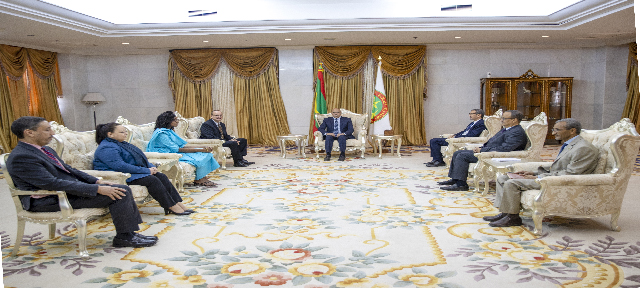
On 11 November, in Nouakchott, His Excellency Mr. Mohamed Ould Cheikh El Ghazouani, the President of the Republic, received a mission from the International Monetary Fund (IMF) led by Mr. Félix Fischer, the IMF Mission Chief for Mauritania.
The meeting focused on the areas of cooperation between Mauritania and this international financial institution and the means likely to develop and strengthen them in the service of the economic development of our country.
Soon after the meeting, Mr. Fischer made the following statement to the Mauritanian news agency:
“IMF staff has reached an ad referendum staff-level agreement with the Mauritanian authorities on a three-year program under the Extended Credit Facility (ECF) and Extended Fund Facility (EFF). This staff-level agreement is subject to the approval of IMF Management and the Executive Board scheduled for January 2023. The arrangements would give Mauritania access to IMF credit in the amount of SDR [64.40] million, equivalent to approximately US$[82.75] million, for a period of 39 months.
“Mauritania’s economic reform program supported by the IMF arrangements aims to preserve macroeconomic stability, to consolidate the foundations for sustainable, inclusive growth, and to reduce poverty. The program includes three pillars: (i) improving medium-term budgeting to maintain fiscal sustainability, to gradually reduce debt and to smoothen the volatility of extractive revenues and protect social spending; (ii) strengthening the monetary and foreign exchange policy frameworks and development of the money and foreign exchange markets to gain better control of inflation and to ensure that Mauritania’s economy is more resilient against exogenous shocks; and (iii) structural reforms designed to strengthen governance, transparency, and the private sector through an improved business climate and financial inclusion.
“The outlook is highly uncertain, and subject to downside risks. Tensions in the Sahel region, the spillovers from Russia’s invasion of Ukraine, and a global slowdown have intensified Mauritania’s economic challenges, and deepened inflationary pressures. This has in turn affected Mauritania’s fiscal and external balances, mainly as a result of rising oil and food prices. Nonetheless, economic growth has accelerated and is expected to reach 5.3 percent in 2022, driven primarily by the mining sector, agriculture, and fisheries. Inflation is expected to stabilize at approximately 11 percent as a result of the tight monetary policy conducted recently by the Banque Centrale de Mauritanie (BCM). The primary balance (excluding grants) is expected to register a deficit of 2.2 percent of GDP, against a primary surplus of 0.8 percent recorded in 2021, while external public debt will remain constant at approximately 43 percent of GDP at end-2022. Gross reserves should amount to approximately US$ 1.5 billion (equivalent to 5.1 months of prospective non-extractive imports).
“Global developments could weaken exports and extractive revenues and lead to further increases in import prices, resulting in a widening balance of payment needs that would exert pressure on international reserves and the fiscal outlook. The sharp rise in international commodity prices and more frequent climate crises in Mauritania could further fuel domestic inflation, increase food insecurity and jeopardize the economic recovery. There is also a risk of new waves of the COVID-19 pandemic. Prudent fiscal and monetary policies should therefore continue in order to maintain macroeconomic stability.”
“The mission is grateful to the authorities of Mauritania and to its stakeholders for their warm welcome, constructive meetings, and excellent cooperation.”