

Mauritanian President: Addressing Climate Change Is National Priority Requiring International Solidarity and Faster Implementation of Paris Agreement
Antalya
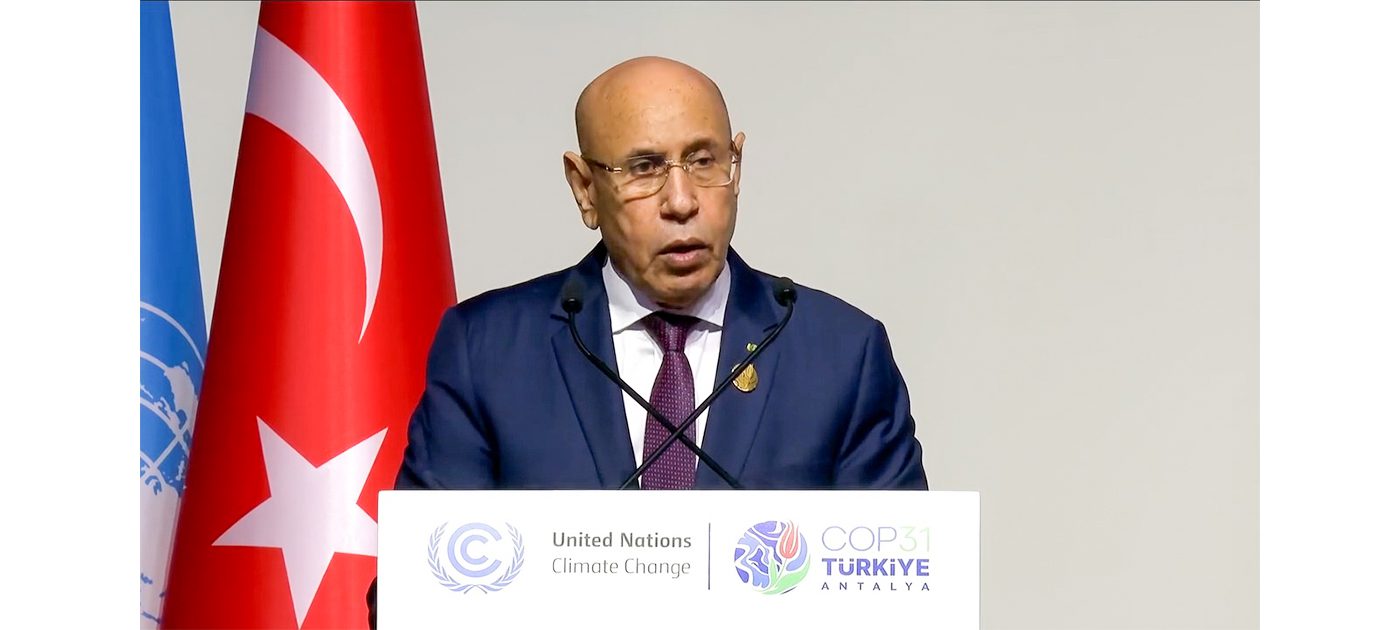
His Excellency the President of the Republic, Mr. Mohamed Ould Cheikh El Ghazouani, affirmed that Mauritania, despite its limited contribution to global emissions, is among the countries most affected by climate change, facing drought, water scarcity, desertification, and coastal erosion. Speaking at the Antalya Leaders’ Summit during COP31, he stressed the need for stronger climate adaptation measures and international cooperation to support vulnerable countries.
The following is the text of the speech by His Excellency the President of the Republic:
“In the name of God, the Most Gracious, the Most Merciful, and may peace and blessings be upon our Prophet Mouhamed, his family, and his companions.
Mr. President,
Your Excellencies and Highnesses, Heads of State and Government,
Your Excellencies,
Ladies and Gentlemen,
Distinguished Guests,
Peace be upon you, and may the mercy and blessings of God be upon you,
I am pleased, first of all, to congratulate the Republic of Turkey on its presidency of the 31st Conference of the Parties, and for organizing it with such meticulous care. I would like to thank the Federative Republic of Brazil for its efforts during its presidency of the previous session to strengthen multilateral climate action, and at the same time, I commend Australia’s role in leading the international negotiations related to this conference.
We wish the Republic of Ethiopia every success as it prepares to host the 32nd session of the Conference of the Parties.
Mauritania, despite its small carbon footprint, remains one of the countries most severely affected by climate change and its devastating consequences, such as drought, water scarcity, land degradation, desertification, coastal erosion, and others.
All of these factors have contributed to the fragmentation of our rural social and economic fabric, threatened our food security, and hindered our development through their negative impacts on marine ecosystems and natural ecosystems. Therefore, from our perspective, addressing climate change, strengthening our ability to adapt to it, and mitigating its negative impacts are among our top social, economic, and even security priorities.
Consequently, in collaboration with our partners, we are implementing ambitious programs to strengthen resilience to climate change, restore degraded lands, and combat desertification—such as our active contribution to the Great Green Wall Initiative, and our active role in the Sahel Climate Commission and the Joint Commission to Combat the Effects of Drought in the Sahel, to name just a few.
In November 2025, our country adopted its third Nationally Determined Contribution (NDC) for the 2035 horizon; the associated investment plan is currently being prepared, and our National Adaptation Plan is nearing completion. These two frameworks will enable us to improve the planning of our interventions, mobilize the necessary resources, and measure progress transparently.
At the same time, we are working to strengthen policies to protect vulnerable population groups and respond to climate shocks by building a comprehensive social safety net that supports the most needy families and enhances their capacity to cope with crises and difficulties that affect their living conditions.
These efforts are accompanied by structural reforms aimed at integrating the climate dimension into various public policies, with the involvement of stakeholders, particularly the private sector, research institutions, and civil society.
These reforms include adopting mechanisms to track spending and budgets allocated to climate action, reviewing water policy, reducing greenhouse gas emissions in the extraction sector, and incorporating climate criteria into the selection of public investment projects.
We are also working to harness our vast renewable energy resources and develop green hydrogen to accelerate our energy transition, attract sustainable investments, and create jobs.
However, in all these efforts, we—like most developing countries—still need increased international support to strengthen resilience and adaptation and to ensure a just and effective energy transition.
In this context, we call for climate finance that is accessible and tailored to the needs of our countries, and we also call for enhanced technology transfer, institutional capacity building, and increased technical and technological assistance. We hope that this conference will serve as an opportunity to strengthen trust among the Parties, accelerate the implementation of the Paris Agreement, and respond tangibly to the needs of the countries most vulnerable to and affected by climate change.
We are confident that by uniting our efforts, we can make climate action a catalyst for strengthening resilience, achieving sustainable development, consolidating stability, and instilling hope in the hearts of present and future generations.
Thank you, and may the peace and mercy of God be upon you.”