

Mauritania, UNESCO Hold High-Level Meeting on Vocational Training Partnership
Nouakchott
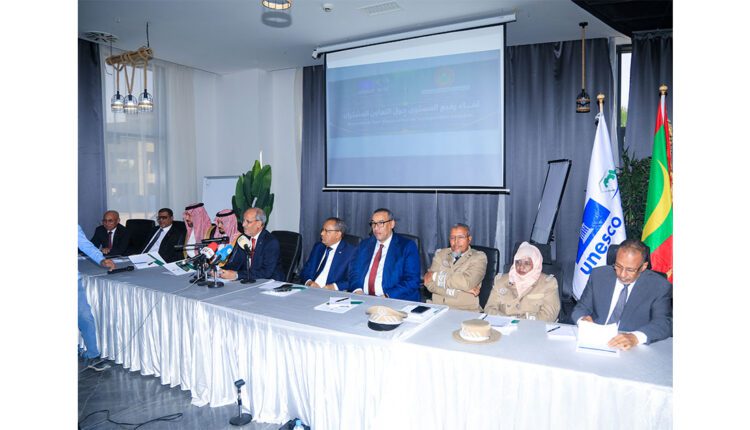
Nouakchott, 10 November 2026 – The capital, Nouakchott, hosted on Tuesday a high-level meeting to establish a strategic partnership between the Ministry of Vocational Training, Traditional Industry and Crafts and the UNESCO Regional Centre for Quality and Excellence in Education, aimed at developing the vocational training system in Mauritania, enhancing its quality, and aligning its outcomes with labour market requirements.
The opening of the meeting was chaired by the Minister of Vocational Training, Traditional Industry and Crafts, Mr. Mohamed Maa El Ainine Ould Eyih, in the presence of the Minister of Economic Affairs and Development, Mr. Mohamedou Ahmedou Mhaimid, and the Minister of Higher Education and Scientific Research, Mr. Yacoub Ould Moine, with the participation of officials and experts from the Ministry and the Centre, as well as representatives of the private sector and development-related companies.
In his address on the occasion, the Minister of Vocational Training, Traditional Industry and Crafts affirmed that vocational training constitutes an essential pillar of economic and social development, given its role in qualifying young people, enhancing their opportunities for integration into professional life, and providing the skills needed by the national economy.
He noted that the development of this sector remains linked to its ability to keep pace with economic transformations and respond to labour market requirements, explaining that the system, despite the achievements made, still faces challenges relating to updating the national strategy, improving the alignment of training with the needs of the economy, expanding partnership with the private sector, developing the quality and evaluation system, and strengthening governance and human and institutional capacities.
He considered that cooperation with the UNESCO Regional Centre offers an important opportunity to benefit from regional and international experiences and expertise, through conducting a comprehensive diagnosis of the vocational training system, based on the Arab Model for Technical and Vocational Education and Training, and working to update the national strategy and prepare a realistic implementation plan defining priorities and implementation mechanisms.
He stressed that achieving the desired objectives requires coordinating the efforts of the various governmental parties, the private sector, and technical and financial partners, expressing hope that the meeting would culminate in a practical action plan and a memorandum of understanding establishing a sustainable and effective partnership between the Ministry and the Centre.
For his part, the Director-General of the UNESCO Regional Centre for Quality and Excellence in Education, Dr. *Abdelrahman Ben Ibrahim Al-Mudayris*, affirmed that the Arab Model for Quality and Excellence provides a specialised reference framework for developing the quality of technical and vocational education and training, with the possibility of adapting it to the specificities of the Mauritanian context and its development needs.
He presented the four pillars on which the Model is based, explaining that its importance lies in linking strategic planning to quality of implementation, and in embedding evaluation and continuous improvement within institutional practices, with particular attention to measuring the quality of outputs and their impact on trainees, institutions, the labour market and society.
He added that the success of strategic partnerships does not stop at the level of ambitions and declared objectives, but is embodied essentially in the practical results they achieve, expressing his hope that the meeting would lead to a joint action plan and a phased implementation roadmap, including a clear definition of roles and responsibilities, the formation of a joint working team, and the adoption of effective governance and monitoring mechanisms, in addition to setting precise indicators to measure progress and achievement.
He affirmed the Centre’s readiness to mobilise its technical and knowledge expertise and capabilities to support all that has been agreed upon, in the belief that investment in the quality of technical and vocational education and training is, at its core, an investment in people, and in their ability to produce, innovate and participate actively in building their country.