

Prime Minister Opens High-Level Forum on Climate, Peace, Security in Sahel and Gulf of Guinea
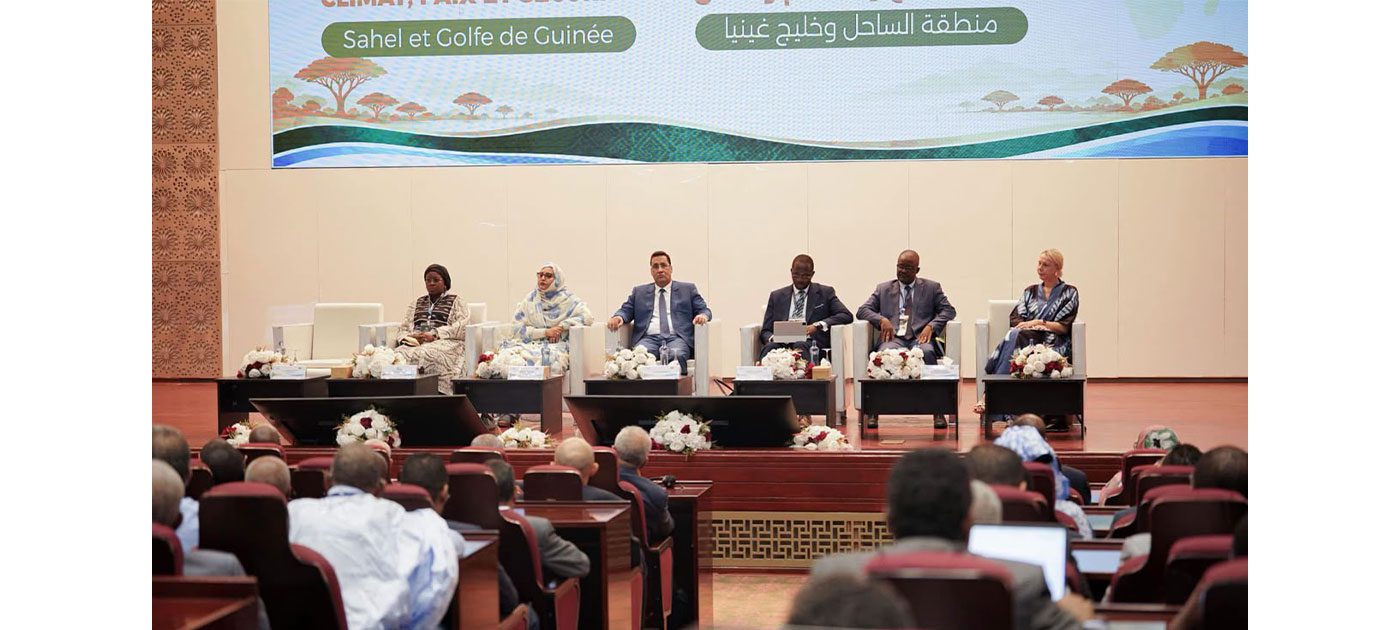
Prime Minister Mr. Mokhtar Ould Djay, on behalf of the President of the Republic, Mr. Mohamed Ould Cheikh El Ghazouani, presided on Tuesday over the opening of the High-Level Forum on Climate, Peace and Security in the Sahel and Gulf of Guinea regions, held at the “Mokhtar Ould Daddah” Conference Center in Nouakchott under the theme: “Together for Resilience and Peace.”
Organized in partnership with the United Nations Development Programme (UNDP) and scheduled to take place over three days, the forum aims to strengthen dialogue and consultation on common challenges related to climate change, peace, security, and development. It also seeks to promote the exchange of experiences and expertise and to explore ways to strengthen regional cooperation in order to build resilience and address the growing impacts of climate change.
In his opening remarks, the Prime Minister underscored the importance of the forum as a platform for dialogue on the close links between climate change, peace, security, and development. He noted that this edition builds on the Bamako Forum, held in November 2023, and represents a significant evolution through the expansion of consultations to include the countries of the Gulf of Guinea.
He explained that this expansion reflects the need for a regional approach based on the similarities and interdependence of the challenges facing the countries of the region, as well as on the principle of solidarity among them.
The Prime Minister stressed that climate change has become a factor of economic and social vulnerability, driven by extreme climatic phenomena such as drought, desertification, land degradation, and growing pressure on water resources, as well as flooding and coastal erosion.
He pointed out that these phenomena have profound repercussions on food security, population movements, and displacement, as well as on the stability of regions and economies in the Sahel and Gulf of Guinea.
He emphasized that climate action can no longer be separated from development policies, human security, and peacebuilding efforts, calling for climate considerations to be placed at the heart of public policies, investments, and crisis prevention and management strategies.
The Prime Minister drew attention to the particular vulnerability of the African continent to the consequences of climate change, despite its limited contribution to global greenhouse gas emissions. He stressed the need to strengthen international solidarity, particularly in the areas of climate finance, adaptation, technology transfer, and capacity-building.
He also underscored the importance of strengthening the capacities of African states, developing resilient infrastructure, protecting ecosystems, and promoting the sustainable management of natural resources, with a view to making climate resilience a driver of economic development, enhanced food security, job creation, and improved living conditions for populations.
The Prime Minister reviewed the efforts undertaken by Mauritania, under the directives of President of the Republic Mr. Mohamed Ould Cheikh El Ghazouani, in the areas of environmental protection, climate action, and sustainable development.
He noted that the government is working to translate these orientations into concrete policies and programmes aimed at strengthening the resilience of populations, protecting natural resources, supporting productive sectors, and mobilizing the investments needed to achieve sustainable and inclusive growth.
He added that the Nationally Determined Contribution (NDC 3.0), the land restoration and rehabilitation programme, the protection of coastal areas, biodiversity conservation, and the development of the green economy constitute key pillars of this approach, alongside enhanced intersectoral coordination to ensure that responses to climate risks are integrated into economic, social, territorial, and security policies.
Finally, he stressed that the holding of this forum in Nouakchott comes at a crucial time for the international climate agenda, ahead of the 31st Conference of the Parties (COP31), scheduled to take place in Antalya, Türkiye.
He called for this opportunity to be used to strengthen coordination, amplify the voice of the African continent and its peoples, together with their concerns and aspirations, and reaffirm the need to support the most vulnerable countries in a manner commensurate with the challenges they face.
The Prime Minister stressed the importance of regional cooperation as an essential tool for strengthening resilience, given that impacts relating to natural resources, pastoral and agricultural systems, coastal areas, river basins, and population movements transcend national borders. A collective response is therefore essential to address the challenges posed by climate change.
In this context, the Prime Minister emphasized the need to strengthen rapprochement and cooperation between the countries of the Sahel and those of the Gulf of Guinea by intensifying dialogue, consultation, information-sharing, and the harmonization of positions, as well as by sharing the results of early warning systems, promoting integrated and joint management of natural resources, and mobilizing investments to build more resilient areas.
He expressed the hope that the forum’s proceedings would result in practical and concrete recommendations capable of strengthening cooperation among the countries of the region and helping to transform climate from a factor that exacerbates vulnerability into a driver of development, stability, peace, cooperation, and shared prosperity for the peoples of the region and the African continent.
For her part, Minister of Environment and Sustainable Development Ms. Messouda Mint Baham Ould Mohamed Laghdaf affirmed that the holding of this conference in Nouakchott demonstrates the growing importance of issues related to climate change, human security, and sustainable development. It also reflects the urgent need to strengthen regional cooperation in order to address the common challenges facing the countries of the region.
She explained that the Sahel and Gulf of Guinea regions face a number of interrelated challenges and growing vulnerabilities, including the impacts of climate change, increasing pressure on natural resources, land degradation, the growing frequency of extreme weather events, as well as socio-economic challenges. She stressed that these transformations require a collective and innovative response based on solidarity, coordination, and the exchange of experiences.
The Minister stressed that addressing these challenges requires the adoption of an integrated approach that goes beyond a sector-by-sector response and is based on strengthening coordination among environmental policies, peacebuilding and stability efforts, security requirements, and sustainable development objectives, in order to ensure greater resilience in the face of growing crises and risks.
The Minister affirmed that Mauritania, guided by the enlightened vision of President of the Republic Mr. Mohamed Ould Cheikh El Ghazouani, attaches particular importance to strengthening the resilience of populations and ecosystems in the face of climate and environmental challenges. This approach is based on the firm conviction that environmental protection and the sustainable management of natural resources are two fundamental pillars for achieving stability and prosperity, strengthening social cohesion, and supporting sustainable development pathways.
She stressed that the challenge is not limited to combating the effects of climate change, but also requires investment in sustainable solutions, strengthening the capacities of local communities, and developing regional cooperation mechanisms in order to transform environmental and climate challenges into opportunities to promote development and stability.
The Minister expressed her sincere thanks and deep appreciation to all partners who contributed to the organization of the meeting, particularly the United Nations Development Programme (UNDP), as well as the various regional and international institutions and organizations that support peace efforts, strengthen resilience, and promote sustainable development pathways in the region.
She concluded by stressing that pooling efforts and strengthening partnerships among the various stakeholders remain essential to developing more effective and sustainable responses capable of addressing climate and environmental challenges, consolidating security and stability, and supporting the development process in the Sahel and Gulf of Guinea regions.
For his part, the Resident Representative of the United Nations Development Programme (UNDP) in Mauritania, Mr. Mansour Ndiaye, stressed that the holding of this forum is of great importance for the Sahel and Gulf of Guinea regions, which are rich in natural resources and characterized by strong political will and growing ambition for comprehensive and integrated development.
He explained that the region represents a promising area for productive investment, but that climate change has become a risk multiplier, exacerbating existing vulnerabilities, increasing pressure on natural resources, and affecting population movements, social cohesion, and integration among communities.
He stressed that the United Nations Development Programme and the United Nations system are fully prepared to work alongside governments, regional organizations, the private sector, civil society, and other stakeholders to make this forum a concrete platform for directing investments toward shared priorities and promoting cooperation and the convergence of efforts.
The UNDP Resident Representative in Mauritania stressed that climate, peace, and security issues are interdependent and constitute key factors in achieving sustainable development and strengthening resilience, thereby contributing to consolidating stability, enhancing security, and supporting development pathways in the Sahel and Gulf of Guinea regions.
He added that pooling efforts, strengthening partnerships, and mobilizing and directing resources toward shared priorities would make it possible to develop practical and sustainable solutions to the interconnected challenges facing the region and support its peoples’ aspirations for peace, stability, and development.