

President of Republic in Adrar: Listening to Citizens and Informing Them on National Affairs Are the Main Goals of the Visit
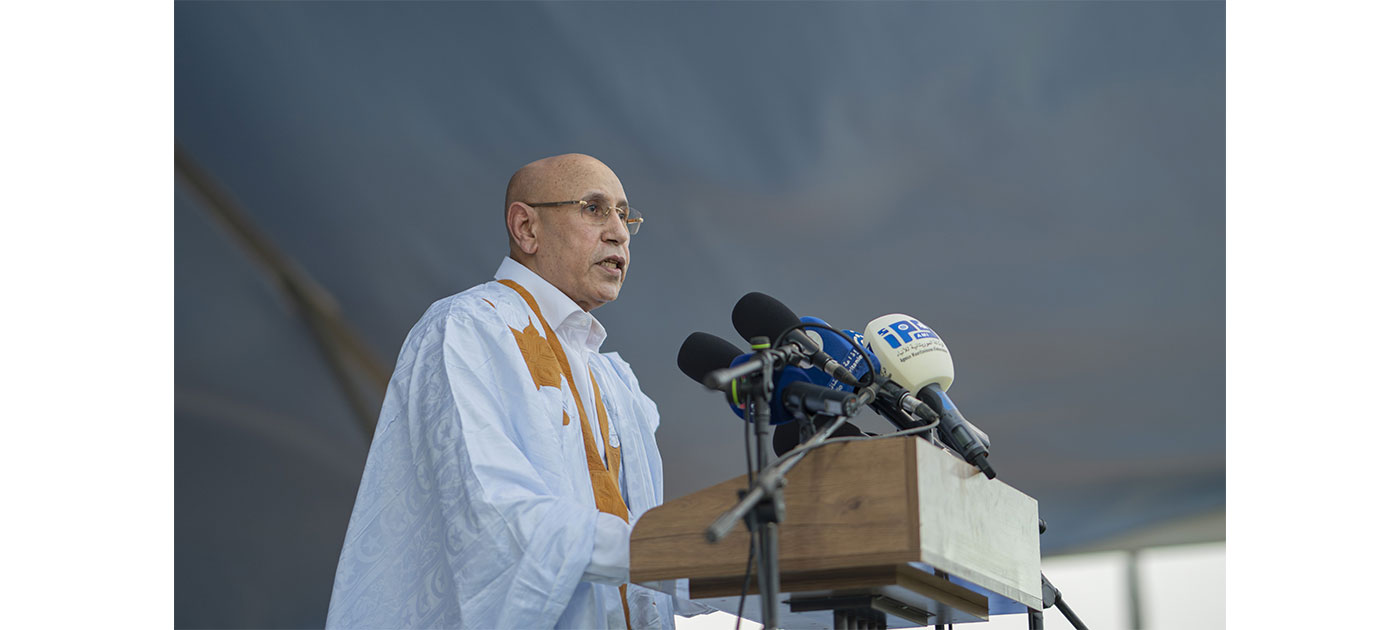
His Excellency the President of the Republic, Mr. Mohamed Ould Cheikh El Ghazouani, chaired a large public rally in Atar on Sunday evening, at the beginning of the working and information-gathering visit he is currently undertaking in the Wilaya of Adrar.
His Excellency the President of the Republic explained that his visit to the wilaya serves two essential objectives. The first is to listen to the population, learn from them about the situation in the wilaya, understand the main challenges and problems it faces, and identify the priorities that require prompt attention.
The second objective is to inform the population of the wilaya about the general situation in the country and engage with them in an exchange of views on a number of major national issues, with a view to strengthening communication and consultation on matters of common interest.
His Excellency the President of the Republic expressed his gratitude to the people of the Wilaya of Adrar for their strong and remarkable presence, both in terms of numbers and diversity, as well as for the warm public welcome extended to him upon his arrival in the city of Atar. He said that this mobilization reflected their patriotic spirit, their constant interest in public affairs, and their willingness to support the process of nation-building and the consolidation of the country’s development.
Below is the text of the speech delivered by His Excellency the President of the Republic before the people of the Wilaya of Adrar:
“People of the Wilaya of Adrar,
Assalamou alaykoum wa rahmatoullahi wa barakatouhou.
I thank you, dear citizens of the Wilaya of Adrar, for your presence this evening, for the massive welcome you extended to me a few moments ago, and for this large, vibrant, and diverse public rally.
I am happy and reassured to stand before you today, in the presence of this remarkable audience, remarkable both in number and in spirit, which testifies to your patriotic spirit, your constant interest in public affairs, and your steadfast support for the country’s nation-building and development process.
People of the Wilaya of Adrar,
My visit among you today has two essential objectives.
The first is that I have come to listen to you and learn from you about the situation in your wilaya, the problems it faces, and the priorities that we must address as soon as possible.
The importance we attach to this objective stems from our deep conviction that every citizen, wherever they may be, must equitably benefit from the resources and potential of their country; that every wilaya must play an effective role in defining its priorities, building its present, and preparing its future; and that local needs must become an essential component in the formulation of development decisions.
Our conviction is that whenever development indicators improve at the national level, this improvement must be reflected across the wilayas, moughataas, and communes through bringing state services closer to citizens, improving education and the healthcare system, strengthening water, electricity, and road networks, and creating employment opportunities that significantly expand prospects for local development.
This requires a more equitable distribution of investments and the opening of new horizons for regions that, for historical, geographical, or economic reasons, have hitherto benefited less from the development process.
Ultimately, our objective is for every citizen to feel that their share of the opportunities offered by their country, of state services, and of the fruits of economic growth reaches them on the basis of equity and equality.
We are fully aware of the development challenges facing your wilaya, notably the need to intensify efforts to open up isolated areas, mobilize surface and groundwater resources, and promote and develop the wilaya’s immense agricultural and tourism potential.
This awareness is reflected in the volume of public investment allocated to the wilaya since 2019, which has reached 40 billion old ouguiyas. It is also reflected in the share allocated to your wilaya under the Program for Access to Essential Local Development Services, currently under implementation, which amounts to 12 billion old ouguiyas.
In your wilaya, this program covers 206 projects in the fields of education, health, water, electricity, and the opening up of isolated areas.
Nationwide, implementation of this program is progressing under good conditions, with a completion rate that has so far reached nearly 68 percent.
We have instructed the Government to dispatch ministerial missions to the various wilayas to identify needs and shortcomings, in consultation with citizens, in preparation for the launch of the second phase of this program.
Among the main achievements that your wilaya is set to benefit from under this program this year are, notably, connecting the city of Atar to the national electricity grid before the end of the year, incha Allah; launching the reconstruction of 75 kilometers of the Akjoujt–Atar road as a first phase; continuing studies aimed at finding sustainable solutions to the water problem in the wilaya; launching reconstruction works on the urban roads of the city of Atar; and continuing efforts by the agriculture and tourism sectors to create an economic dynamic in oasis agriculture and enhance the wilaya’s tourism appeal.
Regarding the details of the wilaya’s development situation, particularly its potential, achievements, prospects, and the challenges it faces, these will be discussed during meetings scheduled to take place at the level of each moughataa.
The second objective of this visit is to inform the population about the general situation in the country and exchange views with you on some of the major national issues.
As for the general situation of the country, it is, as I have repeatedly stated, good, with the help of Allah and thanks to the efforts we all make.
Security is ensured, thanks to the sacrifices made by our armed forces and security services. The political situation is normal, and the institutions of the Republic are functioning regularly. The country maintains excellent relations with its brothers, neighbors, and partners. Its standing is preserved, and its efforts are appreciated at the regional and international levels. The economic situation is under control. We forecast a growth rate of around 5 percent this year, despite the negative effects of the international situation on prices and supply chains. National markets are abundantly and normally supplied.
The Government is making significant efforts to limit increases in the prices of consumer goods, in partnership with economic operators; to continue providing direct support to low-income households and retired workers; and to continue implementing the development programs and major projects to which we have committed.
However, this does not mean that there are no problems, difficulties, and dysfunctions, nor that it would not have been possible to do better.
For example, the energy crisis raging globally as a result of the deterioration of the security situation in the Middle East has caused an unprecedented rise in oil prices, with the price of a ton of diesel increasing from $726 to $1,500.
Our country has been affected by this crisis, like all other states, and citizens have been particularly affected by the resulting price increases.
Despite this, during the first two quarters of the year, the Government has so far allocated 36 billion old ouguiyas to support the price of this product. The support bill for the third quarter of the year is expected to exceed 20 billion old ouguiyas.
Without this support, the price of diesel, for instance, would have reached between 800 and 900 old ouguiyas.
We have also allocated more than 20 billion old ouguiyas so far to provide direct support to low-income households, workers, and retirees. The most recent operation, the “Aoun” program, benefited more than 350,000 families.
All of this testifies to our capacity, with the help of Allah, to withstand crises and challenges. This capacity is strengthened each time our social cohesion is consolidated and our domestic front is strengthened.
We must therefore all actively contribute to strengthening this domestic front so that each generation can hand down to the next a more united homeland, carrying more hope, more prosperity, greater justice, and greater equity.
I recall, in this regard, a speech delivered by founding President Mokhtar Ould Daddah to the inhabitants of the city of Atar, three years before independence. He had then been elected in your wilaya as a territorial deputy.
On that occasion, he shared with those present his reflections on the future of a country that was still under construction, asking them, and asking himself with them, what kind of Mauritania they desired.
The State has changed considerably since that time. It has certainly undergone profound shocks, but it has emerged stronger thanks to the cumulative, valued, and commendable efforts made by several successive generations of its leaders. Its circumstances have changed, its population has doubled, and it has become predominantly young, better educated, better trained, more open, and more ambitious in its aspirations. The country has also undergone considerable urban transformation. Its institutions have developed, society’s needs have increased, and its aspirations have reached new heights.
Despite all these transformations, the fundamental question posed at the time by President Mokhtar Ould Daddah remains current and relevant, and we continue, generation after generation, to strive to answer it.
Our responsibility today is to update the answer to this question in light of our present circumstances by asking ourselves sincerely: Does the institutional system established in the past, within which we continue to operate, suffice to meet the current needs of the State and society? And what must we develop within it so that the State remains capable of reinforcing national unity and social cohesion, consolidating the State of citizenship, law, and institutions, and fulfilling the aspirations of its citizens for development, justice, equity, dignity, and prosperity?
I harbor great hope that the inclusive national dialogue to be held soon, incha Allah, will make it possible to reach a broad consensus on major national issues and contribute to strengthening the national pact, making it more capable of integrating the reality of a rapidly evolving country and more representative of the aspirations of its new generations.
I do not mean by this that we must redefine the homeland, undermine its foundations and republican principles, or alter its cultural and civilizational identity. What I mean is that we must emerge from this dialogue with stronger social cohesion, a consolidated bond of citizenship, greater justice and equity, and stronger, more harmonious, and more effective institutions that are better able to adapt to the evolution of reality.
This dialogue must be inclusive and serious, recognizing neither taboos nor orientations imposed by any party whatsoever. Its conclusions must stem exclusively from its own deliberations. Only under this condition can it constitute a sincere expression of what we all want for our country.
Peoples who do not question their trajectories, reassess their strategies, and project themselves into the future are, in most cases, the least capable of resisting, adapting, and enduring.
Therefore, I call upon all participants in the upcoming dialogue to give precedence to the general interest and to constantly demonstrate flexibility and responsibility. I hope that all Mauritanians will contribute constructively to the success of this dialogue.
I thank you.
Assalamou alaykoum wa rahmatoullahi wa barakatouhou.”