

President of Republic: We are working to make our Diversity rich and our differences strong and complementary
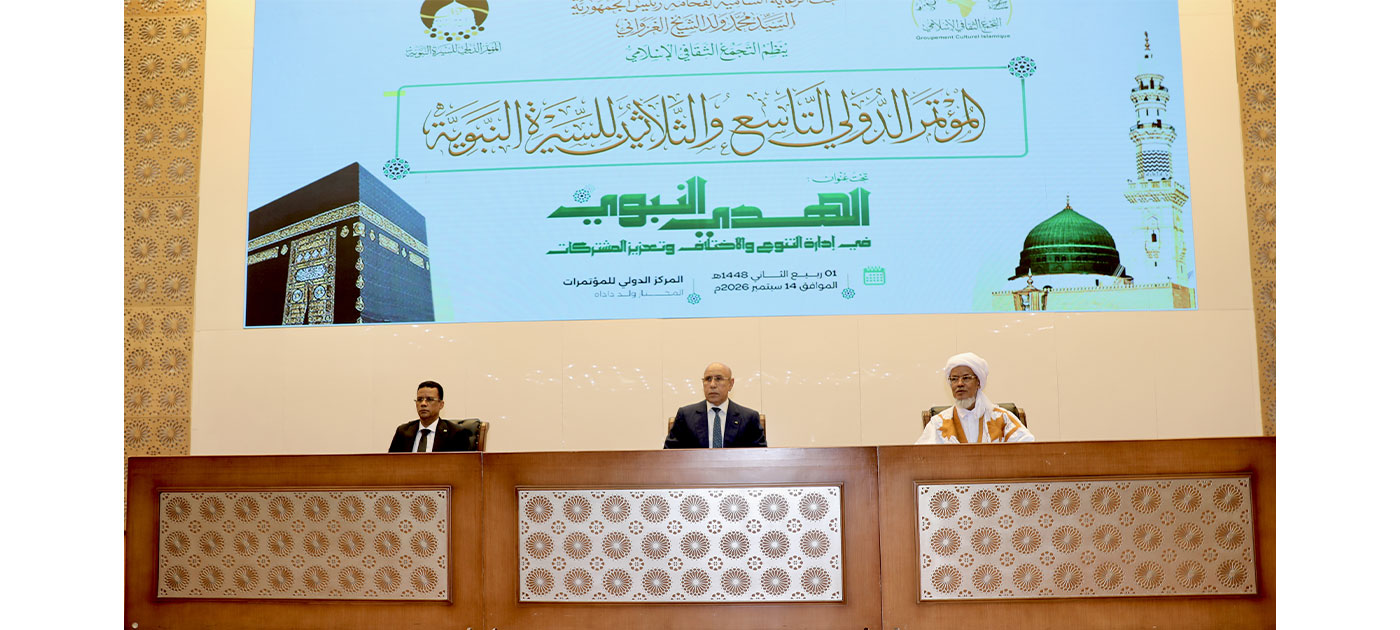
His Excellency the President of the Republic, Mr. Mohamed Ould Cheikh El-Ghazouani, indicated that diversity and difference are natural characteristics of human existence, and that the true challenge does not lie in their existence, but in how they are managed and transformed into sources of enrichment, integration, and strength, rather than factors of division, violence, and extremism.
His Excellency the President of the Republic made these remarks in a speech delivered on Monday at the opening of the 39th session of the International Conference on the Biography of the Prophet. He emphasized that societies and countries that are able to effectively manage their diversity and differences are better positioned to strengthen social cohesion and accelerate progress and development.
Here is the full text of the speech:
“Mr. Prime Minister;
Mr. President of the National Assembly;
Mr. President of the Foundation of Democratic Opposition;
Honorable Ministers;
Excellencies, members of the diplomatic corps;
Gentlemen, leaders of the military and security services;
Mr. Wali of Nouakchott West;
Madam President of the Nouakchott Region;
Ladies and gentlemen, elected officials;
Mr. President of the Islamic Cultural Association of Mauritania and West Africa;
Eminent scholars, thinkers, and researchers;
Dear participants,
It is my honor to welcome you to the Islamic Republic of Mauritania, among your brothers, and to thank you for your participation in this blessed scientific conference.
I would also like to express our appreciation to the organizers of the Islamic Cultural Rally for their efforts to serve the Prophet’s biography and for their constant commitment to ensuring that the topics of this conference remain closely linked to the most important challenges facing our societies, as is the case with this current session, held under the theme: ‘The Prophet’s Teachings in Managing Diversity and Differences and Strengthening Common Ground.’
Ladies and gentlemen,
The very nature of human existence is characterized, in general, by diversity and differences in races, colors, languages, as well as cultural and civilizational origins. Such is the law of God in His creation.
Since dignity is fundamentally inherent in the human being as a human being, and not in secondary characteristics such as skin color, language, or other attributes, diversity—just like difference—is a natural phenomenon that poses no problem in itself. The problem, and therein lies the challenge, is how it is managed and organized.
When managed well, diversity becomes a factor of enrichment, integration, and strength that reinforces social cohesion and accelerates progress and development. When managed poorly, however, it becomes a negative factor that leads to the weakening of the bonds of citizenship and social cohesion, and subsequently to division, discord, violence, and extremism. Nothing is more destructive to societies and states than their inability to manage and organize the diversity and differences that characterize them.
The instability, violence, terrorism, and conflicts witnessed throughout our world are, in many forms, a stark testimony to this reality.
Faced with the magnitude of the challenge posed by the management of diversity, it is urgent today to draw inspiration from the Prophet’s example in his approach to difference, relying on the noble Islamic value system that upholds equality in dignity, fraternity, solidarity, acceptance of others, as well as justice and equity.
It was thanks to this value system that the Messenger of God—peace and blessings be upon him—transformed diversity and difference within the nascent Islamic community of that time, moving away from the narrow confines of ethnic and tribal sectarianism toward the grandeur of the Ummah and the bond of faith uniting all believers.
However, embodying these values of equality, fraternity, justice, and equity is not limited to glorifying or encouraging them. Above all, it requires transforming them into a living spirit that animates our relationships, our behavior, our institutions, and the various ways in which we manage public affairs.
This is what we have worked toward, and continue to work toward, with perseverance and determination: adopting an approach of openness toward all; promoting a culture of dialogue, consultation, and respect for those with divergent opinions; and adhering to the common values that unite us, such as religion, citizenship, shared history, belonging to the same land, and a common destiny.
Likewise, we are working to strengthen institutions, consolidate the rule of law, anchor social justice, and progressively rebalance its principles through intensive support for the most vulnerable groups, the fight against poverty and exclusion, the reinforcement of social cohesion, and the promotion of national unity, so that our diversity becomes a source of wealth and our differences become a source of strength and complementarity.
We are determined to build a society at peace with itself, purged of the remnants of historical injustices and the legacies of the past, where citizenship and consideration for common ground take precedence over everything else, and which draws from its diversity the strength to achieve its aspirations.
We must all realize the magnitude of the responsibility incumbent upon us regarding the necessity of successfully carrying out this societal project, always keeping in mind that our success in this domain depends, to a large extent, on our ability to properly manage and harness the wealth of diversity and difference with which God has blessed us.
Scholars, thinkers, and researchers have, at this precise level, a role of paramount importance, given the responsibility incumbent upon them to promote a correct understanding of religion, foster a culture of balance and moderation, and provide serious scientific answers to the questions preoccupying new generations, in order to prevent extremism and fanaticism and reconcile the authenticity of the Islamic reference with the imperatives of the modern state.
In declaring, with God’s blessing, the opening of this conference, I wish its proceedings every success and achievement.
I thank you, and may peace, mercy, and blessings of Allah be upon you.”