

Minister of Real Estate and State Properties: Halting the real estate bleeding required practical solutions that take into account the interests of citizens.
Nouakchott
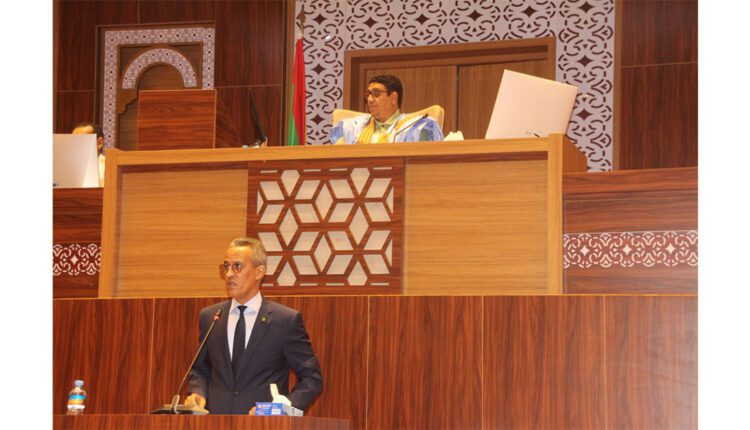
The National Assembly allocated its public session held this evening, chaired by Mr. Hassan Cheikh Baha, Vice President of the Assembly, to listen to the responses the Minister of Real Estate, State Property, and Land Reform, Mr. Mokhtar Ahmed Bouceif, to two oral questions posed by deputies Ahmedou Mohamed Mahfouz Mbaala and Mohamed Yahya Al-Mustapha.Deputy Ahmedou Mohamed Mahfouz Mbaala explained in his question that the urban reality of Nouakchott and the interior cities is facing many problems that endanger citizens’ properties and create numerous issues in different regions of the country.He inquired about the plans and measures taken by the sector of Real Estate, State Property, and Land Reform to overcome these challenges.As for the question from Deputy Mohamed Yahya El-Mustapha, he indicated that the real estate market is experiencing an unprecedented rise in the prices of land parcels, leading to significant difficulties for citizens, especially low-income groups, in accessing decent housing, in addition to the exacerbation of land disputes related to ownership and use.
He expressed surprise at the leniency in granting “building permits” on plots of land that do not meet the minimum requirements for urban qualification and basic services, questioning the plans and mechanisms that the ministry currently relies on or intends to implement in the future to solve these issues.In response to the two questions, the Minister of Real Estate, State Property, and Land Reform highlighted the importance of the real estate sector for the population, pointing out that Mauritanians, like other people around the world, view real estate as an entry point for investment, housing, ownership, and saving. This relationship was discovered by them since the 1970s during the years of drought and the accompanying waves of migration from rural to urban areas.He explained that the real estate sector, since the country’s independence, has been managed by several ministries and uncoordinated authorities, in addition to the chaos that characterized the interaction of the administration in this area and the beneficiaries, as well as the brokers, which contributed to the emergence of the phenomenon of random settlements (gazra).
 The Minister reviewed the discrepancies in the real estate sector in Mauritania, confirming that His Excellency the President of the Republic, Mr. Mohamed Ould Cheikh El Ghazouani, based on previous observations, realized the necessity of establishing a dedicated sector for real estate to resolve all these issues, which was accomplished in August 2024.He stated that the sector began to perform its duties with its current administrative structure and the regulations that granted it authority, starting in March 2025, noting that after receiving the files from other sectors, the sector created a clear vision of the extent of the discrepancies and major challenges in the real estate sector.
He reviewed the problems faced by the sector, such as rural cuts, dual grants, compensation requests, planning issues, and the lifting of encryption.He added that the existing political will, proper diagnosis, awareness of the scale of challenges, and prioritization are all factors pushing the sector to address property issues in Nouakchott first, given that it is the country’s front and most of the problematic properties are located there.He indicated that after resolving these issues, this experience will be generalized to all other internal states using the same methodology, awaiting the establishment of guiding plans and subdivision plans in these districts.
He confirmed that the cessation of the “Ghazra” bleed occurred in areas of Teyaret where brokers operate, causing disputes over real estate, and in Tevragh Zeina, which has many rural land seizures and planned development projects that have not seen the light of day. In addition, some citizens are carrying out economic projects there without having documents proving their ownership of those plots.He affirmed that stopping the real estate bleed requires finding objective solutions that take into account the interests of citizens and the state’s prestige, which holds exclusivity in planning and granting, adding that the expansion of the city of Nouakchott results in issues related to providing public services for the residents.