

President of Republic: “Mauritania Remains a Secure and Stable Nation, Advancing Development and Strengthening National Unity”
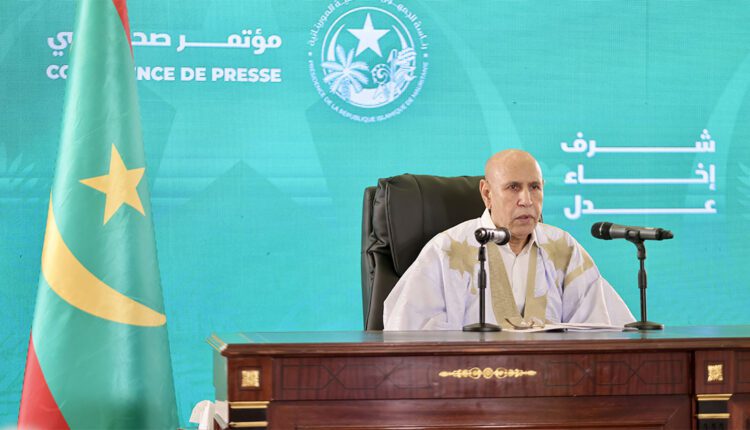
His Excellency Mr. Mohamed Ould Cheikh El Ghazouani, the President of the Republic, reaffirmed on July 24 that Mauritania is a safe and stable country whose institutions are functioning normally. He added that efforts are continuing to strengthen social cohesion and national unity, improve citizens’ living conditions, and build a more resilient economy despite the impact of successive international crises.
Speaking at a news conference held at the Presidential Palace in Nouakchott with both national and international media, the President explained that the meeting was an opportunity to inform the public and reinforce citizens’ right to access information. It also served as a forum to discuss his social and development agenda, which he presented during his 2019 presidential election campaign.
He emphasized that this agenda places the individual citizen at the center of development and public policy, with the goal of building a modern state supported by strong institutions capable of serving the people and achieving the Mauritania that all citizens aspire to, a nation founded on freedom, justice, equality, and prosperity.
The President noted that implementing this vision involves addressing several major challenges, including political issues, improving governance, strengthening national unity and social cohesion, combating poverty, injustice, and vulnerability, and building a productive and diversified economy. He also stressed the importance of maintaining security and stability in light of the current regional and international environment.
He further recalled that his “Taahoudaty” (“My Commitments”) and “My Ambition for the Nation” programs were designed to address these challenges and continue implementing reforms based on the achievements of his first term and the new priorities of the current phase.
Mr. Mohamed Ould Cheikh El Ghazouani explained that the country’s development trajectory was affected by the global crises that began at the end of 2019, particularly the COVID-19 pandemic, followed by the war in Ukraine, as well as the conflict in the Middle East. He noted that these crises disrupted global supply chains and financing for businesses, affecting world economies, international trade, and the multilateral international system.
He stated that although Mauritania was not a direct participant in these crises, it nevertheless experienced their consequences. He emphasized that national efforts have enabled the country to make significant progress in implementing the government’s programs and added that work is continuing at an accelerated pace to achieve the objectives of the “My Ambition for the Nation” program.
Regarding the political sphere, the President said that Mauritania has made important progress toward normalizing relations between the State and the country’s various political actors, as well as among political actors themselves. This has been achieved by fostering a culture of mutual respect and allowing each party to play its role without resorting to rhetoric that demeans or excludes others.
He stressed that strengthening national unity, consolidating the rule of law, developing the democratic system, and combating corruption are ongoing processes that require continuous effort. These are not goals that end with the completion of a single project but rather require sustained commitment over time.
On the social front, the President highlighted progress in promoting social cohesion, expanding social protection programs, and improving access to essential public services, particularly water, electricity, healthcare, and education. He also noted that administrative reforms are continuing to make public institutions more responsive and accessible to citizens.
With regard to the economy, he said that Mauritania has recorded improvements across several key indicators as a result of policies aimed at diversifying the economy and strengthening its ability to generate added value and create employment opportunities. He also pointed to reforms implemented in the productive sectors, the private sector, and the informal economy.
The President of the Republic explained that these efforts have had a positive impact on the country’s overall economic indicators, which have shown improvements in several areas, including gross domestic product (GDP), inflation, the debt-to-GDP ratio, and the trade balance. He said these results reflect the strength of the economy and its ability to withstand various challenges.
Regarding security, the President emphasized that security and stability are the foundation upon which all development efforts depend, noting that much work remains to be done in this area.
He added that Mauritania has succeeded, through the efforts of its armed forces and security services, in strengthening its preparedness and capacity to respond to a wide range of security challenges by adopting a multidimensional security strategy.
In response to a question about the possibility of amending the Constitution to allow him to seek a third presidential term, President Mohamed Ould Cheikh El Ghazouani said that the issue is not a priority at this time and that he sees no connection between it and the ongoing national dialogue process.
He explained that raising this debate at the very beginning of his second term, which is still in its early stages, means focusing on future political questions at the expense of the country’s immediate priorities. He stressed that attention should instead remain on implementing development programs and serving the needs of citizens.
He added that debating the issue does not serve the public interest and is driven more by political speculation than by practical realities. He then reaffirmed his commitment to the Constitution and to the will of the people, stating:
“I will not do anything that is not provided for in the Constitution and that the people do not want.”
The President concluded by assuring that, until the end of his term, his efforts will remain focused on implementing his electoral program and continuing the country’s reform and development agenda. He expressed hope that the person chosen by the Mauritanian people in the 2029 presidential election will build upon the achievements made so far, in the service of the nation and its continued development.Top of Form
Bottom of Form
Regarding a question about his assessment of the government’s performance, Mr. Mohamed Ould Cheikh El Ghazouani said that his evaluation is based on results achieved on the ground, rather than on impressions or rhetoric, while also taking into account the views of all stakeholders, whether from the opposition, the governing majority, or ordinary citizens.
He explained that the government has been working in a difficult regional and international environment but has nevertheless succeeded in implementing reforms and development projects, while making significant progress in the areas of water, electricity, education, healthcare, and other essential public services.
The President praised the efforts of the Prime Minister and members of the government, stating that the achievements made so far are substantial. However, he emphasized that the country’s ambitions remain high and that not all of the government’s objectives have yet been achieved.
He stressed that the next phase will require greater efficiency and a faster pace of implementation, calling on the government to intensify its efforts to fulfill its commitments and address the country’s current challenges.
In response to a question about the main challenges facing the “My Ambition for the Nation” program, President Mohamed Ould Cheikh El Ghazouani said that challenges remain present at every stage of the program’s implementation. He emphasized that the foremost priority is to continue advancing the country’s development and reform agenda in a regional and international environment characterized by instability and rapid change.
He added that the uncertainty prevailing around the world makes it extremely difficult to anticipate future developments, creating additional challenges for the implementation of Mauritania’s national development programs.
The President of the Republic affirmed that, despite these circumstances, Mauritania continues to implement its development program. He considered that these challenges are not unique to the country but affect many nations facing profound transformations taking place on the international stage.
Regarding the issue of corruption, particularly in contracts related to hydrocarbons, mining, and direct-award contracts, His Excellency President Mohamed Ould Cheikh El Ghazouani stated that corruption is one of the most serious challenges confronting states. He stressed that combating this phenomenon is a priority, as no public policy that tolerates or protects corruption can achieve development or guarantee justice.
He said he does not share the view that corruption has increased recently, noting that the indicators available to the State, and sometimes provided by technical and financial partners, show, on the contrary, that corruption is declining.
He added that these indicators include the increase in state financial resources, the growth in the number of projects and programs financed through national resources, and the improvements observed in the implementation of development projects, despite delays that some initiatives may experience.
His Excellency the President emphasized that the increase in public investment and the expansion of development and social projects completed or currently underway demonstrate the effectiveness of efforts made to strengthen governance. He added that the implementation of major projects financed through national resources is incompatible with the existence of a level of corruption as high as is often alleged.
The President recalled that the fight against corruption should not be linked to individuals but should instead rely on institutional work that ensures continuity and effectiveness. He stressed that institutions are the main guarantee for establishing good governance and achieving progress.
He clarified that sanctions fall exclusively within the authority of the judiciary and that he does not interfere in any case involving any individual, whether a minister or an administrative official. He stressed that only the judicial authority is empowered to determine responsibilities and issue rulings.
He stated that in 2025, several corruption cases were referred to the courts, involving more than one hundred individuals. Some of them were placed under judicial supervision or formally charged, while other officials lost their positions due to cases related to mismanagement.
The President of the Republic emphasized the need to strengthen the role of institutions and enable them to fully carry out their responsibilities. He recalled that each institution has clearly defined powers under the Constitution and the law: the government exercises executive authority, the judiciary exercises its authority independently, and Parliament is responsible for legislative functions.
He noted that reducing the responsibilities of the State to a single person or a single institution does not support the process of institution-building. He reiterated the fundamental principle of avoiding interventions that could undermine the independence of institutions and allowing each one to exercise its powers within the legal framework governing its operations.
The President stated that the fight against corruption cannot be an individual responsibility but rather a collective responsibility requiring the participation of everyone, each at their own level. He stressed that corruption is a complex and multidimensional phenomenon.
He explained that corruption is not limited solely to financial and administrative aspects but also includes ethical, social, and political dimensions, which he said create the environment in which financial and administrative corruption can flourish.
He added that effectively eliminating corruption requires the adoption of a comprehensive and institutional approach based on strengthening the capacities of state institutions so that they can fully perform their duties, developing mechanisms for oversight and accountability, and respecting the powers granted by law to each institution.
President Mohamed Ould Cheikh El Ghazouani affirmed that strengthening institutional capacities and improving institutional performance, while ensuring that institutions fully assume their responsibilities, represent the best means of reducing corruption and establishing good governance. He stressed that building a strong state necessarily depends on effective institutions capable of carrying out their responsibilities fully.
In response to a question regarding security transformations in the region and their consequences, His Excellency the President stated that Mauritania, as a Sahel country, faces common security challenges with neighboring states. He said that the nature of current threats requires adopting a broader concept of security that goes beyond traditional geographical borders.
He explained that what can be described as “geographical security” means that the security of each state is closely linked to its regional environment and to the situation prevailing in neighboring countries. He affirmed that Mauritania is working to strengthen its relations with countries in the region and develop joint cooperation to address these challenges.
He added that protecting the country requires, alongside strengthening regional cooperation, the continued development of the capabilities of the armed and security forces, as well as enhancing their level of preparedness to confront various threats. He considered these forces to be the guarantors of national security and the protection of the country’s interests.
The President of the Republic stated that the experience of the G-5 Sahel served as an important framework for cooperation, given the geographical and security similarities among the countries of the region, particularly the vast desert areas and the difficulties they present in terms of monitoring and control.
He said that cross-border security challenges require permanent coordination among states, as groups and organizations threatening stability do not recognize national borders. He stressed that collective action and the integration of security approaches have become essential to address risks and strengthen regional security.
President Mohamed Ould Cheikh El Ghazouani assured that Mauritania’s relations with neighboring countries are excellent, emphasizing that the country continues its efforts to strengthen regional cooperation while developing the capabilities of its defense and security institutions so that they can carry out their missions under the best possible conditions.
He recalled that the Republic of Mali is a direct neighbor of Mauritania and that the two countries share deep historical, human, and economic ties. He noted that Mali is going through a difficult period and that, drawing on its own experience in dealing with similar security challenges, Mauritania is managing the situation with wisdom and prudence to preserve bonds of brotherhood and good neighborly relations.
Regarding refugees, the President stated that the security situation in the region will not affect Mauritania’s reception of its Malian brothers and other refugees. He explained that Mauritania is hosting nearly 150,000 refugees in the Mberra camp, while the camp’s initial capacity was estimated at between 50,000 and 60,000 people.
He added that the country continues to provide hospitality and assistance to refugees despite the pressures placed on host areas. He affirmed that all newcomers are welcome, subject to completion of the legal procedures for identification and registration.
Regarding irregular migration, His Excellency the President of the Republic explained that it is a global phenomenon that continues to grow. He noted that Mauritania has, in recent years, become a destination for some migrants due to the security, stability, and opportunities it provides. He emphasized that the country welcomes those seeking to improve their living conditions, provided that they respect national laws.
He clarified that respecting these laws requires entering the country through legal channels and regularizing the administrative status of the individuals concerned. He observed that the real problem does not lie with migrants themselves, but rather with trafficking networks that facilitate irregular migration, exploit migrants’ vulnerability, and put their lives at risk.
The President affirmed that the State will continue to fight these criminal networks firmly, considering that they engage in human trafficking and exploit migrants’ needs for illegal financial gain.
In response to a question regarding the assessment of the impact of completed projects on development and the contribution of government action to achieving territorial equity, particularly for the regions of the River Valley, His Excellency the President emphasized that development is an evolving and continuous process, closely linked to citizens’ aspirations and the changing nature of their needs.
He explained that meeting basic needs naturally creates new expectations, which is a normal evolution within societies. Thus, after access to water is achieved, the need for distribution networks emerges, followed by electricity and other services. Similarly, demands for improved connectivity gradually evolve, moving from unpaved tracks to paved roads. According to him, this evolution does not reflect dissatisfaction with achievements already made, but rather represents a legitimate aspiration for further progress.
He indicated that recent years have witnessed major achievements, particularly in the areas of infrastructure, support for productive sectors, and strengthening public services. However, he stressed that development remains an ongoing process requiring continued efforts.
Addressing the issue of territorial equity, he stated that the wilayas of the Valley region hold an important place in development programs. He explained that the adopted approach aims to ensure that all regions have equitable access to basic services while directing investments according to the specific characteristics and potential of each area.
He cited the example of the wilayas of Gorgol and Guidimagha, explaining that the first benefited from programs worth 19 billion old ouguiyas, while the second received around 12 billion old ouguiyas. According to him, this reflects the State’s commitment to distributing investments while taking into account the needs of populations and the specific capacities of each region.
The President of the Republic affirmed that the development vision is not based on an equal distribution of investments among all wilayas, but rather on enhancing the strengths and potential of each one. In this regard, he stressed that the regions of the River Valley represent a key pillar for achieving food sovereignty, thanks to their significant agricultural potential. He referred to projects carried out in land development, the creation of irrigation networks, and the provision of equipment needed to modernize agriculture.
He also stated that the objective is to build balanced development based on the specific characteristics of each region, in order to transform their assets into genuine opportunities for economic growth and improved living conditions for citizens.
In response to a question about the role Mauritania can play through a positive diplomacy approach, as well as the country’s energy security situation, he recalled that Mauritania’s geographical position represents a strategic advantage, as it combines its African identity with its belonging to the Arab world.
He explained that this position provides the country with broad opportunities to strengthen its presence at both regional and international levels by developing relations with its natural areas of influence, particularly in Africa and the Arab world. He emphasized the importance of strengthening economic and trade cooperation with neighboring countries, especially those in West Africa.
In this context, Mr. Mohamed Ould Cheikh El Ghazouani highlighted the importance of partnership with the Economic Community of West African States (ECOWAS), stating that it could open new prospects for trade exchanges and provide Mauritanian products with improved access to regional markets under preferential conditions. He added that this dynamic also contributes to strengthening Mauritania’s influence at the regional and international levels.
Regarding energy security, the President assured that securing energy supplies has become a strategic challenge amid global crises. He stated that Mauritania is working to strengthen its capacities in this area through the development of storage facilities and the improvement of infrastructure related to hydrocarbons.
He explained that the storage capacities previously available in Nouadhibou and Nouakchott came from old facilities that no longer fully met current needs, which led the State to launch rehabilitation projects and the construction of new infrastructure.
He stated that the storage facilities in Nouadhibou have been rehabilitated and are now ready to receive their planned capacity, while new projects are underway in Nouakchott, bringing the total storage capacity to 123,000 cubic meters. This includes a facility with a capacity of 23,000 cubic meters, which is ready to be commissioned once safety requirements are met, as well as another facility with a capacity of 100,000 cubic meters, expected to be completed before the end of the year.
His Excellency emphasized that these projects aim to strengthen energy security, reduce dependence on hydrocarbon imports, particularly fuels used for electricity generation, and increase the country’s ability to withstand market fluctuations and potential crises.
He also highlighted the importance of upcoming energy projects, including a gas-fired power plant using Mauritanian gas and a solar power plant, each with a capacity of 250 megawatts. He said these projects will help make better use of national resources and accelerate the transition toward more sustainable energy.
Regarding the law on national symbols, His Excellency the President of the Republic affirmed that freedom of expression is one of the fundamental pillars of any genuine democracy. He stated that every citizen has the right to express their opinion and criticize public policies and general orientations, provided that this is done in a spirit of responsibility and objectivity.
He considered constructive criticism to be a real added value, as it contributes to correcting policies and improving performance, especially when it is accompanied by practical proposals and solutions. However, he recalled that democracy is not limited to rights alone but also involves duties and responsibilities, requiring a higher level of public debate in the service of the national interest.
He stressed that the issue does not lie in exercising the right to criticism, but rather in the nature of certain forms of speech that go beyond objective criticism and become defamation, distortion of facts, or incitement to division. He emphasized the need to distinguish between responsible freedom of expression and statements that may undermine national unity or the country’s vital interests.
His Excellency affirmed that public debate should focus on issues that strengthen national cohesion, consolidate state-building, and encourage participation and dialogue, rather than on discourse that fuels internal divisions or harms the image of the country and its institutions.
Regarding the law on symbols, the President clarified that its purpose is not to protect any particular individual or group, but rather to safeguard the general interest and preserve the status of the Nation, the Republic, and state institutions. He called for terminology that more accurately reflects the content of the law, suggesting names such as “Law on the Protection of the Nation,” “Law on the Protection of the Republic,” or “Law on the Protection of Institutions.”
He emphasized that all comments and concerns expressed regarding the legislation are welcome and that a review of the law, as well as its possible evolution to ensure greater clarity and prevent misinterpretation, remains both possible and desirable. He called for making use of the diversity of opinions and experiences in order to reach a more precise and balanced formulation.
Finally, he considered that the media and social debate generated by this issue represents a natural practice in a free society, provided that it takes place within the framework of respect for responsibilities, laws, and the country’s supreme interests. He emphasized that the ultimate objective remains the strengthening of the institutions of the Republic and the preservation of their fundamental principles.
In response to a question about how he would like history to remember him and the legacy he hopes to leave for Mauritania, His Excellency the President of the Republic affirmed that he is not concerned with remaining in power or with what will be said about him in the future. He stated that his main concern is to faithfully and devotedly fulfill the responsibility entrusted to him.
He explained that he hopes to leave office with the conviction that he has fulfilled his duty toward his country and his people, and that he has devoted all his efforts to serving the nation, while acknowledging that the assessment of individuals and their actions remains subject to differing perspectives.
Regarding the legacy he wishes to leave to Mauritania, he stated that it primarily consists of consolidating stability, strengthening constitutional and national institutions in their independence and effectiveness, and establishing a culture of institutional work as the foundation of a strong state.
He also expressed his desire to strengthen national unity and social cohesion, reduce sources of injustice and tension, and create conditions for economic and social development that benefit all citizens without exclusion or marginalization.
His Excellency the President emphasized that these objectives are not distant ambitions but realistic challenges that can be achieved through continued efforts, strengthening the foundations of the State, and consolidating the process of comprehensive development.
Addressing Saudi investments in Mauritania, particularly in the energy and agricultural sectors, and responding to a question about their contribution to transforming relations between the two countries from political cooperation into a broader economic partnership, His Excellency the President affirmed that Mauritanian-Saudi relations are based on strong strategic foundations rooted in historical, fraternal ties and shared interests.
He stated that the Kingdom of Saudi Arabia is a strategic partner of Mauritania and that relations between the two countries have reached a remarkable level of cooperation across various fields. He reaffirmed the shared commitment to continue developing these relations and strengthening economic cooperation and investment in the service of the interests of both brotherly peoples.
He noted that Saudi investments in strategic sectors, particularly energy, agriculture, and infrastructure, demonstrate the depth of this partnership. He stressed that relying on investment partnerships represents an essential tool for supporting national development and diversifying sources of financing for major projects.
Addressing the issue of public debt, His Excellency the President of the Republic affirmed that the country’s financial situation has improved significantly in recent years. He explained that the debt-to-GDP ratio, which stood in 2019 at approximately 91% of GDP including the Kuwaiti debt, and 79% excluding it, has now been reduced to a level ranging between 40% and 45%.
He added that this improvement is confirmed by other economic indicators, including the achievement of a budget surplus in the past and the current reduction of the budget deficit to less than 1%. He considered these results to reflect tangible progress in public financial management and the strengthening of economic stability.
He reaffirmed the strength of relations between Mauritania and the Kingdom of Saudi Arabia, as well as the importance of continuing to strengthen cooperation between the two countries across all areas in order to create new opportunities for investment and development in support of their shared interests.
Responding to a question regarding the issue of the human rights legacy, His Excellency the President of the Republic stated that the country has made significant progress in addressing this matter and that the achievements made so far are encouraging.
He explained that the efforts undertaken have resulted in substantial advances and that the remaining unresolved issues are limited to certain arrangements or details that can still be finalized. He noted that there is now consensus on the essential and fundamental principles.
He recalled that Mauritania, like many other countries, has gone through difficult periods that left painful wounds and lasting consequences. He emphasized that addressing such sensitive issues requires an approach based on fairness, strengthening national unity, and consolidating trust among the different components of society.
He stated that the State remains open and willing to examine all cases in which individuals may have suffered injustice, in order to explore appropriate solutions that guarantee justice and the rights of all.
His Excellency the President called on all of the country’s active forces, particularly political parties, civil society organizations, religious figures, administrative officials, and media actors, to continue contributing to this national process in a spirit of responsibility and cooperation.
He stressed that resolving the issue of the human rights legacy is not the responsibility of a single party, but rather a collective process aimed at strengthening national unity, promoting fairness, and preserving social cohesion. He recalled that important steps have already been taken and that efforts are continuing to complete the remaining work.
Addressing the initiatives undertaken in favor of youth, His Excellency the President of the Republic affirmed that the current term is “a term for youth and by youth,” expressing his conviction that young people represent the strength of the present and the foundation of the future.
He explained that youth empowerment policy is based on two essential pillars: their participation in responsibilities and decision-making, and their preparation for the demands of the future. In this regard, he recalled that the relevant department was renamed the Ministry of Youth Empowerment, Employment, Sports, and Civic Service in order to reflect the importance given to this category within public policies.
He indicated that youth political participation has been strengthened through the creation of a dedicated electoral list reserved for young people, as well as through the development of mechanisms aimed at improving their representation at local and national levels, ensuring their involvement in monitoring development programs.
On the economic front, he explained that the State has developed support programs for small and medium-sized enterprises and established spaces and infrastructure enabling young people to develop their skills and carry out their activities.
He also emphasized the importance of rejuvenating the administration by opening positions to young talents, recalling national recruitment campaigns organized in various sectors, including the recruitment of approximately 8,000 young people, which he described as an important step toward bringing new momentum to state institutions.
In the fields of education and training, His Excellency the President reaffirmed the continuation of reforms to the education system, the expansion of higher education institutions and diversification of their academic programs, as well as the development of vocational training, in order to better meet development needs and labor market requirements.
He stated that the objective is to train a generation of qualified young people capable of assuming responsibilities and contributing fully to national development.
Responding to a question about the lack of visible impact of gas production on citizens’ living conditions, as well as the increase in domestic gas prices despite Mauritania entering the era of gas production, His Excellency the President explained that possessing natural resources does not automatically mean that they are immediately transformed into wealth. He stressed that such a process requires major investments, specialized expertise, and technologies capable of creating real economic value for the benefit of citizens.
He clarified that Mauritanian gas extracted under the current project is not domestic cooking gas, but rather natural gas that undergoes processing operations to separate its different components, with cooking gas representing only a small portion. He recalled that the project is primarily intended for production, export, and the gradual development of the resources generated.
He affirmed that citizens have the right to be fully informed about the progress of the gas sector and the various stages of its development, emphasizing the importance of ensuring transparent management of national resources.
He stressed that natural resources, whether gas, agriculture, or fisheries, only become true wealth after they are exploited and developed, which requires partnerships, investments, and high-level technical expertise.
Regarding the joint gas project with Senegal, His Excellency the President recalled that the agreement signed in 2015 is based on a clearly defined partnership between the two countries. He explained that Mauritania’s participation was carried out through the Mauritanian Hydrocarbons Company, with a 7% stake, a participation that required financing due to the scale of the investments involved.
He affirmed that relying on foreign companies does not in any way undermine national sovereignty, but rather represents a pragmatic choice adopted by many countries given the financing capacity, technologies, and expertise these companies bring to major projects, while ensuring the rights and revenues of the State.
He explained that gas projects require a long period before generating significant revenues, due to the scale of initial investments and the repayment of the costs incurred. He indicated that these revenues will increase gradually as production expands and as the different phases of the project develop.
In conclusion, His Excellency the President of the Republic affirmed that gas represents a strategic opportunity for Mauritania and that transforming it into a true engine of development requires a realistic vision, rigorous management, and the strengthening of national capacities, so that the country can benefit sustainably from its resources.
At the close of the news conference, His Excellency the President of the Republic stated:
“Our country, thanks to Allah, is in a satisfactory situation and its prospects are promising, despite the difficult circumstances the world is currently experiencing. We will continue implementing the development programs to which we committed ourselves before the Mauritanian people. We will continue to promote openness toward everyone, without distinction, and to implement our priorities, including improving the living conditions of the most modest and vulnerable citizens, as well as focusing on empowering young people and creating the conditions that enable them to contribute to the development of the country.”
He added:
“I am convinced that our future depends above all on the sincerity of our intentions, our solidarity, and our ability to work together seriously for the present and future of our country. We must transform our differences, which are a healthy phenomenon, into a source of richness and strength, because we are all united by our love for this homeland.”