

The Commissioner for Human Rights reaffirms Mauritania’s firm commitment to the values of justice, dignity and equality in Geneva
Geneva
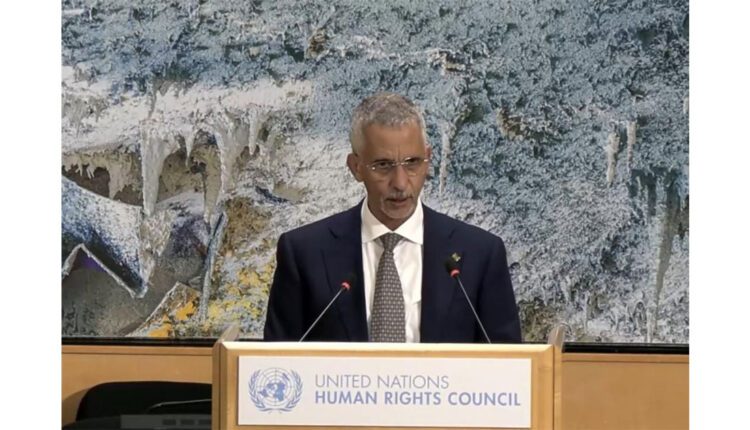
The Commissioner for Human Rights, Humanitarian Action and Relations with Civil Society, Mr. Sid’Ahmed Ely Benane, emphasized that human rights in Mauritania are a sovereign choice, the result of a strong national will, a constitution guaranteeing freedoms and a reformist vision moving steadily towards cumulative reform based on self-assessment, openness to partnerships and the strengthening of national institutions.
He made these remarks on Wednesday in Geneva, before the 61st session of the Human Rights Council, where he explained that His Excellency the President of the Republic, Mr. Mohamed Ould Cheikh El Ghazouani, has, since taking office, implemented an approach based on openness to all partners and actors, without discrimination, and on the promotion of peace and civil harmony. This has resulted in achievements aimed at consolidating national unity and combating various forms of injustice and inequality.
He added that the Mauritanian government is continuing to implement the National Strategy for the Promotion and Protection of Human Rights (2024-2028), which aims to integrate a human rights-based approach into various public policies, strengthen the effectiveness of national institutions and enshrine the principles of transparency and accountability.
He emphasized that the promotion of rights is inseparable from overall development, as civil and political rights cannot flourish in the presence of poverty, vulnerability and a lack of essential services.
He noted that, in this context, Mauritania has stepped up its efforts to combat poverty, extend social protection networks, improve access to education and health care, and empower vulnerable groups, particularly women and young people.
The Commissioner reaffirmed Mauritania’s commitment to human rights values and the principles of justice, dignity and equality, as well as to dialogue, a strategic choice in a rapidly changing world.
He emphasized the importance of the Human Rights Council as a platform for dialogue and responsible cooperation.
He also addressed migration challenges, noting that Mauritania, due to its geographical location, is an important transit country for migrants and refugees. This situation creates growing challenges in terms of humanitarian aid, human rights and security, particularly as some migrants fall victim to smuggling and human trafficking networks.
In this context, he indicated that Mauritania has adopted a balanced approach that combines the fight against criminal networks with the protection of migrants’ rights. This approach involves strengthening the legal framework, intensifying judicial control, setting up reception and accommodation centers, and guaranteeing access to essential services, in accordance with the principle of non-refoulement.
He emphasized that migration management is a shared responsibility that requires international cooperation based on shared responsibility and addressing the root causes of irregular migration, including through support for sustainable development in countries of origin.
The Commissioner reviewed the challenges facing the Sahel region in particular, including terrorism, organized crime, irregular migration, climate change and economic pressures.
He noted that Mauritania is committed to striking a balance between protecting national security and respecting rights and freedoms, considering security and human rights to be complementary.
He added that Mauritania is continuing its efforts at the international and regional levels to contribute to conflict resolution by welcoming and hosting displaced persons and asylum seekers, implementing a comprehensive approach to security to combat terrorism, extremism and transnational crime, and participating in peacekeeping operations in the Central African Republic.
The Commissioner stressed the need to end the suffering of the Palestinian people in the Gaza Strip, calling for increased humanitarian aid and support for relief and reconstruction efforts to alleviate the suffering of civilians.