

Government spokesperson Acting: Those involved in Contract Termination – 900 people Subscribed Irregularly
Nouakchott
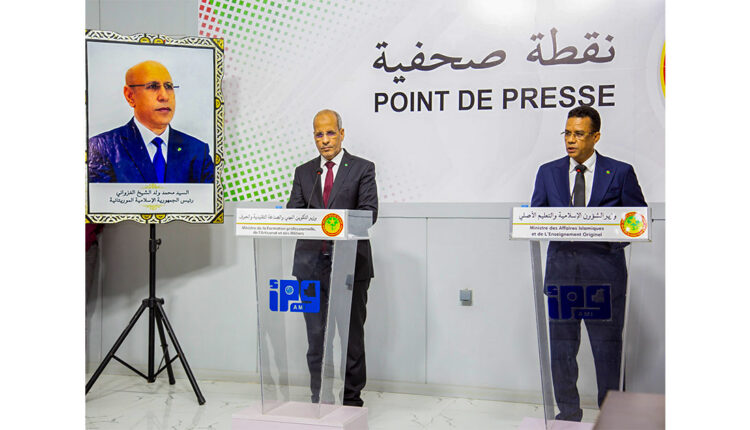
The Minister of Vocational Training, Handicrafts, and Trades, and Acting Government Spokesperson, Mr. Mohamed Ma El-Ainine Ould Eyih, denied what was circulated on social media regarding the termination of service providers’ contracts in government sectors at the beginning of next year, affirming that it concerns only 900 people who were recruited irregularly after the circular issued by the Prime Minister, which restricts employment to recruitment only.
In response to a question about the state’s abandonment of service providers, while commenting on the results of the Council of Ministers meeting this evening, Wednesday in Nouakchott, accompanied by His the Minister of Islamic Affairs and Traditional Education, he confirmed that the situation of the contract workers in state institutions, numbering 30,000, remains unchanged.
Regarding the draft decree establishing a public institution of an administrative nature called the National Agency for Technical and Vocational Training, the Minister stated that this agency will serve as a mechanism for implementing national vocational training policies. It will incorporate, upon assuming its responsibilities, 19 institutions in the field of vocational training, in addition to the National Institute for the Promotion of Vocational Training.
He added that the board of directors of the institution will assign him the task of approving the annual work plan in the field of vocational training, noting that the agency is expected to contribute to improving the alignment of vocational training with labor market needs, enhancing the responsiveness to training requirements, as well as rationalizing resources.
He affirmed that the work of the twenty institutions that will be under the umbrella of the agency will continue in the current manner until the new agency system comes into effect.
The Minister also mentioned the context in which the agency was established, which is the aging of the last sector reform, dating back to the late 1990s and early 2000s, and what the sector subsequently witnessed in terms of an increase in the number of schools and a doubling of the number of trainees by 100%, in addition to the growing need to meet labor market requirements. The agency will also allow – the Minister adds – for the centralization of the management of schools affiliated with the sector, as well as being part of the commitment of His Excellency the President, Mr. Mohamed Ould Cheikh El Ghazouani, to establish it in his most recent electoral program.
In turn, the Minister of Islamic Affairs and Original Education, Mr. Fadhil Ould Sidati Ould Ahmed Louly, stated, while commenting on the statement regarding the organization of the 2026 Hajj season, that the cost of Hajj for the upcoming season will decrease by more than 76,270 old ouguiyas, as a result of negotiations conducted by the sector with its Saudi counterpart to reduce costs, which resulted in the reduction of some services.
He added that the second improvement that the upcoming Hajj season will witness is the digitization of all Hajj procedures, starting from registration through a dedicated platform, to issuing the visa and travel ticket. The season will also witness the renewal of an agreement with the private sector through the Mauritanian Employers’ Union, which will lead to obliging Hajj agencies not to increase the Hajj price agreed upon by both parties, as well as not exceeding the specified time frame for registering pilgrims.
Regarding the statement related to the diagnosis of the Islamic Affairs and Original Education sector, the Minister said that it aims to bring about a qualitative leap in the work of the sector, through a plan based on four main pillars, related to institutional transformation and governance enhancement, curriculum and educational program development, human resource development, as well as management development and the promotion of integration and partnership.
He added that the plan aims to issue two laws to regulate mosques and prayer halls, to protect society, and to establish a national agency for Hajj, in addition to developing educational programs to meet labor market needs, enhancing literacy programs, as well as putting a plan to develop the human resources of the sector and strengthen partnership with other sectors.
He revealed that the diagnosis showed a series of gaps between the reality of the sector and what is expected of it, due to a number of imbalances, including the absence of a strategic vision, weak human resources, deficiencies in information systems, and a lack of curriculum development.
He added that the diagnosis highlighted other weaknesses, such as the disconnect between basic education and the labor market, and the limited impact of literacy programs.
The Minister pointed out that the two statements constitute a translation of the electoral program of His Excellency the President of the Republic, Mr. Mohamed Ould Cheikh El Ghazouani, ‘My Ambition for the Nation,’ in which he committed to developing the sector and improving its services, affirming that the two projects represent a commitment to a roadmap aimed at strengthening our national security and facilitating the Hajj service for citizens.