

Organizing a workshop on Mauritania’s Accession Process to the Convention on the Protection and Use of Watercourses
Nouakchott
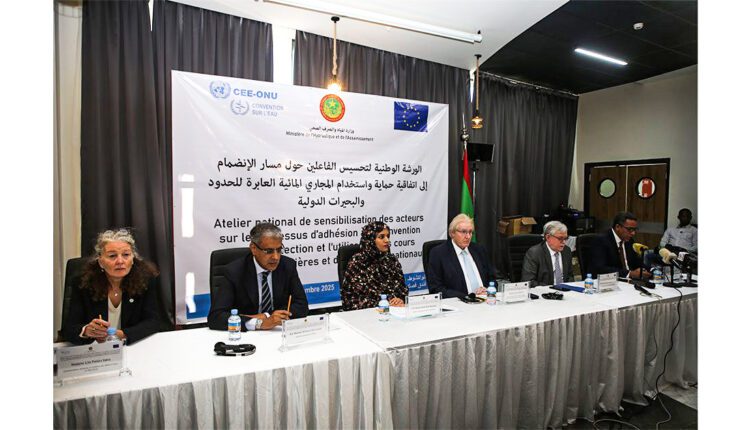
The Minister of Water and Sanitation, Mrs. Amal Mint Maouloud, inaugurated this morning, Tuesday, in Nouakchott, in the presence of the Minister of Energy and Oil, Mr. Mohamed Ould Khaled, a national workshop to raise awareness among stakeholders about Mauritania’s process of joining the Convention on the Protection and Use of Transboundary Watercourses and International Lakes.
This workshop, organized by the Ministry of Water and Sanitation in collaboration with the European Union, the United Nations Economic Commission for Europe (UNECE), and the Water Convention Secretariat, is attended by various stakeholders, including ministries and public institutions, technical and financial partners, non-governmental organizations, local communities, and national experts.
The two-day workshop aims to raise awareness and mobilize stakeholders in the water and sanitation sector, as well as relevant authorities, about the challenges, benefits, and It also seeks, in particular, to share the experiences of countries that have joined the convention, to identify the aspirations, contributions, and responsibilities of the various stakeholders, and to present the content of the United Nations Convention on the Protection and Use of Transboundary Watercourses and International Lakes in terms of the benefits and obligations for Mauritania, in addition to discussing practical implementation methods of this convention to address the challenges of water resources management in the country.implications of the Islamic Republic of Mauritania joining this convention.
The workshop is expected to produce several outcomes, the most prominent of which are raising awareness among the various stakeholders about the stakes of the agreement, achieving a shared understanding of the accession process, and reaching consensus on the next steps in this process.In a speech on the occasion, the Minister of Water and Sanitation explained that the drinking water supply system in our country relies primarily on the waters of the Senegal River and groundwater, with the river’s waters accounting for about 90 percent of renewable surface water resources, while the main known groundwater layers form transboundary aquifers shared by our country with neighboring nations in the region.
She highlighted that the water and sanitation sector holds a central position within the program of His Excellency the President of the Republic, Mr. Mohamed Ould Cheikh El Ghazouani, noting that in this context, the national strategy for water and sanitation access up to 2030 has been prepared, in line with the Sustainable Development Goals.
She added that Mauritania is located in the heart of the Sahel region, characterized by its vast geographical area and unique climatic and environmental features, which makes water issues a top priority for government work.
For his part, the High Commissioner of the Senegal River Basin Development Organization, Mr. Mohamed Ould Abdel Vettah, praised the efforts made by the organization in facing the challenges of climate change and increasing needs, recalling in this regard the ongoing commitment of His Excellency the President of the Islamic Republic of Mauritania, the rotating President of the Conference of Heads of State and He appreciated the efforts of the Ministry of Water and Sanitation, recalling the laying of the foundation stone for the project to supply the city of Kiffa, as well as towns and cities in the regions of Guidimakha and Gorgol, with drinking water from the Senegal River, which enhances integration and the joint management of cross-border waters.overnment of the Senegal River Basin Development Organization (OMVS).
In turn, the Ambassador of the European Union to Mauritania, His Excellency Mr. Joaquín Tasco Villalonga, emphasized the importance of this workshop dedicated to Mauritania’s accession process to the United Nations Convention on the Protection of Transboundary Watercourses and International Lakes, thanking the Ministry of Water and Sanitation and the Convention Secretariat for their good preparation for this workshop.
She said that Mauritania, like its neighbors, is on the front line in addressing challenges related to transboundary water, while at the same time confirming its ability to find effective solutions to these challenges.
For his part, Mr. Marco Kainar, Director of the Environment Department at the European Union and the United Nations Secretariat of the Water Convention, highlighted the importance of this workshop in the context of enhancing cooperation in the field of water, given its role in preventing conflicts, promoting environmental and climate resilience, supporting sustainable development, and improving community well-being, expressing his gratitude to the European Union for its financial support for this workshop, to the participating European parties, and to the partners, especially the Senegal River Investment Organization.