

President of Republic: “We Are Determined To Make Mauritania’s Enormous Potential a Lever for Shared Prosperity in Africa”
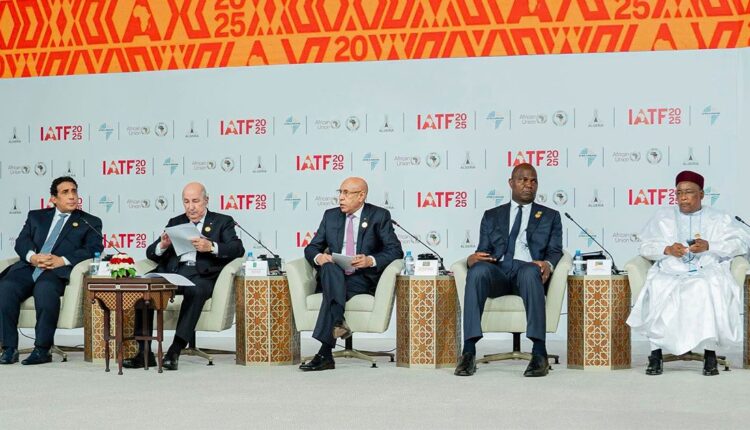
On 4 September, His Excellency Mr. Mohamed Ould Cheikh El-Ghazouani, the President of the Republic, participated in a high-level panel discussion as part of the intra-African trade fair “IATF 2025,” held at the International Convention Center in Algiers.
At the beginning of the session, His Excellency the President of the Republic expressed his sincere thanks to Algerian President H.E. Abdelmadjid Tebboune, the African Union Commission, the Secretariat of the African Continental Free Trade Area (AfCFTA), and the African Export-Import Bank (Afreximbank) for organizing this presidential round table, whose themes (productive capacities, industrial policies, and economic diversification) are in line with our common desire to develop the AfCFTA and make it contribute significantly to building a more integrated, competitive, and prosperous Africa.
He emphasized Mauritania’s determination to transform its enormous mineral, fisheries, gas, renewable energy, and green hydrogen potential into a lever for shared prosperity, benefiting Africa.
Here is the text of the President’s speech:
“Thank you, Mr. President,
On behalf of myself and the Mauritanian people, I would like to express my sincere gratitude to my brother His Excellency Abdelmadjid Tebboune, President of the People’s Democratic Republic of Algeria, as well as to the Algerian government and people, for the great attention, hospitality, and warm welcome they have shown us on this occasion.
I would also like to congratulate the African Union Commission, the AfCFTA Secretariat, and the African Export-Import Bank (Afreximbank) on the success of this fourth edition of the Intra-African Trade Fair and thank them for organizing this presidential roundtable, whose themes—production capacity, industrial policies, and economic diversification, are in line with our common desire to develop the AfCFTA and contribute significantly to building a more integrated, competitive, and prosperous Africa.
My country, Mauritania, has made its National Strategy for Accelerated Growth and Shared Prosperity a framework for guiding its development path toward economic diversification and the achievement of sustained and inclusive growth, aiming for a growth rate of over 7% per year, a reduction in the poverty rate to 20%, and the diversification and intensification of the industrial fabric to bring the contribution of the industrial sector to 15% of GDP, all within the framework of economic integration and intra-regional trade between the components of the African Continental Free Trade Area in the very near future.
This requires establishing high-quality economic infrastructure, strengthening the competitiveness of the private sector, and diversifying and intensifying the industrial fabric.
To ensure the effective implementation of this strategy, our country has enormous natural resources, including a coastline rich in fishery resources and highly rated gas and energy reserves, and we are working to develop and improve the exploitation of these resources.
In the mining sector, for example, which accounts for around 20% of GDP and 76% of Mauritanian exports, we are working on new strategic projects that will significantly increase our capacity to produce processed metals, estimated at nearly 35 million tons per year in the future.
In addition, there are gold and copper projects that are constantly progressing, some of which are already in operation, while others will be operational in the near future, inshallah, paving the way for the local processing of these minerals.
In the energy sector, the major Grand Tortue Ahmeyim gas project will supply 2.5 million tons of liquefied natural gas per year in its first phase, and in a second phase, this production will double to 5 million tons, then a few years later (before 2029-2030) 10 million cubic meters, in addition to our great potential in renewable energies.
Still in the gas sector, we have a very large project in Biralla, whose reserves are estimated to be three times those of GTA, which I just mentioned.
In the fishing industry, with an estimated production capacity of 1.8 million tons per year, we aim to increase the level of local processing to boost local added value and create numerous employment opportunities.
In the agri-food sector, we aim to achieve 50% food self-sufficiency by 2030, inshallah.
We aspire to diversify and deepen the local processing of these resources, and to gradually move from an economy that depends almost entirely on the export of raw materials to a diversified and competitive economy with a solid manufacturing base.
To implement this structural transformation, we have embarked on far-reaching reforms, including new laws on mining, green hydrogen, investment, public-private partnerships, and a reform of the public procurement system.
Nous investirons également dans les secteurs de l’énergie solaire et éolienne afin d’augmenter leur part dans notre mix énergétique de 42 % actuellement à 70 % d’ici 2030, inchallah.
We will also invest in solar and wind energy to increase their share in our energy mix from the current 42% to 70% by 2030, God willing.
As successful industrial development depends on the existence of modern infrastructure, Mauritania has prioritized the expansion of ports, highways, and active corridors for industrialization and support for continental integration. In this context, the Autonomous Port of Nouakchott has been modernized to increase its capacity by 5 million tons per year, and a partnership with the private sector is being finalized to establish a deep-water port in Nouadhibou as a regional hub for minerals, fishing, and transit. Partnerships are underway for the multifunctional port of N’Diago.
Regarding roads, three major projects are underway: the Nouakchott-Boutilimitt road, which will open a strategic corridor to Mali via the independent dry port of Gougui Zemal; the Nouadhibou-Nouakchott-Rosso road, which will connect to the Rosso bridge and promote trade with the ECOWAS region; and the Tindouf-Zouerate road, which provides a direct and very important land link with neighboring Algeria and strengthens the trans-Saharan corridor.
In this context, our goal is to reduce logistics costs, which currently represent around 25% of the value of exports, to bring them closer to the African average of 10%.
More broadly, recognizing that strategic partnerships are a key lever for stimulating manufacturing activity, we are working with international financial institutions such as Afreximbank, the African Development Bank, and the World Bank to finance port and logistics infrastructure and support SMEs and emerging industries through appropriate financing mechanisms and trade facilitation tools.
We are also working with ECOWAS and the Arab Maghreb Union to improve logistics connectivity, set standards, and simplify customs procedures, and we aspire to make Mauritania a platform for industrial transformation and a hub for trade between North and West Africa and the rest of the continent.
In conclusion, I would like to reiterate three priority objectives of our strategy for accelerated growth and shared prosperity, namely the development of a diversified industry with strong job creation and value-added capacity, the modernization of infrastructure and ports, and strong interregional partnerships, both financial and technological, to accelerate our continental integration.
In Mauritania, we are determined to make our enormous potential in minerals, fisheries, gas, renewable energies, green hydrogen, and other areas a lever for achieving shared prosperity for the benefit of the continent.
Thank you.