

President of Republic at AU Summit: “We Must Redouble Our Efforts To Achieve an Educational Revolution in Africa”
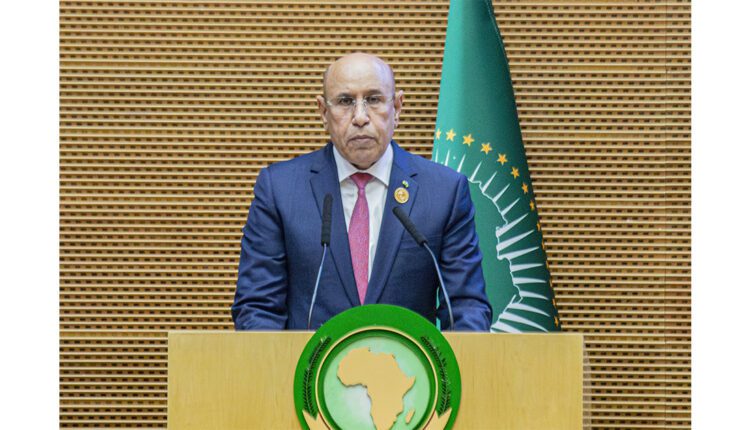
On 17 February, in Addis Ababa, HE. Mr. Mohamed Ould Cheikh Ghazouani, the President of the Islamic Republic of Mauritania and current President-in-Office of the African Union (AU), expressed his deep appreciation and gratitude to African leaders for his choice as President of the African Union.
In his opening speech at the 37th session of the AU Conference of Heads of State and Government, he said he was grateful for this honor and aware of the magnitude of the heavy responsibilities that it implies, particularly in this critical and sensitive circumstance that our continent and the world, in general, are going through.
Her Excellency stressed the need to redouble efforts to achieve an educational revolution in Africa that provides its children with opportunities for education, training, and skills development continuously and contributes to unleashing the energies of African women’s creative skills to empower them and strengthen their effective participation in leadership in various development pathways.
Below is the President’s full speech:
“In the name of Allah, the most gracious, the most merciful
May Allah’s blessings be upon the most honorable messengers
- Your Majesties, Excellencies and Heads of State and Government, my dear colleagues;
- Ladies and gentlemen, heads of delegations, Ministers
- Mr. Chairman of the African Union Commission
- Mr. Secretary General of the Arab League
- Mr. Secretary General of the United Nations
- Representatives of international organizations
- Your Excellencies the Ambassadors
At the beginning of my speech, on your behalf and on my own behalf, I would like to express our thanks to the government and people of the Federal Republic of Ethiopia for the fraternal reception and generous hospitality they always extended to us on the occasion of the holding of our various summits in this beautiful African capital.
This beautiful city is the birthplace of the first institutional expression of our common will for unity and integration; A birth that resulted from the insightful visions of the Founding Fathers and their strong resolve, which was clearly embodied in the words of the late President Mokhtar Ould Daddah in his speech during the inaugural session in 1963: “We are the focus of attention of the entire world, especially our African peoples, and the greatest crime we can commit against these peoples is to fail.” End. Martyrdom.
The deceased believed in the necessity of promoting joint African action, firmly convinced that his country, which constitutes a historical and cultural link between the south and north of the continent, must be one of the pillars of this emerging African edifice.
Allow me to express to you, my dear colleagues, my appreciation for you and my deep gratitude for the trust you have placed on me, and I especially mention my brothers and friends, the leaders of North Africa, who honored me, as you all have just done, by choosing me to undertake this noble mission in the service of our Union.
As grateful and honored as I am for this honor, I am fully aware of the magnitude of the enormous responsibilities it entails, especially in the critical and sensitive circumstance that our continent and the world in general are going through.
I will bear this responsibility in the framework of permanent consultation and close coordination with all of you.
I also extend my congratulations to my brother and friend, His Excellency Mr. Ghazali Assoumani, President of the United Republic of Comoros, for his outstanding leadership qualities and for the commendable efforts he has made to advance our union in the direction of achieving the aspirations of the African peoples. I appreciate, at the same time, what His Excellency Mr. Moussa Faki Mahamat, Chairperson of the African Union Commission, his team, and other AU bodies have played as a constructive role in the institutional reform of the Union to raise the level of its performance, efficiency and effectiveness.
Dear Ladies and Gentlemen,
What the Founding Fathers aspired to is essentially what we built together Agenda 2063, which translates into our plans for the Africa we want: “An integrated and prosperous Africa, peacefully reigned, led by its citizens, and a dynamic force in the international arena.”
It is well known that the chances of success of plans and strategies designed to achieve this ultimate goal are contingent on effective investment in human resources, which allows for a comprehensive and high-quality education, open to science and technology.
The adoption of “African Education for the Twenty-First Century: Building Resilient Education Systems to Increase Access to Inclusive, Sustainable, Quality and Relevant Education in Africa as this year’s theme, is a particularly relevant choice. Education is the starting point for all sustainable development action, and a powerful dependent on security and stability and a means of acquiring and developing skills that provide adequate employment opportunities and reduce cycles of unemployment, poverty and precariousness.
Allow me, colleagues, to focus here on young people, who currently make up about 62% of Africa’s population. The loss of our youth is the loss of our continent and the uneducated youth is a lost youth.
The scene presented by millions of young Africans, deprived of basic skills, unemployed in their countries or crammed into death boats, on various irregular migration routes, due to the obstruction of prospects for a decent life and the lack of active participation in the building of their homelands, is heartbreaking and underscores the urgency of revolutionizing our education systems.
Our continent is lagging behind in achieving the fourth Sustainable Development Goal, due to the lack of access to our education systems, high drop-out rates, lack of quality education and training and their adequacy to the various challenges we face.
It is not acceptable that more than 17% of our children are not in primary school, nor that 75% of our secondary school children are not able to have skills at this stage.
All of us, governments, civil societies and actors in various fields, must redouble our efforts to raise awareness and mobilize human, technical and financial resources to bring about an educational revolution that provides all our daughters and sons with opportunities for lifelong learning, training and skills development, and contributes to unleashing the creative energies of African women, empowering them and strengthening their effective participation in leadership in the various development processes.
Ten years have passed since the adoption of our first ten-year plan as part of the implementation of Agenda 2063, which serves as the basis for the preparation of the medium-term development plans of Member States, regional economic communities, and African Union bodies.
Ten years in which regional and international circumstances have not been favorable, with successive and often simultaneous health, environmental, economic, and security crises exacerbating the scale of the challenges facing the continent with their negative effects, creating strong obstacles that have often hindered and slowed down the achievement of the hoped-for progress in the implementation of Agenda 2063.
However, promising progress has been made in several areas, such as progress in the African Continental Free Trade Area (AfCFTA) process, with the successful completion of the first phase, the entry into force of the Protocols on Trade in Goods, Trade in Services and Dispute Settlement advancing negotiations on the second phase of the protocols on investment, intellectual property rights, and competition policy at an acceptable pace, as well as the serious launch of the AfCFTA Electronic Tariff Book, its Guide to Rules of Origin and its Trade Initiative.
Encouraging progress has also been made in the areas of digital, road and electricity infrastructure, as well as airspace liberalization, with 37 countries joining the Continental Aviation Single Market System (CONCOM), in addition to the African Peer Review Mechanism, the New Partnership for Africa’s Development (NEPAD) and institutional reform.
The continent’s presence in international institutions has also strengthened, notably with its entry as a permanent member of the G20.
There is still an urgent need to reform the United Nations, to ensure the strengthening of our continent’s presence in its leadership bodies, by obtaining a permanent seat on the UN Security Council.
In your name, and with your support, I will seek to intensify efforts on these various tracks, as well as on the tracks of reforming the multilateral cooperation system and public development support bodies, to create a new development financing charter that will be more flexible, sustainable, and faster in enabling access to financing, in a way that does not aggravate Debt problems. Here, I cannot fail to mention the valuable efforts of the African Development Bank in this context.
I will also work with you to establish a more balanced, equitable, and sensitive international system for the less developed countries, in which our continent has a heard voice and an effective ability to influence.
The international system, in its current form, is characterized by a lot of unfairness and varying standards, often at the expense of the weakest and least developed countries, as it is often the case with the issues and rights of countries on our continents.
To realize the extent of this international system’s need for reform, it is sufficient to look at what is happening in the Gaza Strip, in terms of killing and destruction, and a violation of the principles of international legitimacy and human rights, as well as the reluctance of the international community to put the weight required to achieve an immediate ceasefire, bring in aid, and begin in establishing a comprehensive and lasting solution that secures the inherent right of the Palestinians to establish their independent state, with East Jerusalem as its capital, under the relevant international legitimacy resolutions.
Let me seize the opportunity to say that I am proud of the African Union’s positions that reject injustice, support just causes, and adhere to international law and international humanitarian law, especially with regard to the Palestinian issue.
Your Majesties and Excellencies,
Ladies, and gentlemen,
Despite the progress achieved here and there on some tracks, the general nature of our efforts is to implement the seven aspirations that are the goals of the 2063 Agenda remains slow and stumbling.
Thus, within the framework of the 10-year plan 2024-2034, all our efforts must be focused on addressing the crisis and deteriorating situation at many levels on our African continent.
More than 600 million Africans still do not have access to electricity in the twenty-first century.
Our continent also harbors more than 50% of the extreme poverty rate in the world, and possesses 25% of the world’s arable land, but contributes only about 10% of global agricultural production, which continually threatens its food security. It is known that there is no sovereignty without effective, strong, and sustainable food systems. This is what the Russian-Ukrainian crisis revealed: the limited ability to withstand due to the resulting disruption in supply chains.
In general, our continent is experiencing a strange paradox, embodied in the enormous discrepancy between its huge potential, in terms of young human resources, distinguished strategic location, and enormous natural resources, which qualify it to be an oasis of security, peace and prosperity, and its actual reality, which is often characterized by poverty and fragility.
To overcome this paradox, we are obligated to mobilize all energies and resources to ensure the strict and effective implementation of the second ten-year plan 2024-2034.
The reports that will be presented by my brothers and distinguished presidents, and the useful diagnostics and recommendations they will contain regarding completing the process of establishing the African Continental Free Trade Area and implementing the infrastructure program in its second edition, PIDA 2, the agricultural capabilities enhancement project, and the continental electric market project, will constitute a strong impetus for the implementation of the second ten-year plan. Implementing institutional and organizational reform of the Union’s bodies will be an essential lever for implementing this plan.
It goes without saying that the effectiveness of implementing this second ten-year plan depends on our ability to involve the private sector in a strong and effective manner in implementing its various axes.
Your Majesties, and Excellencies,
Ladies, and gentlemen
One of the greatest challenges facing our continent is the spread of tensions, armed conflicts, and terrorist groups, which constantly threaten state entities by undermining security and stability, dismantling social fabrics, impeding development efforts, and severely harming the living conditions of the population.
The loss of life and destruction of infrastructure, economic and social systems that terrorism, civil conflicts, and wars cause on our continent make the battle for security and peace a priority.
We must work together to establish collective continental security by developing the African peace and security architecture and its multiple support mechanisms, such as the continental early warning system, the African Standby Force, and others, and improving the level of coordination and cooperation within and between the regional economic communities.
We will not overcome security challenges individually nor in isolation from seeking to address the development and social challenges that fuel them. We must build a comprehensive continental strategy that takes into account the security, economic, social, and intellectual dimensions.
The Africa we want is the one that takes care of itself and works to resolve its conflicts on its own. It does not wait for ready-made solutions to come to it, but rather it achieves, through dialogue, coordination, and creativity, solutions that suit the challenges it faces.
We indeed need to expand and diversify partnerships with various parties, but in such a way that we do not become a stage for competition or settling scores between others, which often leads to crisis and turmoil, economically, socially, and especially security-wise.
What makes the continental security scene even more complex and dark is the unconstitutional changes that our continent has recently witnessed, which have harmed the institutional, social, and political stability in many of our countries.
There is no doubt that our Union has made a significant effort, through its legal mechanisms, decisions, and numerous statements, as in Algeria in 1999, in Lomé in 2000, and in Accra in 2022, to stand up to various forms of unconstitutional changes, but that did not prevent them from returning disturbingly and unacceptably at the same time.
This reality requires all of us to work to consolidate the principles of the rule of law and establish true democracies that ensure a peaceful and smooth transfer of power within a framework of stability and transparency.
This requires working to calm political life, overcoming social differences and ethnic rivalries through dialogue and consensus, and improving the level of social, economic, and political governance in general.
Today, we need inspiration from ancient African wisdom, the spirit of dialogue and consultation, and the constant search for consensual solutions in the management of various issues to innovate new formulas that restore calm and peace to social and political life.
Just as we need to improve economic, social, and political governance, we also need to improve environmental governance.
Despite our small continental contribution to the emissions that lead to global warming, we are most affected by the resulting climate changes and their consequences, such as floods, desertification, drought, and deterioration in the balance of continental and marine ecosystems.
Therefore, we must intensify efforts to enhance the ability of our citizens to adapt to environmental repercussions and make efforts and work towards a just, gradual, and sustainable environmental and energy transition.
Our continent’s possession of significant capabilities of green hydrogen makes us able to rise to the challenge of comprehensive access to clean energy and accelerate the pace of industrial transformation on the continent if we intensify coordination among us and establish partnerships that help mobilize the financial resources necessary to bring about a continental energy revolution through expanded exploitation of green hydrogen.
I will work, with Allah’s will and strength, and with all of your support, to contribute effectively to the process of transforming our continent’s enormous potential in this field into actual development projects that contribute significantly to achieving the goals of the 2063 Agenda.
The international and continental circumstances existing today need only unity and fusion of efforts. This is what is entailed by our common values, dictated by our awareness of the unity of destiny, necessitated by the magnitude of the challenges facing us, and required by the lofty goal we seek.
Achieving our ultimate goal of “an integrated, prosperous, peaceful Africa whose citizens are in charge of its leadership and which represents a dynamic force in the international arena” may seem intractable, given the temporary circumstantial situations surrounding the continent’s present, but it is a goal within our reach and we will achieve it, with Allah’s will and strength within the set period of 2063. Thanks to the strength of our union, our enormous resources, our young human resources, and our ambitious forward-looking outlook.
Therefore, we must all continue the institutional development of our African Union. From its gate, we take control of our future, take care of our affairs, increase our integration and unity, and achieve the legitimate aspirations of our people embodied in the 2063 Agenda.
As I call for greater unity and redoubling of efforts to address the various challenges facing our continent, I announce, with Allah’s blessing, the opening of this 37th session of the Assembly of Heads of State and Government of the African Union, wishing its work great success.
Thank you, and may Allah’s peace, mercy, and blessings be upon you.”